
Avenc de les Rovires
Nou i important avenc de 126 m de fondària a Sant Llorenç del Munt
EspeleoWorld
Avenc de les Rovires
Nou i important avenc de 126 m de fondària a Sant Llorenç del Munt
Matadepera · Vallès Occidental
Length: 416 m · Depth: 126 m
Updated record
https://espeleoworld.com/en/c/avenc-de-les-rovires
Information can change. Always verify coordinates, access, weather, and cave conditions before setting out.
A new and important 126 m deep pit in Sant Llorenç del Munt, with a demanding route and sections suitable only for experienced cavers.
Topographic
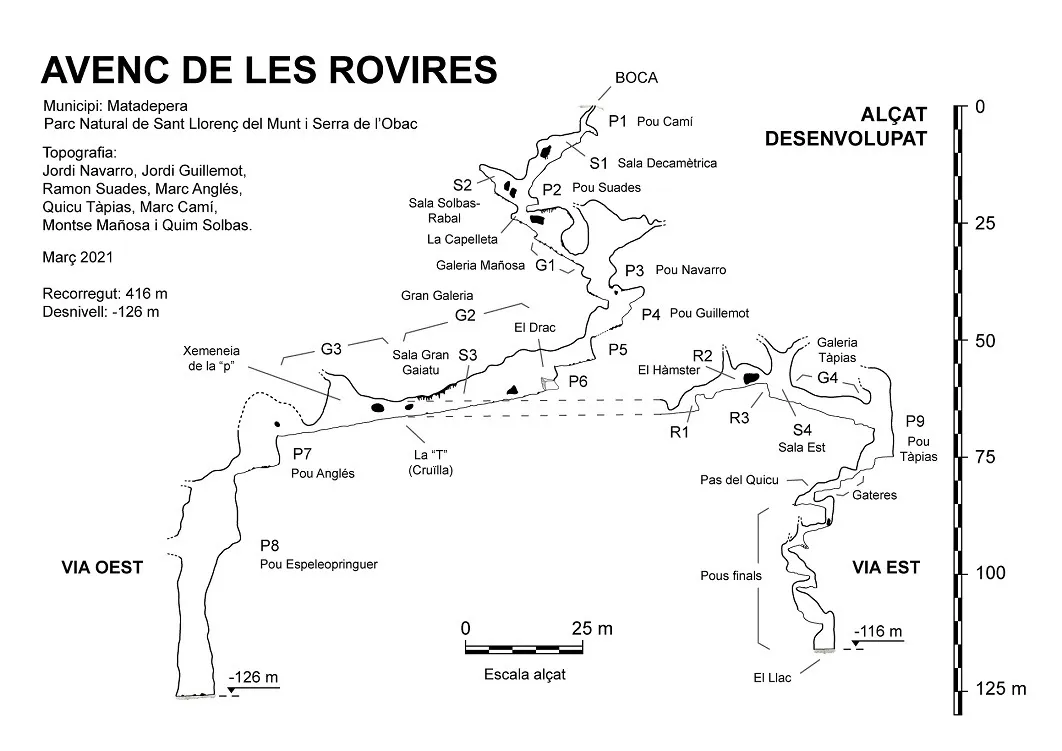

Espeleoindex · CC BY-NC 4.0, https://creativecommons.org/licenses/by-nc/4.0/ · Image © its author.
Photos

Espeleoindex · CC BY-NC 4.0, https://creativecommons.org/licenses/by-nc/4.0/ · Image © its author.
Description
Morphology
Access to the pit is via a narrow entrance and a steeply descending ramp, which immediately connects with a selective vertical squeeze P1 (Pou Camí); once past the squeeze, a small ramp descends and places you at the end of a rectangular room with a flat ceiling and considerable dimensions S1 (Sala Decamètrica).
At the opposite end of the room, a new gallery continues descending over some drops and with walls covered in flowstone. At the end of the gallery there is a pit P2 (Pou Suades) of 10m draped in flowstone. Before reaching the bottom there is a marked ledge, at the end of which is the crawl that gives access to a room parallel to the pit S2 (Sala Solbas-Rabal), decorated and distributed over several levels as well as several connection points with the previous access pit.
If you finish descending the pit you will find two openings and we will follow the lower one through a drop, beneath which is la Capelleta. We reach a new descending gallery of generous dimensions and high ceilings G1 (Galeria Mañosa). Continuing along the gallery, it momentarily reduces its dimensions until the head of pit P3 (Pou Navarro) of 7m, which is made up of 2 drops with a ledge in between. Above this pit there is a wide and high chimney of just over 20m.
The next pit in the chain P4 (Pou Guillemot) of 6m, is adorned on the ceiling and walls with flowstone and formations from the seepage of the adjoining high chimney. Just above the head there is a wide rock bridge, relatively unstable. Once at the base of the series of pits, continuity is via a new gallery that changes direction and reconnects with two small pits P5 (5m) and P6 (3m) to leave us on a large fallen block (El Drac) that occupies a large part of the gallery.
From this point the gallery G2 (Gran Galeria) continues for about 32 linear m with considerable dimensions, especially in height, reaching 10m in some places. At the start of the gallery, there is a large wedged block that forces us to pass beneath it, then to regain the dimensions again and reach the most decorated area of the entire cave, S3 (Sala del Gran Gaiatu). Here, the great variety and concentration of speleothems cover walls, ceiling and floor.
After the decorated area the gallery reduces its dimensions and ends in a confluence (la T). From this point the cave divides into two totally independent routes and in totally opposite directions, one towards the West, the deepest and widest, and another towards the East, a little less deep and narrower and more difficult.
The West route has no appreciable formations and begins with a linear gallery G3 (Galeria Oest) of 27 m. At its start, it has a high chimney (Xemeneia de la “P”). Further on, the gallery decreases in height and width until it makes progress uncomfortable in its last metres, finally connecting with pit P7 (Pou Anglés) of 7m. The head is narrow, but it soon regains the comfortable dimensions that will accompany us to the end of the route.
The next pit P8 (Pou Espeleopringuer) of 46 m has a narrow entrance, then continues in an aerial manner with an intermediate ledge in the middle. After several more relatively aerial re-riggings, we will reach the maximum depth of the cave (-126m).
The East route begins with a crawl that soon regains comfortable dimensions and forces a climb up a drop R1 of 3 m, followed by a small narrow drop. Once past it, a new ascending drop R2 (El hàmster) of 2.5m places us at the highest point of the East route. From this place the descent begins with a new drop R3 of 5 m, broken by a ledge, which gives access to the widest area of the East route, room S4 (Sala Est). Its dimensions are considerable, especially in height, reaching 12 m at some point.
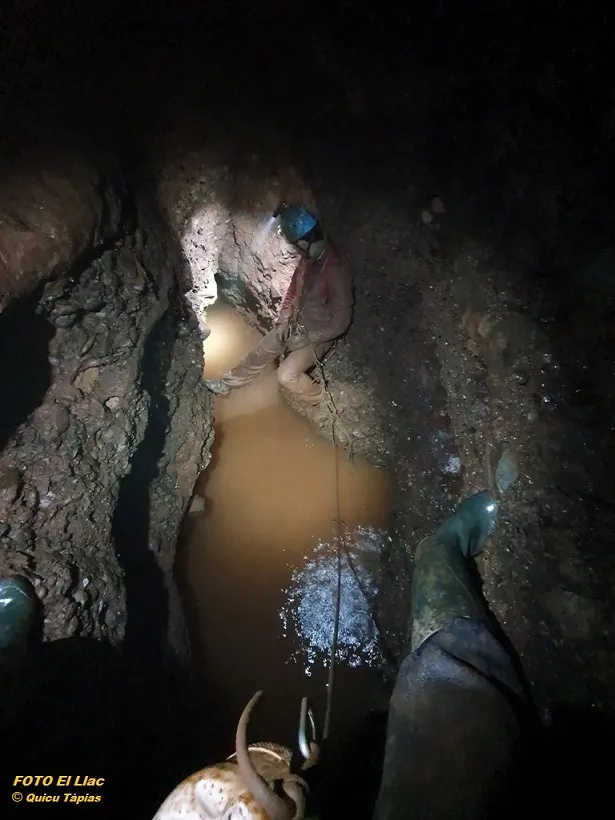
The route continues through a high and narrow descending gallery, called gallery G4 (Galeria Est), of 22 linear m. At the end of this, is pit P9 (Pou Tàpias) of 8 m, with a wide chimney rising above. Below the pit, and after a small descending drop, begins a succession of crawls that culminate in a narrow passage (Pas del Quicu). Once past this, there is a series of small and muddy pits that end the East route in a pit, often flooded with water at a depth of (-116m).
Speleothems
The room S2 (Sala Solbas-Rabal) is decorated. The area S3 (Sala del Gran Gaiatu) is the most decorated of the entire cave, with a great variety and concentration of speleothems that cover walls, ceiling and floor. The pit P2 (Pou Suades) is draped in flowstone. The pit P4 (Pou Guillemot) is adorned on the ceiling and walls with flowstone and formations from the seepage of the adjoining high chimney. The West route has no appreciable formations.
Hydrology
The final pit of the East route is often flooded with water at a depth of (-116m).
Progression
Access to the pit is via a narrow entrance and a steeply descending ramp, which immediately connects with a selective vertical squeeze P1 (Pou Camí). Once past the squeeze, a small ramp descends and places you at the end of a rectangular room S1 (Sala Decamètrica). At the opposite end of the room, a new gallery continues descending over some drops. At the end of the gallery there is a pit P2 (Pou Suades) of 10m. Before reaching the bottom there is a marked ledge, at the end of which is the crawl that gives access to a room parallel to the pit S2 (Sala Solbas-Rabal). If you finish descending the pit you will find two openings and we will follow the lower one through a drop, beneath which is la Capelleta. We reach a new descending gallery G1 (Galeria Mañosa). Continuing along the gallery, it momentarily reduces its dimensions until the head of pit P3 (Pou Navarro) of 7m, which is made up of 2 drops with a ledge in between. The next pit in the chain P4 (Pou Guillemot) of 6m. Once at the base of the series of pits, continuity is via a new gallery that changes direction and reconnects with two small pits P5 (5m) and P6 (3m) to leave us on a large fallen block (El Drac). From this point the gallery G2 (Gran Galeria) continues for about 32 linear m. At the start of the gallery, there is a large wedged block that forces us to pass beneath it, then to reach S3 (Sala del Gran Gaiatu). After the decorated area the gallery ends in a confluence (la T). From this point the cave divides into two totally independent routes: the West route and the East route.
The West route begins with a linear gallery G3 (Galeria Oest) of 27 m. Further on, the gallery decreases in height and width until it makes progress uncomfortable in its last metres, finally connecting with pit P7 (Pou Anglés) of 7m. The next pit P8 (Pou Espeleopringuer) of 46 m has a narrow entrance, then continues in an aerial manner with an intermediate ledge in the middle. After several more relatively aerial re-riggings, we will reach the maximum depth of the cave (-126m).
The East route begins with a crawl that soon regains comfortable dimensions and forces a climb up a drop R1 of 3 m, followed by a small narrow drop. Once past it, a new ascending drop R2 (El hàmster) of 2.5m places us at the highest point of the East route. From this place the descent begins with a new drop R3 of 5 m, broken by a ledge, which gives access to room S4 (Sala Est). The route continues through a descending gallery G4 (Galeria Est), of 22 linear m. At the end of this, is pit P9 (Pou Tàpias) of 8 m. Below the pit, and after a small descending drop, begins a succession of crawls that culminate in a narrow passage (Pas del Quicu). Once past this, there is a series of small and muddy pits that end the East route in a pit, often flooded with water at a depth of (-116m).
Other details
With its 126m depth, the Avenc de les Rovires stands as the cave with the greatest drop in the Parc Natural de Sant Llorenç del Munt-Serra de l'Obac, surpassing the Avenc de l'Espluga by 3m.
ALERT, HYPOXIA…
Aconsellar als future visitors to the Avenc de les Rovires que properly assess its characteristics, to have an oxygen meter if they wish to enter and to bear in mind that an incident in any of the parts that are most difficult to access and progress through could mean a significant problem.
The route has parts that are suitable only for experienced cavers.
History
In January 2016 M. Camí located the cave, cleared the entrance and accessed the upper section of the first pit without passing the vertical squeeze that gives access to the system.
13 October 2019: The Espeleopringuer team managed to pass the initial vertical squeeze and accessed the system for the first time.
Between October 2019 and September 2020, the Espeleopringuer team (Guillemot, J.; Anglés, M.; Tàpias, Q.; Camí, M.; Navarro, J.; Suades, R.; Solbas, Q.; Mañosa, M.) carried out the exploration, rigging, surveying and geological work of the cave, paused by the restrictions of the COVID-19 pandemic.
User Comments (0)
No comments yet.
Be the first to share your experience!
Registered Explorations (0)
No explorations registered yet.
Register your visit to this cave!
Bibliography
- Arxiu Centre Excursionista de Terrassa nº 7 (2022) (en premsa)
- http://caudelguille.net/
- http://santllorencdelmunt.com/
Fotos: Quicu Tàpias i Jordi Navarro
Nearby caves
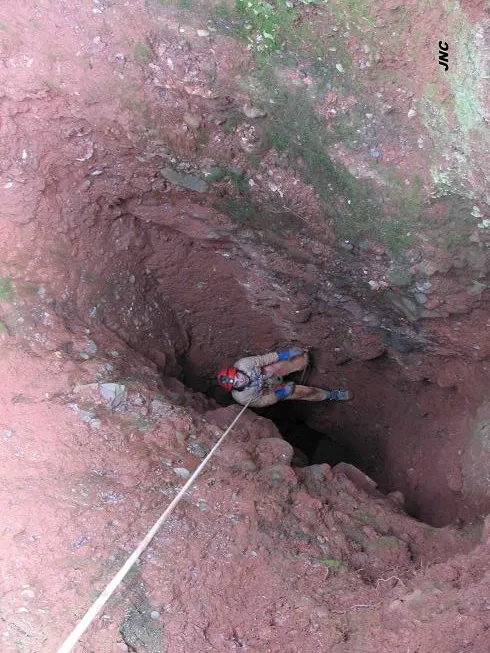
Avenc del Cavall de la Barata
0.6 km · S
Matadepera (Vallès Occidental)
1 topo.3 photos
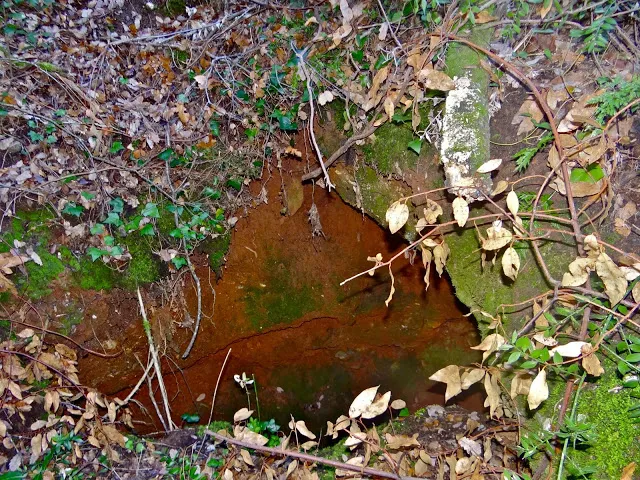
Avenc Fals del Cavall
0.7 km · S
Matadepera (Vallès Occidental)
1 topo.1 photos
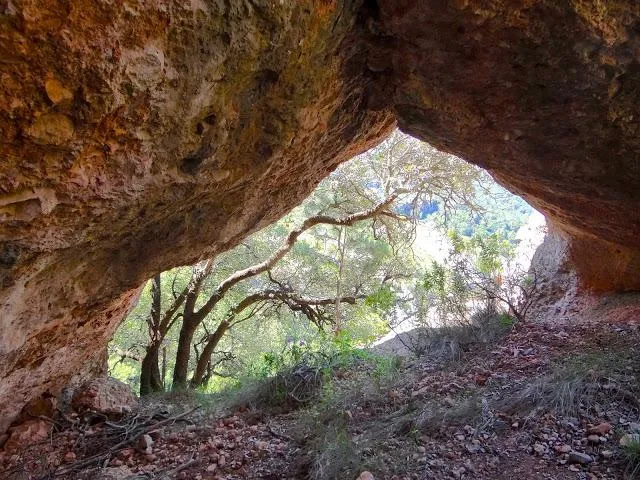
Foradada Morral d'en Bens
0.8 km · NE
Matadepera (Vallès Occidental)
1 topo.1 photos
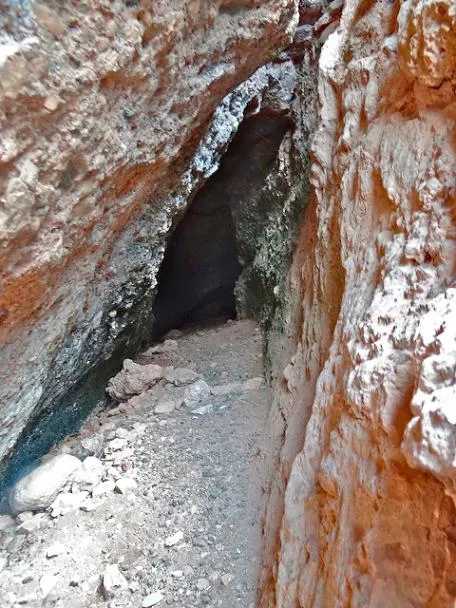
Cova Bellot Ii
0.8 km · NE
Matadepera (Vallès Occidental)
1 topo.1 photos
Source: Espeleoindex (espeleoindex.com), modified. CC BY-NC 4.0, https://creativecommons.org/licenses/by-nc/4.0/