
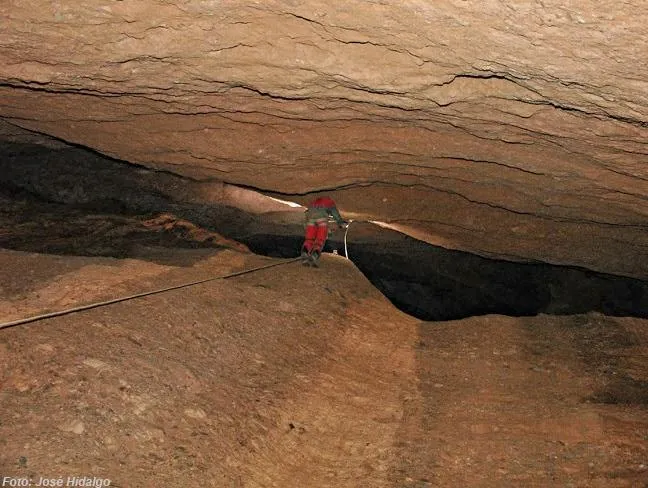
Avenc de la Pinassa
Conegut avenc de 58 m. de fondària a la Serra de l'Obac (Matadepera)
EspeleoWorld
Avenc de la Pinassa
Conegut avenc de 58 m. de fondària a la Serra de l'Obac (Matadepera)
Matadepera · Vallès Occidental
Length: 190 m · Depth: 58 m
Updated record
https://espeleoworld.com/en/c/avenc-de-la-pinassa
Information can change. Always verify coordinates, access, weather, and cave conditions before setting out.
A 58 m deep pit in the Serra de l'Obac (Matadepera), with a funnel-shaped entrance, 6, 36 and 27 m shafts, flowstone and a final crawl.
Topographic
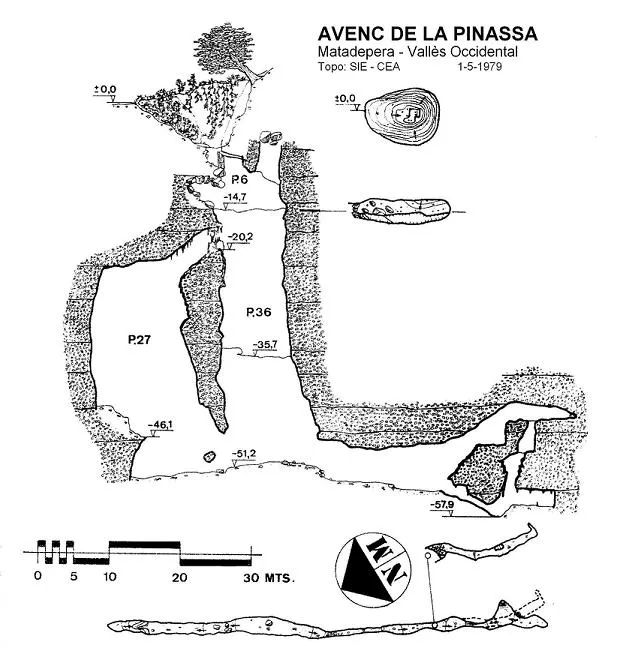

Espeleoindex · CC BY-NC 4.0, https://creativecommons.org/licenses/by-nc/4.0/ · Image © its author.
Photos

Espeleoindex · CC BY-NC 4.0, https://creativecommons.org/licenses/by-nc/4.0/ · Image © its author.
Description
Morphology
The entrance of the pit, surrounded by abundant vegetation, is funnel-shaped and in some places has vertical walls, but at the point where one arrives from the path there is a ramp that allows one to descend to the bottom of the said funnel (level – 6). Here, the shaft already presents a first vertical drop of 6 metres that allows one to reach a ledge that overlooks the entire main shaft. From the point of the ledge farthest from the entrance one can descend directly the 36-metre shaft, which is situated right in the middle of the lower level of the pit (level – 51.2). If one decides to descend below the entry vertical, one descends 6 metres more and enters through a window that gives access to a 27-metre shaft that is situated at the N end of the base of the main shaft. The gallery that forms the lower base of the cavity leads to a point where there is a descending crawl below a magnificent flowstone; once this passage is passed one reaches a small chamber (maximum depth level: 57.9 m) with an ascending chimney that communicates with the upper part of the flowstone.
Speleothems
A magnificent flowstone, below which is the descending crawl; an ascending chimney communicates with the upper part of the flowstone.
Progression
The entrance is funnel-shaped; a ramp allows one to descend to the bottom of the funnel (level – 6). The shaft presents a first vertical drop of 6 metres to a ledge that overlooks the entire main shaft. From the point of the ledge farthest from the entrance one can descend directly the 36-metre shaft to the very middle of the lower level (level – 51.2). If one descends below the entry vertical, one descends 6 metres more and enters through a window that gives access to a 27-metre shaft to the N end of the base of the main shaft. Following the gallery of the lower base one reaches a descending crawl below a magnificent flowstone; once this passage is passed one reaches a small chamber (maximum depth level: 57.9 m) with an ascending chimney that communicates with the upper part of the flowstone.
Other details
Toponymy: Many times we have heard the cavity called Avenc de les Pinasses, although at present the singular form seems more correct (Llopis in 1932 already calls it thus); it should be recorded, however, that Faura (1913) and in the Guia Monogràfica de Sant Llorenç del Munt (1935) call it Pinasses.
We update the record (April 2016) including two more surveys: the one made in 1932 by N. Llopis Lladó (Sota Terra II, 1935) and another, unpublished until now, made by members of the GES – CMB around the beginning of the 1970s during the work being carried out for the preparation of volume 3 of the speleological catalogue of the province of Barcelona that was never published. It should be noted that in the latter the maximum depth level is placed at – 62 metres.
History
The first exploration took place on 13 October 1913, that is, the day after the first exploration of the Avenc de Castellsapera and also under the direction of M. Faura i Sans with his colleagues from the Centre Excursionista de Catalunya: Sagués, Pineda, Cuyàs, Folch and Amat; we think that they also had the collaboration of members of the Centre Excursionista de Terrassa. This exploration went almost unnoticed since Faura only published a brief notice (focused on the Avenc de Castellsapera) in the Il·lustració Catalana of that same year.
The second exploration, without much data about the pit, was not carried out until 9 July 1932 by a large group (21) of members of the Club Muntanyenc Barcelonès, under the direction of Nadal Llopis Lladó. It seems that they had only 15 metres of ladder and had to descend and ascend the shaft with only the help of the rope, which made for a very tiring and highly dangerous exploration.
Until the 1970s the final crawl did not exist and one had to climb the flowstone to reach the final passages. We do not know exactly who or when this crawl below the flowstone was cleared. When the 1979 survey was made it was already open.
User Comments (0)
No comments yet.
Be the first to share your experience!
Registered Explorations (0)
No explorations registered yet.
Register your visit to this cave!
Bibliography
- Aragonès, E. (2010).- Marià Faura i Sans espeleòleg (1883-1941). 106 pp. Federació Catalana d'Espeleologia. Barcelona.
- Castells, P. (1979).- “Revisió topogràfica de dues cavitats de la Serra de l'Obac” . EspeleoSie (23): 47-54. SIE – Centre Excursionista Àliga. Barcelona
- Llopis, N. (1935).- “Avenc de la Pinassa (La Barata)” Sota Terra (II): 49-55. Club Muntanyenc Barcelonès.
- Fotografies de José Hidalgo i Pere Castells, extretes del blog (www.espeleoblog.com.es), post del dia 17/12/2013.
Nearby caves
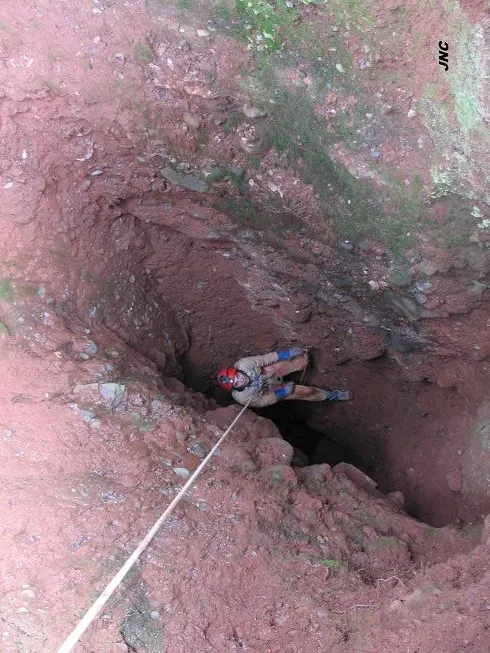
Avenc del Cavall de la Barata
0.8 km · NE
Matadepera (Vallès Occidental)
1 topo.3 photos
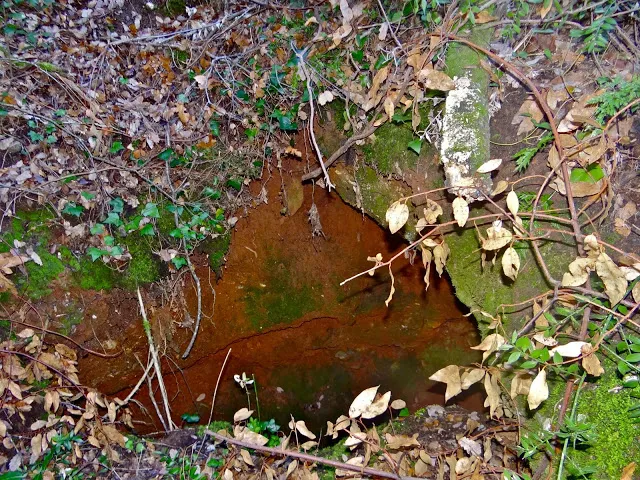
Avenc Fals del Cavall
0.8 km · NE
Matadepera (Vallès Occidental)
1 topo.1 photos
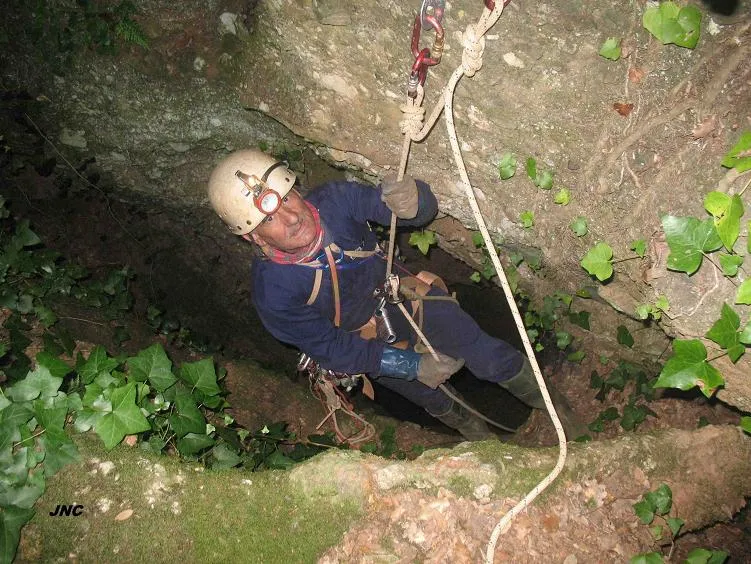
Avenc d'en Sendo
0.8 km · S
Matadepera (Vallès Occidental)
1 topo.3 photos
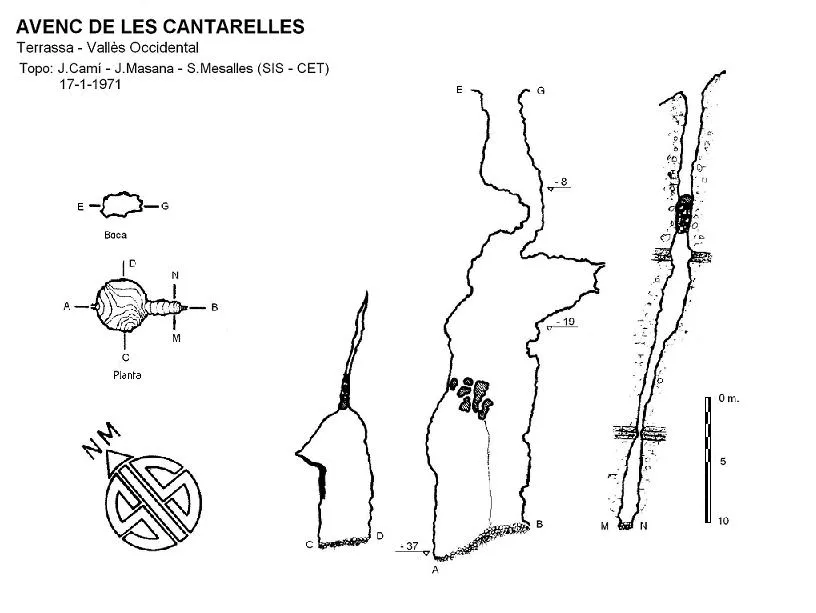
Avenc de les Cantarelles
1.0 km · NW
Terrassa (Vallès Occidental)
1 topo.
Source: Espeleoindex (espeleoindex.com), modified. CC BY-NC 4.0, https://creativecommons.org/licenses/by-nc/4.0/