
Avenc de la Ferla
Històric i important avenc de 172 m. de fondària a Begues.
EspeleoWorld
Avenc de la Ferla
Històric i important avenc de 172 m. de fondària a Begues.
Begues · Baix Llobregat
Length: 704 m · Depth: 172 m
Updated record
https://espeleoworld.com/en/c/avenc-de-la-ferla
Information can change. Always verify coordinates, access, weather, and cave conditions before setting out.
A historic and important 172 m deep pit in Begues, in the Garraf massif, with a 92 m entrance shaft and several interior routes.
Topographic
Espeleoindex · CC BY-NC 4.0, https://creativecommons.org/licenses/by-nc/4.0/ · Image © its author.
Photos
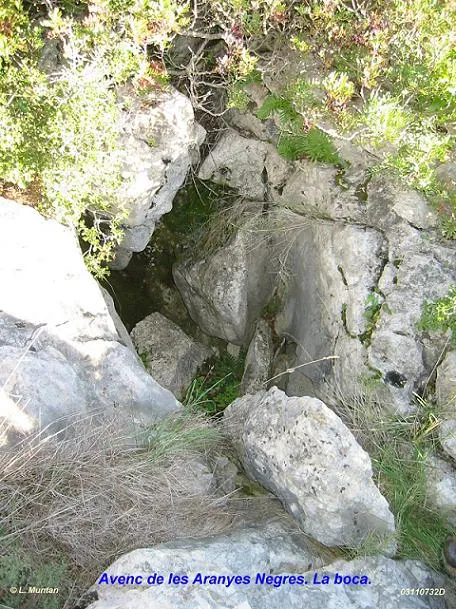
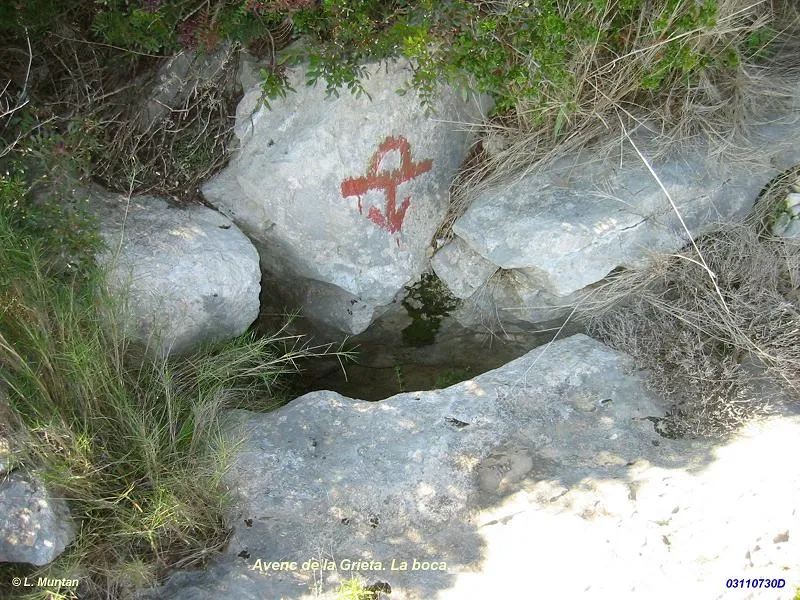
Espeleoindex · CC BY-NC 4.0, https://creativecommons.org/licenses/by-nc/4.0/ · Image © its author.
Description
Morphology
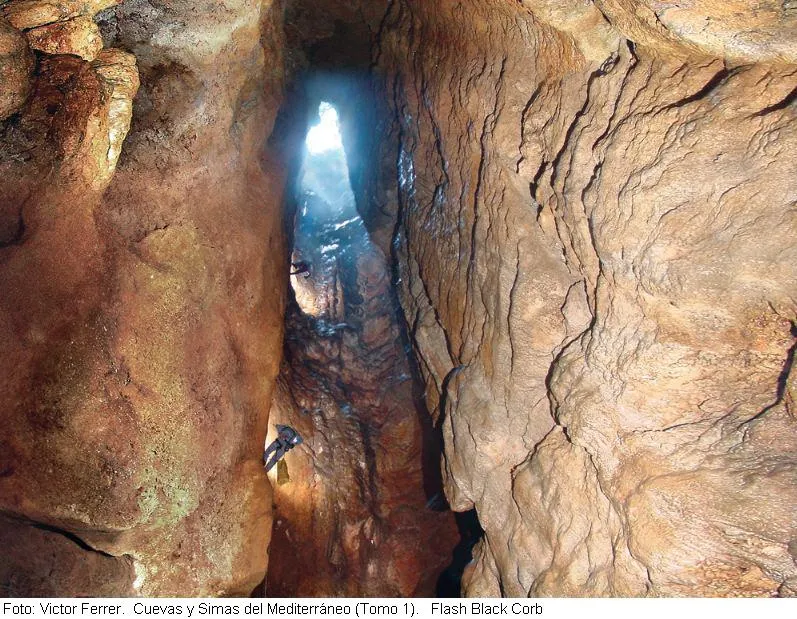
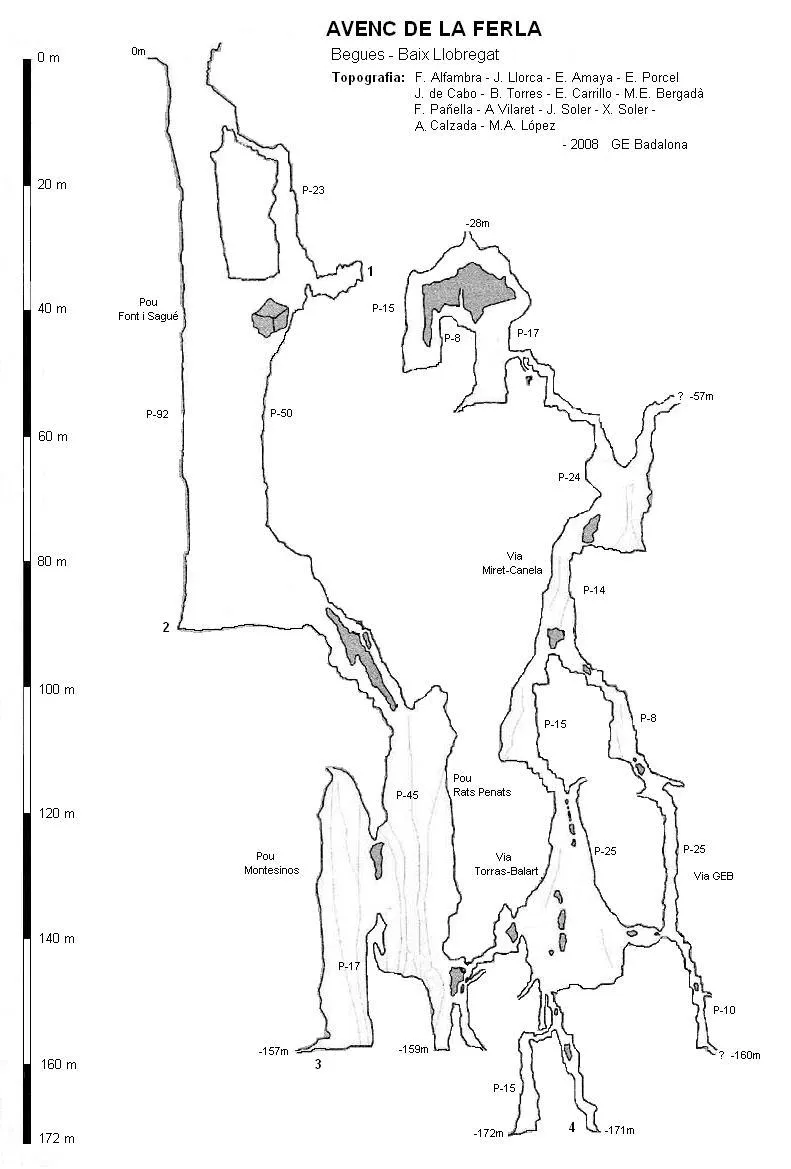
A circular mouth about 5 metres in diameter gives access to a spectacular shaft (Pou Font i Sagué) 92 metres in vertical drop, which widens along one of its transverse axes until reaching 13 x 6 metres at the base of the shaft. In the upper part of the shaft the Via lateral develops, reconnecting with the main shaft (levels -14 to – 40). From the floor of the shaft two descending galleries with drops emerge, entering the roof of the second shaft (Pou dels Rats-penats), 45 metres vertical and formed by two fusoidal concavities fully joined by coalescence. At its base a 10 metre drop can still be descended (level – 159), where the cavity would appear to end. Parallel to the Pou dels Rats-penats another fusoidal cavity develops (Via Montesinos), which by a 17 metre shaft ends in a narrow passage at level – 157. Above the bottom of the final drop of the Pou dels Rats-penats, and from a narrow window, the Via Torras-Balart can be reached, first by a slightly ascending passage leading to a series of small, muddy shafts at the bottom of which the point of maximum depth can be reached. In the upper part of the Via Torras-Balart there is a chimney in which, recently and by means of a spectacular climb, a whole series of ascending shafts has been found (Via Miret-Canela) up to level – 28, where it is closed. From this same route a descending section has also been discovered (Via GEB) which connects by a narrow horizontal passage to the Via Torras-Balart, and if one continues descending through narrow drops and a 10 metre shaft one reaches level – 160.
Hydrology
This cavity is a clear example of one of the few temporary and penetrable swallow holes that can be found in the Garraf massif. The entrance shaft and the two galleries that open at its bottom show a clear erosion morphology and have linked up with a series of internal concavities produced by important lateral seepages.
History
Legendary and known since time immemorial by the people of the region, it does not appear in the speleological bibliography until the first campaigns of N. Font i Sagué. He, together with his companion en Ferret and in the midst of great popular expectation, carried out the first exploration on 15 August 1898, overcoming the great vertical of the first shaft and reaching the head of the second (Pou dels Rats-penats). They calculated a depth of 170 metres.
It was not until 12 October 1924 that a team commanded by Rafael Amat i Carreras faced the second exploration of the ever-feared Ferla. With all kinds of technical and human means, that day Amat reached the bottom of the pit, calculating a depth of 240 metres.
The third exploration took 25 years and took place on 18 and 19 June 1949 by members of the recently created GES del CMB. This expedition had the same epic character as the two previous ones and despite the years passed the equipment was practically the same, that is, from “before the war”. They set up, at the bottom of the entrance shaft, the first underground camp in Spain and the exploration lasted 28 hours. The same point as Amat in 1924 was reached, correcting the depth to – 209. The so-called Pou Montesinos was also discovered and explored.
It was not until 30 and 31 August 1952, on a new visit organised by the CE Comarca de Bages (Manresa) with the participation of two members of the GES, that it was observed that the final section of the pit (4th shaft) had been filled up by clastic products.
A new expedition of the GES on 12 and 13 March 1955 checked the changes suffered and produced a new survey, which lowered all previous levels and calculated (?) that the old bottom of the pit would be located at – 181 metres. On those same days the Via Torras-Balart was discovered, at the bottom of which the deepest point of the cavity was located, giving it 175 metres of vertical drop.
It was not until 1979 that members of the SIE – CE Àliga resurveyed the pit and fixed the maximum depth at 165 metres, at the same point of the Via Torras-Balart.
At the end of 2007, members of the GE Badalona climbed up the highest part of the Via Torras-Balart and began a spectacular climb through a series of shafts (Via Miret-Canela) that are closed at 28 metres from the surface. The work continued throughout 2008 and halfway up the climb they found a descending section (Via GEB) which on one hand reconnects with the Via Torras-Balart and on the other reaches a new shaft that is closed at level -160.
The new survey fixes the maximum depth at level – 172, at the deepest point of the Via Torras-Balart (previously – 165). We can observe that the greatest difference in levels between the SIE survey (1979) and the most recent one of the GEB (2008) is found in the vertical drop of the Pou dels Rats Penats (P.39 for the SIE and P.45 for the GEB).
Bio
Troglocharinus Ferreri Reitt.
24 specimens (supposedly) col. MZB in May 1949.
34 specimens collected by O. Escolà on 1 / 3 / 1964.
1 female specimen collected by Casado on 17 /12 /1966.
1 female specimen collected by O. Escolà on 25 / 3 / 1979.
1 female specimen collected by O. Escolà on 5 / 12 / 1982.
User Comments (0)
No comments yet.
Be the first to share your experience!
Registered Explorations (0)
No explorations registered yet.
Register your visit to this cave!
Bibliography
- Amat i Carreras, R. (1925).- “Sota el massís de Garraf. Excursions espeleològiques als avencs de Begues. Campanya del 1924”. Butll. CEC XXXV (363-364): 233-267. Centre Excursionista de Catalunya. Barcelona.
- Borràs, J. (1974).- Catálogo espeleológico del macizo de Garraf. Vol. III . 207 pp. Barcelona.
- Cardona, F. (1990).- Grans cavitats de Catalunya, vol 2. 484 pp. EC Gràcia, Barcelona.
- Ferrer, V. (2006).- Avencs de Garraf i d'Ordal. 152 pp. + llibret fitxes i topografies. Edició de l'autor. Barcelona.
- GEB (2008).- “Notícia sobre l'avenc de la Ferla” Cavernes (27):6-7. GE Badalona.
- GEB (2009).- “Avenc de la Ferla. Exploració de la nova via Miret-Canela” EspeleoCAT (7): 12-23. Federació Catalana d'Espeleologia. Barcelona.
- Montoriol, J. (1950):- “Estudio geospeleológico de la sima de la Ferla (Macizo de Garraf, Barcelona)”. Pirineos (6): 217-228. Inst.Est.Pirenaicos. CSIC. Zaragoza.
- Montoriol, J. (1985).- “Consideracions morfogèniques sobre la profunditat de l'Avenc de la Ferla (Massís de Garraf)” Sota Terra (6): 26-29. GES-CMB. Barcelona.
- Torras, JMª. (1956).- “Breve reseña de las exploraciones al Avenc de la Ferla” Ciencia y Montaña (2º trim.): 3 pp. CM Barcelonés. Barcelona.
- Victoria, JM. (1979).- “L'Avenc de la Ferla” EspeleoSie (23): 27-32. SIE – CE Àliga. Barcelona.
Nearby caves


Source: Espeleoindex (espeleoindex.com), modified. CC BY-NC 4.0, https://creativecommons.org/licenses/by-nc/4.0/