
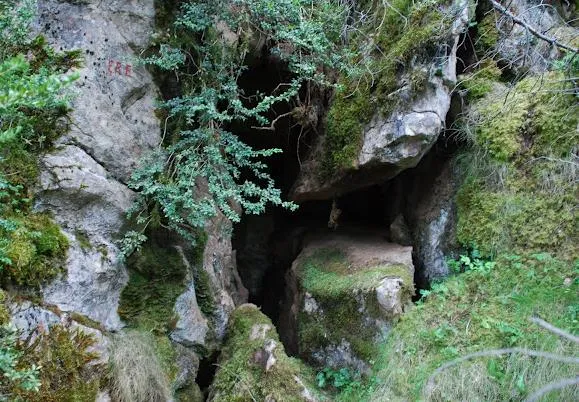
Avenc de la Cabana d'en Garraba
A 62-metre-deep pit at Pont de Bar, an active swallow hole of the torrent de la Barguja. Known since ancient times, explored in 1910 and surveyed in 1973.
EspeleoWorld
Avenc de la Cabana d'en Garraba
A 62-metre-deep pit at Pont de Bar, an active swallow hole of the torrent de la Barguja. Known since ancient times, explored in 1910 and surveyed in 1973.
Pont de Bar, El · Alt Urgell
Length: 425 m · Depth: 62 m
Updated record
https://espeleoworld.com/en/c/avenc-de-la-cabana-d-en-garraba
Information can change. Always verify coordinates, access, weather, and cave conditions before setting out.
A 62-metre-deep pit at Pont de Bar, an active swallow hole of the torrent de la Barguja. Known since ancient times, explored in 1910 and surveyed in 1973.
Topographic
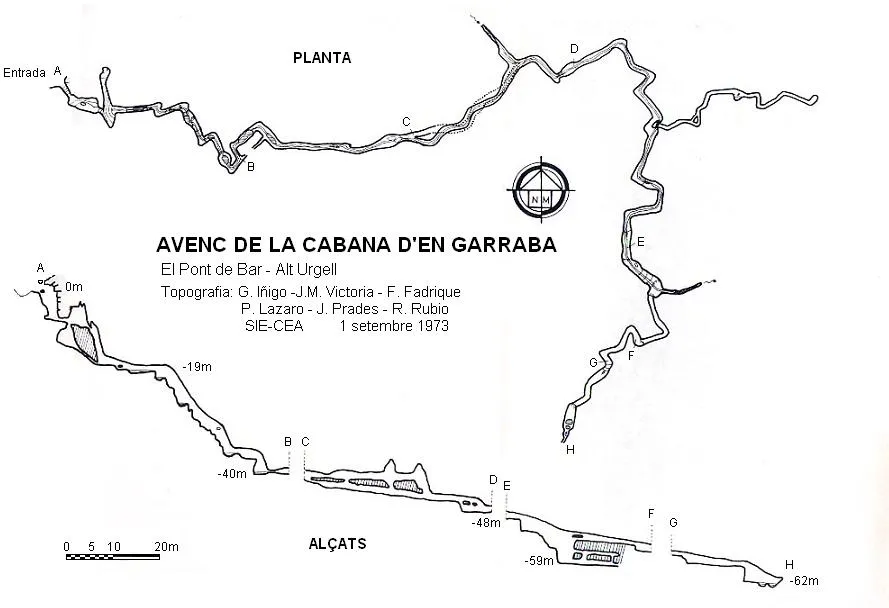
Espeleoindex · CC BY-NC 4.0, https://creativecommons.org/licenses/by-nc/4.0/ · Image © its author.
Photos
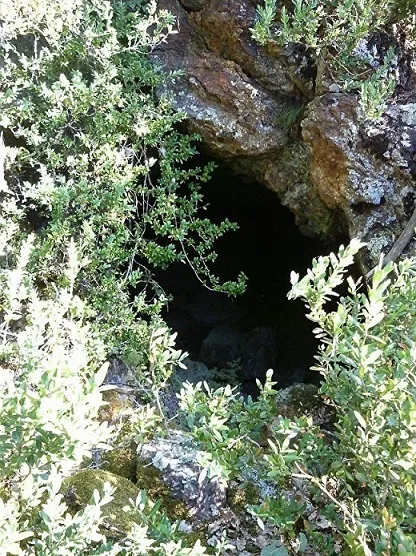
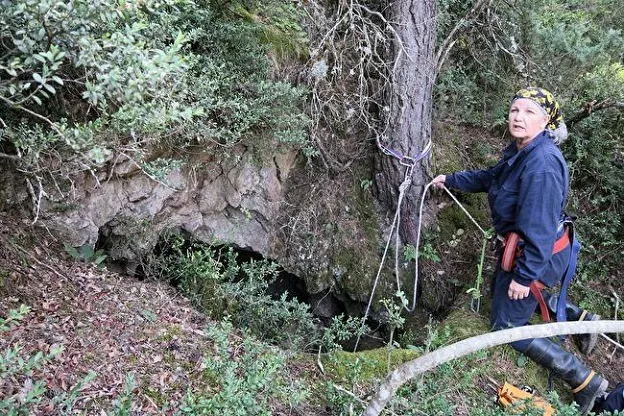
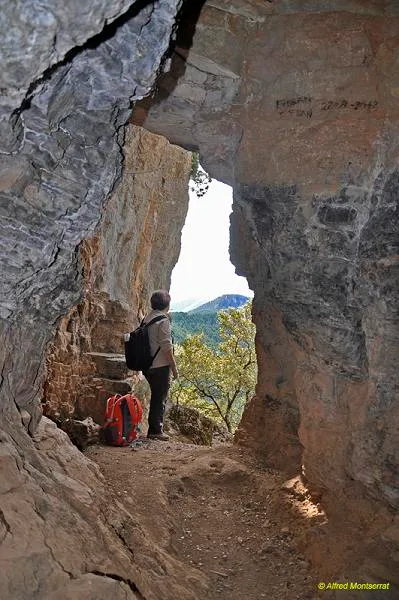
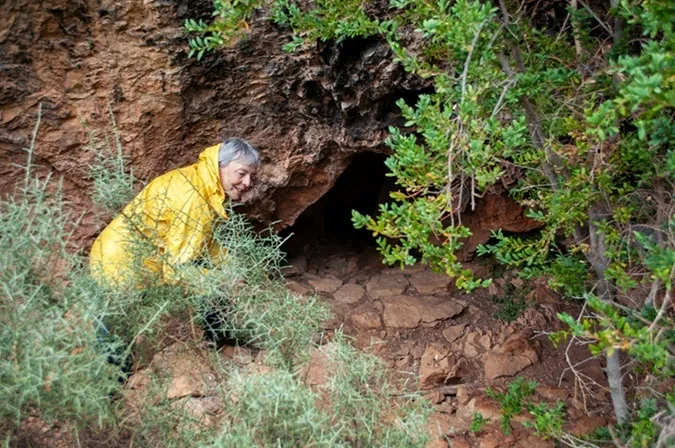
Espeleoindex · CC BY-NC 4.0, https://creativecommons.org/licenses/by-nc/4.0/ · Image © its author.
Description
Morphology
Access is via a short gallery 1.7 x 1 metres, with a small window in the roof. We soon find a drop of -6 metres, from which, after a low passage, we reach a small chamber where there are two pits in plan; we must follow the more easterly one, of -8 metres. This first section is somewhat chaotic with numerous blocks. At the base of the pit, on the left, a short gallery opens in a NE direction. Between elevations -19 and -40 metres we find a succession of small pits and potholes, the last being -3 metres. From this point the gallery loses height (1 x 0.7) and becomes more horizontal, which forces a partial submersion to pass the crawl (-40). The gallery continues for about 40 metres more comfortably, with an average section of 0.8 x 1.7 metres. At this point, the gallery divides into two superimposed conduits with various connections between them, finally joining again. Here we find a gallery on the left just over 10 metres long. The gallery continues with a meandering layout; from elevation -48 metres it turns clearly towards the S. At 270 metres of passage we find on the left a crawl that can be followed for about fifty metres, until it becomes blocked by sediments. The main gallery continues in a S direction while its slope increases, creating small rapids that converge into a beautiful waterfall at -59 metres. From here we find two continuations, towards the NE, a two-storey conduit with communication between them but which proves impenetrable at 10 metres of passage, where the river that has accompanied us through almost the whole cave disappears. If we make a small climb of 5 metres, we can continue towards the SSE along a descending gallery one metre in diameter and 60 metres long; this final section ends at -62 metres depth after a passage of 425 metres.
Hydrology
From this point the main gallery has a small water input. It is an active swallow hole; exploring the cave in the rainy season is quite dangerous.
Other details
Toponymy: At some time this pit has appeared wrongly cited as Avenc de la Cabana d'en Gabarra. However, as regards the name Cabana, we believe that in no case can it be considered synonymous with cave or pit.
History
Due to its characteristics and location, the cave was known since ancient times in the area. The first speleological news corresponds to Mn. Faura i Sants who cites it as Avench d'en Cavana de Garroba from the notes of Jeannel, Mengel and Racovitza who partially explored it with biospeleological objectives on 23 August 1910; it seems that the translation of the original was not accurate enough with the name.
In 1947 Ll. Solé Sabarís and Noel Llopis Lladó in the explanatory memoir of the geological map (1:50,000 sheet of Bellver) include a small note on the cave from the notes of Jeannel and Racovitza and a small catalogue of caves with some interesting observations on the hydrological functioning of the torrent de la Barguja.
In 1964 a group of speleologists among whom was a member of the SIE del CE Àliga explored about 300 metres of galleries (A. Traver 1966).
Between the years 1966 and 1968 the ERE del CE Catalunya visited it on various occasions for mainly biospeleological reasons, resulting in the first location in Catalonia of Niphargus longicaudatus.
Finally, the SIE del CE Àliga surveyed it on 1 September 1973.
Bio
Isopods
Stenasellus virei Dollfus. Ribera, 10-4-1966; Viñas, 24-7-1967; Escolà, 2-6-1968.
Amphipods
Niphargus longicaudatus. Ribera, 10-4-1966.
Coleoptera
Speonomus mengeli (distributed through many caves of the area)
User Comments (0)
No comments yet.
Be the first to share your experience!
Registered Explorations (0)
No explorations registered yet.
Register your visit to this cave!
Bibliography
- Borràs, J.; Miñarro, J.M.; Talavera, F.(1978).-”Alt Urgell i la Cerdanya” Catàleg Espeleològic de Catalunya (Vol.2):1-186. Ed. Políglota. Barcelona.
- Canals, M; Ribera,C. Viñas, R.(1970).-La Fou de Bor i cavitats de l'Alta Vall del Segre. Ed. Montblanc.
- Cardona i Oliván, Ferran.(1989).-”La Serralada Pirinenca”. Grans Cavitats de Catalunya (Primer Volum):1-198. EC Gràcia. Barcelona.
- Escolà, Oleguer.(1978).-”Noves localitzacions de Stenasellus virei a la península ibèrica, especialment a Catalunya”. Butll. Inst. Cat. Hist. Natural (42) Secc. Zool. :119-122.
- Faura i Sans, Mn.(1911).-”Excursiones espeleológicas realizadas durante el año 1910 en la región Catalana”. Boletin Real Soc. Esp. Hist. Natural (11)354-376.
- Guillot, Jaume.(2008).-”Avenc de la Cabana d'en Garraba”. Natura i Aventura (19):24-25.
- SIE.(1976).-”El Avenc de la Cabana d'en Garraba”. EspeleoSie (18):35-48. SIE-CE Àliga. Barcelona.
- Traver, A. (1966).-”Exploracions espeleològiques a la Cerdanya”. Boletín Puig Castellar (4):74-75.
Nearby caves


Source: Espeleoindex (espeleoindex.com), modified. CC BY-NC 4.0, https://creativecommons.org/licenses/by-nc/4.0/