
Avenc de l'Esquerrà
The avenc de l'Esquerrà, in the Garraf massif, is the most important and complex cavity, with 291.4 m of depth and three routes: Via Normal – Anna Maria Pallejà, Via Rat-penat and Via Lamarca-Torras.
EspeleoWorld
Avenc de l'Esquerrà
The avenc de l'Esquerrà, in the Garraf massif, is the most important and complex cavity, with 291.4 m of depth and three routes: Via Normal – Anna Maria Pallejà, Via Rat-penat and Via Lamarca-Torras.
Olesa de Bonesvalls · Alt Penedès
Length: 2050 m · Depth: 291 m
Updated record
https://espeleoworld.com/en/c/avenc-de-l-esquerra
Information can change. Always verify coordinates, access, weather, and cave conditions before setting out.
The avenc de l'Esquerrà, in the Garraf massif, is the most important and complex cavity, with 291.4 m of depth and three routes: Via Normal – Anna Maria Pallejà, Via Rat-penat and Via Lamarca-Torras.
Topographic

Espeleoindex · CC BY-NC 4.0, https://creativecommons.org/licenses/by-nc/4.0/ · Image © its author.
Photos

Espeleoindex · CC BY-NC 4.0, https://creativecommons.org/licenses/by-nc/4.0/ · Image © its author.
Description
Morphology
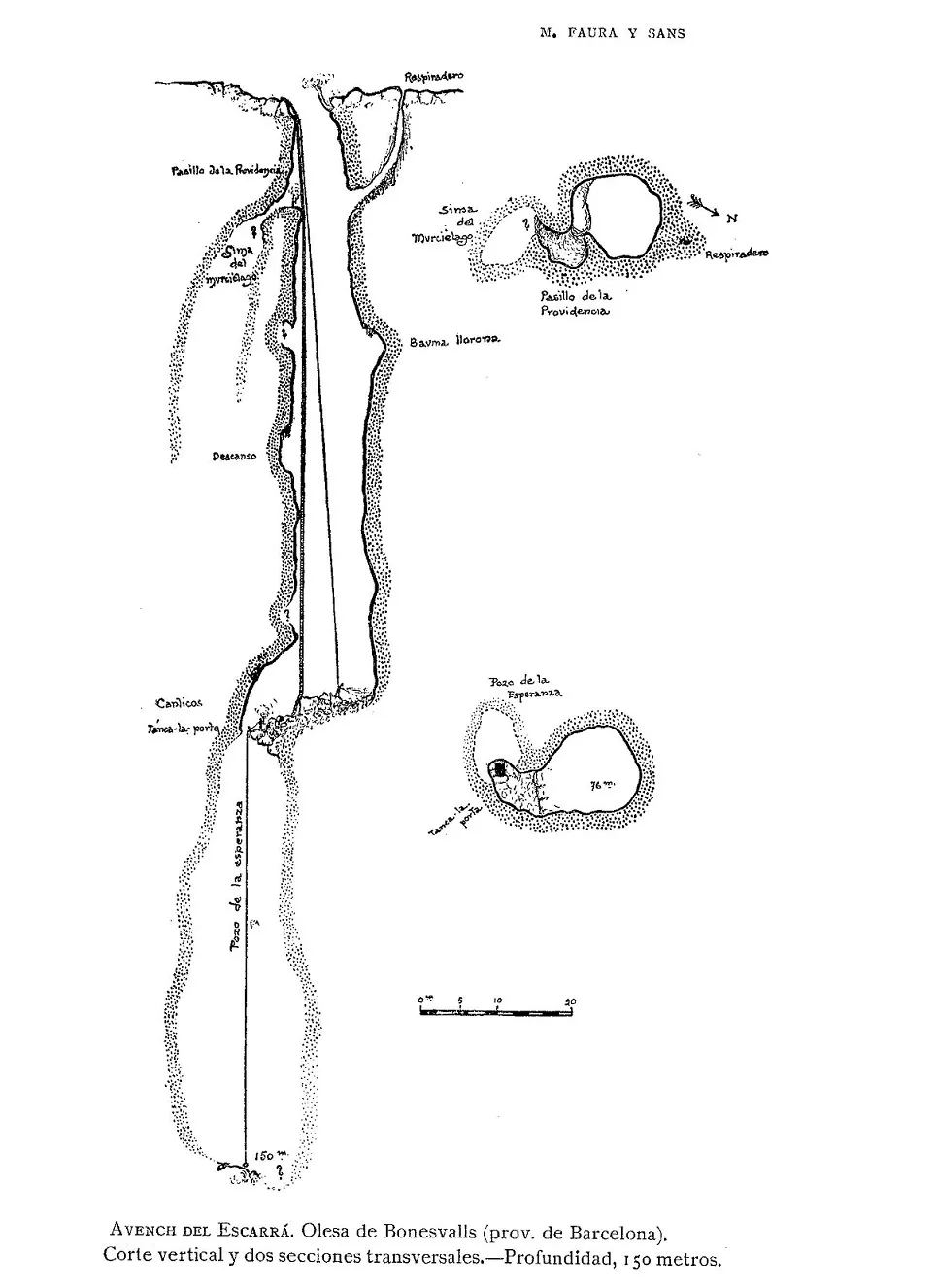
The avenc de l'Esquerrà is the most important cavity of the Garraf massif; it consists of three routes, known as: Via Normal - Anna Maria Pallejà; Via Rat-penat; and Via Lamarca-Torras. Its topographically surveyed vertical drop is -291.4 metres, while the also surveyed length is 1,938 metres, the result of the sum of the 2007 survey plus the survey of the Meandre dels Ribetans: 1784 +154. To this must be added the length of the final stretch of the Via Anna and some small lateral passages explored by the SES – GE Ribes, for which there is no surveyed topography but which will certainly bring the total length to exceed, perhaps only slightly, 2000 metres.
The mouth is almost circular, about 5 metres in diameter, and gives access to the large Faura i Sans pit of 67.7 metres of vertical, which for its first metres maintains its dimensions, widening later towards the N. At -14 metres we find the la Providència ledge, which gives access to the Rat-penat route; at -34 metres a window opens in the S wall through which a narrow gallery is reached that after 5 metres leads to the Artur Brussoto chamber. Already at the base of this first vertical, covered with stones and other debris from the outside, a new vertical of -21 metres opens, which places us in the la Paciència chamber. Walking a few metres, we observe a sudden change of dimensions; above our heads rises the J.M. Torras pit, coming from the Artur Brussoto chamber. A short gallery of modest section places us before a new vertical of -12 metres, landing in a small chamber on the N side, from which some steps descend the Xarel·lo pit, this one with a meander appearance. Once down we find ourselves before a narrow vertical passage, this is the Gatonera de l'Anna, the point where the Anna route begins. After descending a few metres through the crawlway, we reach a balcony before a new vertical of -19 metres, the Cristalls pit; between this pit and the next, called J.M. Anglada, a series of galleries and secondary pits develop, such as the Túnel de la Pastanaga. The J.M. Anglada pit is -23 metres and totally aerial; at its base, a step places us in a lower chamber with a low ceiling and full of clay sediments, where a narrow gallery with important drips begins, leading to a last pit of -14.5 metres that places us in the GES chamber, at -204 metres. Through a narrow passage one reaches a series of small pits and galleries that lead to the -245 metres level, where we find an impassable passage from which a notable air current emerges.
At the bottom of the Pou GER a zone of horizontal predominance opens, made up of a meander originated by dissolution – corrosion. This meander, with evident signs of the extraordinary digging carried out by the members of the SES- GE Ribes, has a width of 0.6 metres and a height of also 0.60 metres. At 20 metres of length, it turns 90º and gives way to the Sala del Part where the dimensions are somewhat more generous. A little further on one reaches the zone of the pits (P-16; P-9 and P-6, consecutive) where the morphology of the passage changes notably, greatly increasing the dimensions, which reach up to 3.90 metres in width. At the base of each pit, which are ramps of about 55º of inclination, one can climb a few metres “upstream” to reach the base of a small waterfall where a small lake originates. Between the second and third vertical there is a narrow passage (Gatonera del Fang-dango) where it is necessary to drag oneself through the mud and which allows entry to the P-6, which is a ramp presenting abundant lithochemical coating in the form of flows and walls clean of sediment. At this point one enters a narrow meander of sub-horizontal predominance (Meandre de les Termòpiles) with some small step and walls covered by sediment. Progress again becomes uncomfortable and one must go seeking the widest zones in order to advance. Further on it widens again and one reaches the most committing point of the cavity, especially when ascending. This narrow passage communicates with a ramp with a stalagmitic floor and a vertical of 7 metres. At its base the small active course is lost under the layer of sediment. At this point there is a tiny chamber only 1.4 metres wide followed by a short horizontal gallery, where the ceiling lowers following a bedding plane until the gallery closes in a mud plug. At the deepest end and beside a curious pendant the point of maximum depth is reached at the -291.4 level, that is, at 42 metres above sea level. Due to the ease with which the sediment of this mud plug can be removed, a digging would be feasible, but access to this final point would greatly hinder the work.
Speleothems
The sala de la Platja turns finding a narrow passage between stalagmitic columns, this is the Taló d'Aquil·les, a descending passage of -4.5 metres somewhat difficult. Once passed and inside a small pothole, a large chamber with an inclined base is observed that leads to the R. Passant pit, of -15 metres. From its bottom a meandriform gallery emerges at the end of which we find a step that places us in the sala GES at -209 metres of depth. An initial narrow passage leads to a small chamber, after another narrowness and a narrow passage where one must get wet we reach a two-metre downclimb where one arrives at a wider chamber. Without descending the Cristalls pit, one passes by some formations and reaches the handline that crosses the GER pit towards the segon sector. Crossing the handline one can continue until finding a sudden change of direction. A few metres on, by a rope, one climbs to the upper part of the galeria Lamarca. Continuing along an upper level to the highest part of the pit, a handline leads to a hanging window that is the entrance to the tercer sector. A small step of 2 metres, and a pit that ends in a descending gallery of good dimensions with a lot of mud, leads to the Caparrós chamber. The bottom of the chamber is at -226 metres. Near here the ascending Fang-Fang gallery develops, which ends after a narrow passage at -191 metres of depth.
CONCRETIONED PITS: To access them, one must position oneself at the start of the flow located in the A. Brussoto chamber, in the direction of the J. León pit. Before descending the flow, one must skirt the large block on the left; a few metres on one climbs on the right to seek the upper part of the J. León pit. Skirting this and passing through a narrow passage between blocks, we reach the beginning of the route. This is formed by a set of spindle-shaped pits, which are linked; the most relevant characteristic, as its name indicates, is the great profusion of concretion existing throughout its extent; there are several lateral pits that are separated by thin partitions of concretion, which subdivide the original pits.
Hydrology
At the base of each pit, which are ramps of about 55º of inclination, one can climb a few metres “upstream” to reach the base of a small waterfall where a small lake originates. At the base of the 7-metre vertical the small active course is lost under the layer of sediment.
Progression
VIA NORMAL – ANNA MARIA PALLARÈS: The mouth is almost circular, about 5 metres in diameter, and gives access to the large Faura i Sans pit of 67.7 metres of vertical, which for its first metres maintains its dimensions, widening later towards the N. At -14 metres we find the la Providència ledge, which gives access to the Rat-penat route; at -34 metres a window opens in the S wall through which a narrow gallery is reached that after 5 metres leads to the Artur Brussoto chamber. Already at the base of this first vertical, covered with stones and other debris from the outside, a new vertical of -21 metres opens, which places us in the la Paciència chamber. Walking a few metres, we observe a sudden change of dimensions; above our heads rises the J.M. Torras pit, coming from the Artur Brussoto chamber. A short gallery of modest section places us before a new vertical of -12 metres, landing in a small chamber on the N side, from which some steps descend the Xarel·lo pit, this one with a meander appearance. Once down we find ourselves before a narrow vertical passage, this is the Gatonera de l'Anna, the point where the Anna route begins. After descending a few metres through the crawlway, we reach a balcony before a new vertical of -19 metres, the Cristalls pit; between this pit and the next, called J.M. Anglada, a series of galleries and secondary pits develop, such as the Túnel de la Pastanaga. The J.M. Anglada pit is -23 metres and totally aerial; at its base, a step places us in a lower chamber with a low ceiling and full of clay sediments, where a narrow gallery with important drips begins, leading to a last pit of -14.5 metres that places us in the GES chamber, at -204 metres. Through a narrow passage one reaches a series of small pits and galleries that lead to the -245 metres level, where we find an impassable passage from which a notable air current emerges.
VIA RAT-PENAT: It begins -14 metres below the mouth of the large Faura i Sans pit, the place where the la Providència ledge is found; a brief stretch of descending gallery leads to a large pit of -24 metres that lands in the A. Brussoto chamber, being occupied by some enormous blocks. From the SE side, a short ramp pours into the large J.M. Torras pit, which lands in the la Paciència chamber, thus communicating with the Normal route. Situated again in the A. Brussoto chamber, and passing under a block, one reaches a flow with a gentle slope that pours into the J. León pit, of -34 metres of depth. Next a step of -6 metres places us in the small chamber known by the name of Cambra Nupcial; from it the Lamarca-Torras route also emerges. Next follow the Pous del Balconet, which we will descend in three pitches. A crawlway and a step place us in a complex zone with different superimposed floors, communicated among themselves by pits. Different steps and a vertical of -12 metres place us in the Platja chamber. The sala de la Platja turns finding a narrow passage between stalagmitic columns, this is the Taló d'Aquil·les, a descending passage of -4.5 metres somewhat difficult. Once passed and inside a small pothole, a large chamber with an inclined base is observed that leads to the R. Passant pit, of -15 metres. From its bottom a meandriform gallery emerges at the end of which we find a step that places us in the sala GES at -209 metres of depth. An initial narrow passage leads to a small chamber, after another narrowness and a narrow passage where one must get wet we reach a two-metre downclimb where one arrives at a wider chamber. Without descending the Cristalls pit, one passes by some formations and reaches the handline that crosses the GER pit towards the segon sector. Crossing the handline one can continue until finding a sudden change of direction. A few metres on, by a rope, one climbs to the upper part of the galeria Lamarca. Continuing along an upper level to the highest part of the pit, a handline leads to a hanging window that is the entrance to the tercer sector. A small step of 2 metres, and a pit that ends in a descending gallery of good dimensions with a lot of mud, leads to the Caparrós chamber. The bottom of the chamber is at -226 metres. Near here the ascending Fang-Fang gallery develops, which ends after a narrow passage at -191 metres of depth.
VIA LAMARCA – TORRAS: This route is accessed after climbing a metre and a half up the Cambra Nupcial; it is a crawlway that, following a step of -4 metres, places us on a balcony above the E. Lamarca pit; the vertical is -45 metres almost totally aerial, the pit reaching an important cross-section. Situated at the base, the cavity continues through a window located 5 metres higher up; one must pendulum to access it; once at the window, a gallery of steep inclination begins. A step of 2 metres precedes a new vertical of -19 metres. From the dome of this pit, an ascending handline leads to the Grúmuls gallery; it is an elliptically shaped gallery through which, climbing 10 metres, one accesses an upper level with a smaller gallery. Situated again at the -19 metres pit, once at its base, a short climb must be made to reach la Fonteta, it is a sandy small chamber partly covered by water; on the left, overcoming a step, we find some meanders that we will follow at mid-height until reaching a window that gives onto a short pit with the base covered in water, which is the lowest point of this route, -193 metres.
History
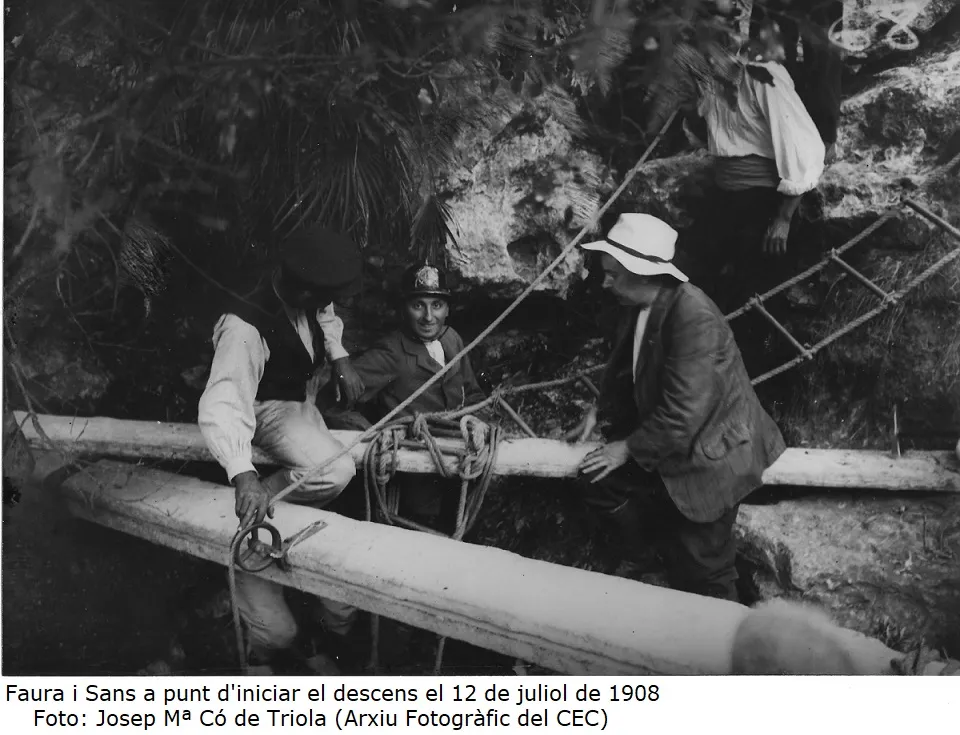
Cavity known since remote times by the people of the region, as it is located on the estate owned by ca l'Esquerrà. The first bibliographic citation is provided by Font i Sagué in his Catàlech (1897), attributing to it a depth of 76 metres, according to a sounding carried out by himself on 25 June 1897, during the preliminary outings of his explorations. On 12 July 1908, the first exploration led by Faura i Sans took place with the participation of members of the Club Muntanyenc, with Albert Santamaria as lead man; Josep Mª Có de Triola, taking photographs; Escofet, Bertrand, Vidal and J. Mitjans, heir of ca l'Esquerrà. They descend the first pit to which they assign a depth of -76 metres, and sound the next pou de l'Esperança, to which they attribute an exaggerated depth, as they place its base at -150 metres. At the same time, Faura notes the existence of a lateral route that opens at -15 metres, baptising it as avenc del Rat-penat (in the survey it appears as sima del murciélago). During this exploration the pit is also descended by Providència Mitjans (daughter of ca l'Esquerrà) and who, as an anecdote, becomes the first woman to practise speleology in Catalonia. She does so down to the ledge that bears her name and which marks the start of the Rat-Penat route. In 1928 Joan Mas, from Begues, together with other amateurs from the village, carries out a new descent. The press considers it a feat, and they claim to have reached 200 metres of depth; in reality it was the -110 level. This exploration, carried out in the month of April, preceded by two months the one later carried out by Rafael Amat i Carreras (Amat was waiting for the road to Olesa to be finished so he could go with his car). Finally, Rafael Amat's exploration took place on 10 June 1928 with a group from the Centre Excursionista Barcelonès, some friends from Begues, among them Joan Mas, and a native of Olesa de Bonesvalls, Xarel·lo, who wanted to take part in the exploration of the most important pit of his village; one of the pits will bear his name. The expedition reached the -120 metres level, and they considered they had reached the bottom of the pit. After a long silence, on 19 April 1948, Montoriol, Vicens, Rovira and Carbonell, members of the GES-CMB, created that very week, organise a new descent, reaching the same point as Amat i Carreras. The exploration was a series of blunders and imprudences. Four years later, Montoriol (1952) wrote a dramatic account of that night spent inside the pit. The Via Rat-penat remained unexplored, until on 1 and 2 November 1952, also members of the GES-CMB (Brusotto, Lamarca, Godall, Ferrero, Cruz), decided to explore it. That day they reached about 90 metres of depth. From this moment the Avenc de l'Esquerrà becomes a priority activity of all the members of the GES and systematic explorations begin, prioritising the exploration of the Rat-penat route, at that time they were already beginning to have fairly “modern” material imported from France. They reach -130 metres and discover the connection with the normal route (Pou Torras). In the course of other explorations, they reach -165 metres and explore the concretioned pits. In 1954, members of the GES, SES and UEC continue the explorations. Enric Lamarca and Josep M. Torras discover an important lateral route off the Rat-Penat route, which will be the one that, under the name of these two GES speleologists, will reach that same year the -193 metres level. In 1955 the bottom of the Rat-Penat route is reached. Among the seven speleologists taking part there is a woman, Maria Puig, of the GES-CMB, who came to hold the Spanish female depth record. In 1956, when the pit was considered fully explored, Anna Maria Pallejà, of the GES-CMB, discovers during some surveying tasks a crawlway located at -120 metres which, after a digging, gives way to the route that bears her name; the bottom of the route is reached that same year. In 1968 the first complete survey of the pit is presented, carried out by the GES; the maximum level is located on the Rat-penat route, with a depth of -206 metres. In 1973, the SIE-CEA devotes different sessions to making a survey revision and the result gave about 10 metres of reduction of the levels of the GES survey on the three routes: the final level of the Rat-penat route places the bottom at -197.4 metres, the Anna route becomes – 194 and the Lamarca-Torras route has its bottom at – 181. This survey remained unpublished, but we have been able to locate the drawing of the elevation of the Rat-penat route. In 1982, members of the ECG undertake a systematic reconnaissance of all the pits of the cavity, in search of possible hanging galleries, leading to the discovery of various galleries of short length as well as a chamber of 10X6 metres. A new survey is made, reaching the maximum depth on the Rat-penat route, with -209 metres. In 1994 the GER (Rubí) carry out a digging in the sala GES of the Rat-penat route, finding new galleries and pits, ending the exploration in the Pou GER, placing the maximum depth at -236 metres. The GER (Rubí), after several attempts, finally in 1997 manage to access the Lamarca-Torras route, at the pou de la Fonteta and the Grúmuls gallery. The same group in 1999 dig with micro explosives the ramp of the Fang-Fang achieving more length. In 2003, the GER (Rubí) carries out a digging at the bottom of the Lamarca-Torras route, where they cover about 7 metres. On the same route, they dig open a passage in the Túnel del Infern, which gives them more length. From the year 2007 until 2010, members of the SES-GER of Sant Pere de Ribes begin a series of explorations and diggings, which will result in the discovery of new pits on the Anna Maria Pallejà route, which reaches the depth of -245 metres; on this route, S. Serrano and X. Atencia find at the bottom of a small 7-metre pit in the Túnel de la Pastanaga, a note dated 1956 and signed by the members of the GES-CMB. They also explore a branch on this route, the passatge de la Flama de les Ànimes, in which, besides various chambers, they find the longest gallery of the cavity, with 45 metres. At -12 metres from the access mouth, they explore the galeria dels cent anys. Also on the Rat-Penat route, they reach -305 metres of depth; of these explorations there is only evidence of the making of some sketches, in which no scale appears. On 22 January 2013, Judit Parés, aged 16, and Alejandro Serrano of the SES-GER, carry out a new exploration to the end of the Rat-Penat route, placing according to them the final level at -336 metres of depth; on this occasion survey data are taken, although we only have news of the publication of a polygonal traverse of the elevation. Two months later the SES-GER repeats the exploration again for a television documentary. Finally, on 26 January 2019, Luis Almela, Joaquín Almela (EC Castelló) and Vicente Barraquet (UEC – Tortosa), supported by colleagues from their respective clubs, carry out a complete exploration and the corresponding survey of the Meandre dels Ribetans, reaching the maximum depth level of the pit which stands at 291.4 metres. They also took the corresponding measurements along the whole Via Rat-penat and were able to make a comparison with all the levels of the previous surveys.
Bio
Coleoptera: Troglocharinus ferreri Reitt.
- 00-05-1948 Francesc Vicens 1 indiv.
- 19-05-1957 J.M. Anglada 3 indiv.
- 17-04-1964 O. Escolà 54 indiv.
- 01-02-1970 Ll. Auroux ?
- 14-06-1970 O. Escolà 8 indiv.
- 08-08-1976 O. Escolà 3 indiv.
- 27-05-1979 O. Escolà 4 indiv.
- 25-01-1980 O. Escolà 11 indiv.
- 19-12-1982 O. Escolà 230 indiv.
User Comments (0)
No comments yet.
Be the first to share your experience!
Registered Explorations (0)
No explorations registered yet.
Register your visit to this cave!
Bibliography
- AA.VV. (2008).- Avenc de l'Esquerrà. 100 Anys d'història (1908-2008). 88 pp. Federació Catalana d'Espeleologia. Barcelona.
- Almela, L.; Barraquet, V.; Almela, J. (2019).- “Nuevos trabajos de topografía en el Avenc de l'Esquerrà”. Gota a gota (1): 26-33. Revista digital del GE de Villacarrillo.
- Amat i Carreras, Rafael (1972).-”Sota el massís de Garraf-III”. Espeleòleg (16):787-801. ERE-CEC.Barcelona.
- Aragonès, Enric (2010).- Marià Faura i Sans espeleòleg (1883-1941). 106 pp. Federació Catalana d'Espeleologia. Barcelona.
- Armengou, J.M. (1955).-”L'avenc de l'Esquerrà”. Cordada (1):4-7.
- Borràs, Joan (1974).-Catálogo Espeleológico del Macizo de Garraf (vol.III):1-208. Barcelona.
- Cardona i Oliván, Ferran (1990).-Grans Cavitats de Catalunya (segon vol.):1-484. EC Gràcia.
- ECG (1983).-”L'avenc de l'Esquerrà”. Exploracions (7):65-78. EC Gràcia.
- Faura i Sans, M. (1911).-”La espeleología de Cataluña”. Mem. Real Soc. Esp. Hist. Nat. (6). Madrid.
- Fernández, Àlex; Poquet, Xavier (2004).-”Nova profunditat i noves galeries a les vies Rat-Penat i Lamarca-Torras de l'avenc de l'Esquerrà”. Espeleocat (2):29-34. FCE. Barcelona.
- Ferrer Rico, Victor (1993).-”Avenc de l'Esquerrà, Via Rat Penat”. Exploracions (16):103-104. EC Gràcia.
- Ferrer Rico, Victor (2004).-Grandes Cuevas y Simas del Mediterráneo. 1-344.
- Ferrer Rico, Victor (2006).-Avencs de Garraf i d'Ordal. 1-152.
- Montoriol, J. (1950).- “Estudio geoespeleológico de dos simas en el macizo de Garraf (Barcelona)”. Speleon, T.1 (1): 39-53. Universidad de Oviedo.
- Montoriol, J. (1952).- “Catorce horas de lucha en el avenc de l'Escarrá”. Boletín del Club Montañés Barcelonés (1er. Trim): 74-82. CMB. Barcelona.
- Montoriol, J, (1954).- “La hidrología kárstica del Pla de les Basses y sus relaciones con la de otras zonas del Macizo de Garraf” Speleon T-V (1-2): 55-104. Universidad de Oviedo.
- SIRE-UEC (1960).-”Avenc de l'Esquerrà”. Bol. Inf. SIRE (2-3) primera època.
- Ullastre, J.; Masriera, A.(1969).-”Reseña histórica de las exploraciones al avenc de l'Esquerrà”. Geo y Bio Karst (20-21):22-24. Barcelona.
- Vicens, Francesc (1958).-Avencs i Coves. 1-226. Ed. Selecta. Barcelona.
- Dades i croquis extrets del blog (www.espeleobloc.com.es) posts dels dies 15-02-2009 i 18-03-2013.
- Fotografies de Jordi de Cabo de la via Lamarca-Torras, extretes del blog de ratpenat (blogs.barrabes.com) blog Espeleo y fotografia. Post del dia 1-12-2013.
- Fotografies de Jordi de Cabo de la via Normal-Anna Mª Pallejà extretes del blog (espeleoyfotografia.blogspot.com.es) post del dia 28-05-2017
- Documents i fotografies originals (2019) facilitades per Luis Almela Agost, de l'Espeleo Club Castelló
Nearby caves
Avenc del Sogre
0.6 km · NW
Olesa de Bonesvalls (Alt Penedès)
1 topo.7 photos
Avenc Veli Ii
0.7 km · E
Olesa de Bonesvalls (Alt Penedès)
1 topo.2 photos
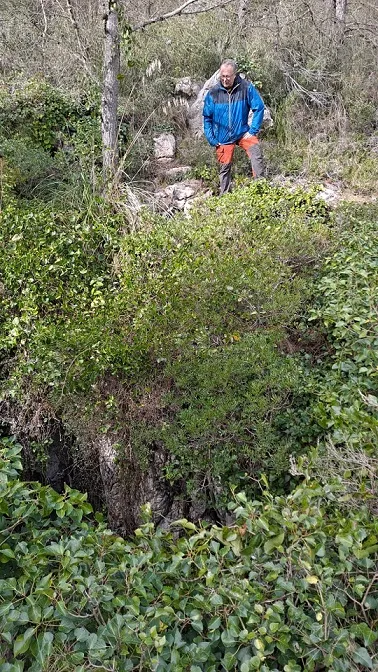
Avenc de la Figuerota
0.8 km · N
Olesa de Bonesvalls (Alt Penedès)
1 topo.1 photos
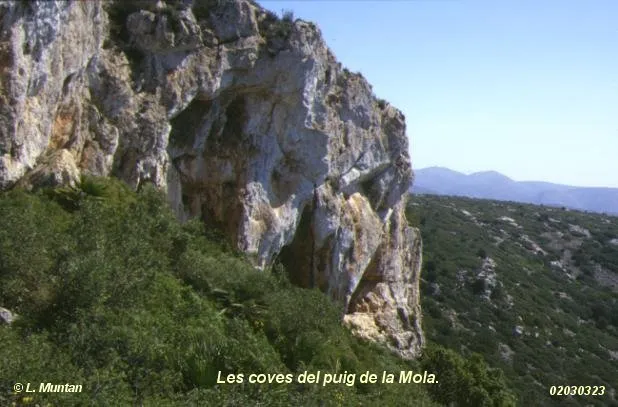
Balmes del Puig de la Mola
0.9 km · SE
Olivella (Garraf)
1 topo.1 photos
Source: Espeleoindex (espeleoindex.com), modified. CC BY-NC 4.0, https://creativecommons.org/licenses/by-nc/4.0/