
Avenc d'en Roca
A 56-metre-deep pit in Cervelló, with a rich speleological past since 1907 and troglobitic fauna.
EspeleoWorld
Avenc d'en Roca
A 56-metre-deep pit in Cervelló, with a rich speleological past since 1907 and troglobitic fauna.
Cervelló · Baix Llobregat
Length: 136 m · Depth: 56 m
Updated record
https://espeleoworld.com/en/c/avenc-d-en-roca
Information can change. Always verify coordinates, access, weather, and cave conditions before setting out.
A 56-metre-deep pit in Cervelló, with a rich speleological past since 1907 and troglobitic fauna.
Topographic
Espeleoindex · CC BY-NC 4.0, https://creativecommons.org/licenses/by-nc/4.0/ · Image © its author.
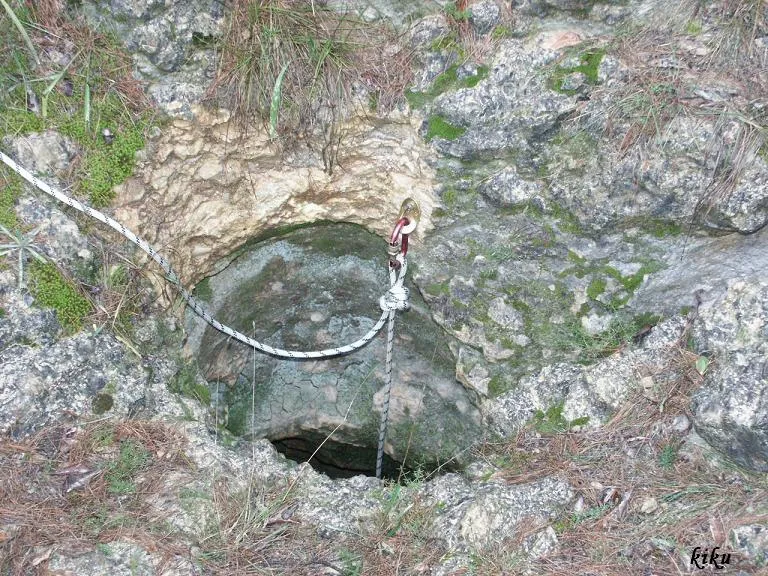
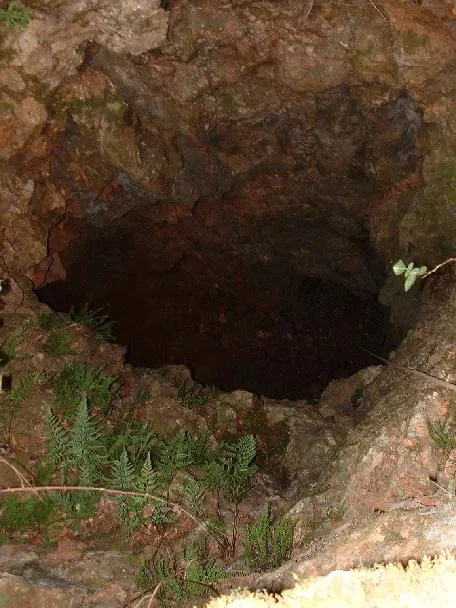
Photos
Espeleoindex · CC BY-NC 4.0, https://creativecommons.org/licenses/by-nc/4.0/ · Image © its author.
Description
Morphology
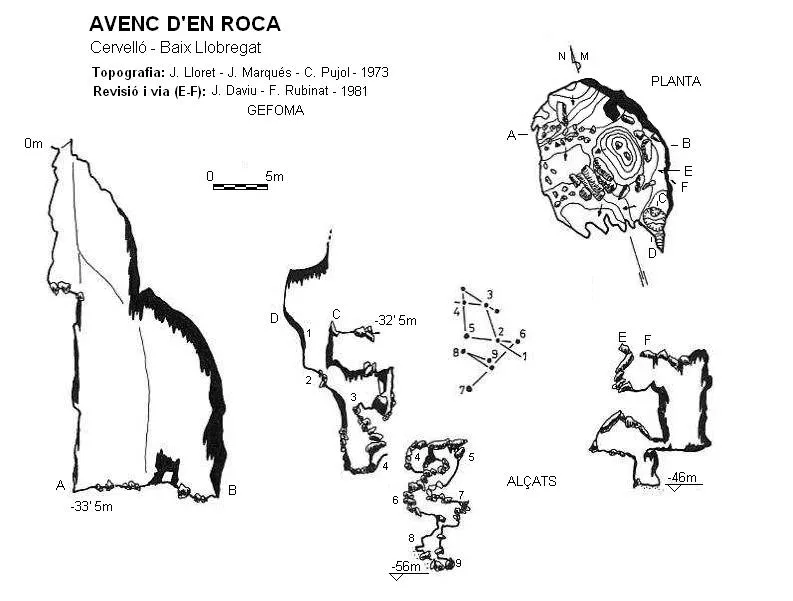
A 13-metre shaft places us on a 3 x 4 metre ledge; a further vertical drop of 19 metres leaves us in a room of 14 x 16 metres with a maximum height of 20 metres, which is heavily decorated with concretions.
At its southern end a three-metre shaft leads us to a series of steps that, among blocks, places us at the -56 metre level. Near this route, about 8 metres away and at the foot of the East wall, there is another access which, by means of various steps, places us at a depth of -46 metres.
History
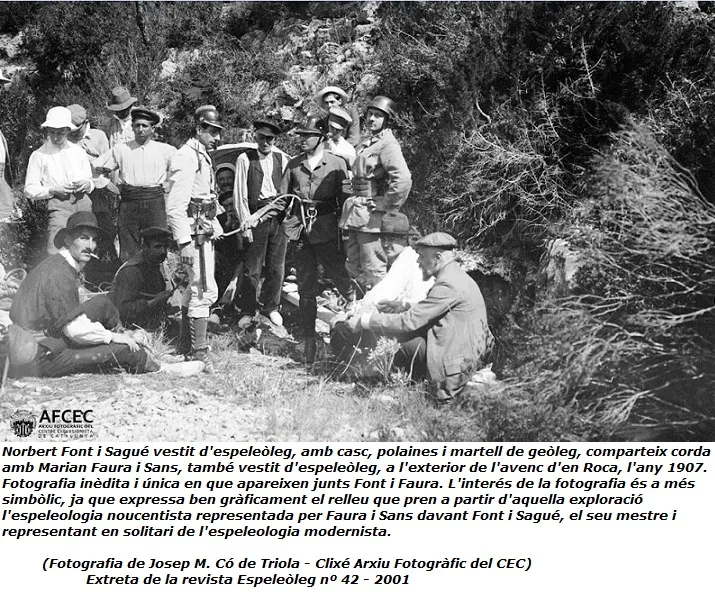
In mid-August 1907, Serafí Alemany, a farmer from l'Ordal, remarked to Antoni Mir, of Can Guineu (Sant Sadurní d'Anoia), that some 35 years earlier he had seen a pit in the Sot d'Agulles that seemed important. Mir, a close friend of Faura i Sans, told him about it, and on the 26th of the same month the three of them went to the entrance and proceeded to make a sounding, agreeing to carry out the exploration a few days later, specifically on 4 September.
When that day arrived, some 50 people gathered around the entrance, members of the Club Muntanyenc and various people from the area. The explorers were: M. Faura i Sans, J. M. Có de Triola, Dr. B. Serradell, A. Santamaria, P. Obiols and some others. When some were on the first ledge, Mn. Font i Sagué arrived, who soon joined them, and Faura offered him the honour of being the first to descend the rest of the shaft. This was Font's last exploration and the only one in which Faura and Font were together.
Ten years later, specifically on 9 November 1917, on the initiative of Faura and Dr. Zariquiey, they decided to commemorate the 10th anniversary of the first exploration, this time carried out from the Centre Excursionista de Catalunya, and they carried out the second exploration.
Around 1935 and the first months of 1936, the Secció de Ciències of the Club Muntanyenc Barcelonès, under the direction of N. Llopis Lladó, organised a whole series of investigations in the area of Vallirana and l'Ordal and again visited the avenc d'en Roca.
From 1949 onwards, the recently created GES – CMB began to visit the cavity very often, and all subsequent generations made it a classic up to the present day.
Around the 1970s, the extractive activity of a quarry (in fact there are two) began in the whole N – NE sector of the coll de l'Ordal, and year after year the quarry face drew closer to the avenc d'en Roca. Even when there were blasts, some stones came quite close to the entrance. Around 1990, the Federació Catalana made some timid approaches to the ajuntament de Cervelló and the response, more or less, was: Don't worry!
By 2016, the ajuntament de Cervelló received an application for permission to extend the extraction area. Faced with this, the village mobilised and obtained the calling of a popular consultation against the extension. The NO to the quarry won by a large margin. At the same time, the Federació Catalana d'Espeleologia created a commission in defence of the avenc d'en Roca and issued a conclusive report, further endorsed by some scientific institutions.
More than 8 years have passed and we ask ourselves: Can we continue without worrying?
As our colleague Enric Porcel informs us, subsequently and at the request of the ERC municipal group of Cervelló, a proposal was submitted calling for a 50-year moratorium on granting new permits for new quarries and for the extension of existing ones, which was approved by the Ple Municipal and is so recorded in the minutes.
Bio
Insecta / Coleoptera / Leiodidae
- Troglocharinus ferreri ferreri (Reitter, 1908)
This beetle is the most emblematic and abundant in the cavities of the Garraf – Ordal. It was collected, among other fauna, by Faura on the day of the first exploration. All this material was handed over to the naturalist Felip Ferrer i Vert (1880-1956) for assessment. Ferrer showed interest in that beetle and sent a specimen, not in very good condition, to Edmund Reitter (1845-1920), an Austrian entomologist who described it under the name Troglophyes (Troglocharinus) ferreri. He placed it within the already existing genus Troglophyes and created a new subgenus: Troglocharinus. Regarding ferreri, Reitter dedicated it to Felip Ferrer as the person who brought to his hands the female specimen that served him to make the description. Would you believe it, Ferrer, acting as intermediary, took the honours.
Felip Ferrer had a modest taxidermy shop in plaça Reial, where he also mingled with many naturalists and entomologists in the well-known gatherings held in the back room. One of the regular attendees was Àngel Lagar. Do not confuse this shop with Dr. Soler's large one, which was active until the end of the 20th century and where the restaurant El Taxidermista was later housed for some years.
We have evidence of other collections of specimens of Troglocharinus in the cavity:
134 specimens by Zariquiey on 4/ XI / 1917
1 specimen by F. Porta in December 1962
1 specimen by R. Viñas in June 1963
42 specimens by O. Escolà on 17 / XI / 1963
49 specimens by J. Pere in December 1965
User Comments (0)
No comments yet.
Be the first to share your experience!
Registered Explorations (0)
No explorations registered yet.
Register your visit to this cave!
Bibliography
- Aragonès i Valls, Enric (2010).- “ N. Font i Sagué i el Club Muntanyenc (1907-1909)” Muntanya (888): 6-11. Centre Excursionista de Catalunya.
- Aragonès i Valls, Enric (2010).- “Primera exploració de l'avenc d'en Roca” Muntanya (888): 12. Centre Excursionista de Catalunya.
- Escolà, Oleguer (1969).- “La contribució dels espeleòlegs al coneixement del gènere Troglocharinus Reitt.” Espeleòleg (8): 293-301. ERE – CEC
- Faura i Sans, Marià (2010).- “¡Un altre avenc! Muntanya (888): 13-17. Centre Excursionista de Catalunya.
- Ferrer, Victor (2006).- Avencs de Garraf i d'Ordal : 152 pp. Edició de l'autor. Barcelona.
- Font i Sagué, Norbert (1907).- “L'Avenc d'en Roca”. Sota Terra I: 53-63. Club Montanyenc. Barcelona.
- Llopis Lladó, N. (1941).- “Morfología e hidrología subterránea de la parte oriental del macizo kárstico de Garraf (Barcelona)” Estudios Geográficos 2 (4): 413-466. Madrid
- Lloret Prieto, J (1974).-“El avenc d'en Roca” GOURS (2):43-47. GEFOMA. Barcelona.
- Rubinat, F. (1981).-“Catàleg Espeleològic del Massís de Garraf. Unitat septentrional”. GOURS (8):45-75. GEFOMA. Barcelona.
- Rubinat, F. (2004).-“Catàleg Espeleològic del Massís de l'Ordal”. Espeleosie (monogràfic):1-117. SIE-CE Àliga. Barcelona.
- Valles, Jordi de (2017).- Catàleg Espeleològic de Catalunya: Baix Llobregat. Volum 6: 468 pp. Espeleo Club de Gràcia / Federació Catalana d'Espeleologia. Barcelona.
- Vives, Salvador (1972).- “Topografies subterrànies al C E de Terrassa”. Comunicaciones del 2º Simposium de Metodología Espeleológica. SIE – CE Àliga. Barcelona.
- Actualització de la fitxa i ampliació de dades (juny 2024) incloent totes les topografies que coneixem, inclosa una d'inèdita de finals de 1954 trobada a l'arxiu ERE – CEC.
- Fotografies de la primera exploració extretes de l'Arxiu Fotogràfic del CEC. Recull de fotografies de diferents autors.
Nearby caves


Source: Espeleoindex (espeleoindex.com), modified. CC BY-NC 4.0, https://creativecommons.org/licenses/by-nc/4.0/