
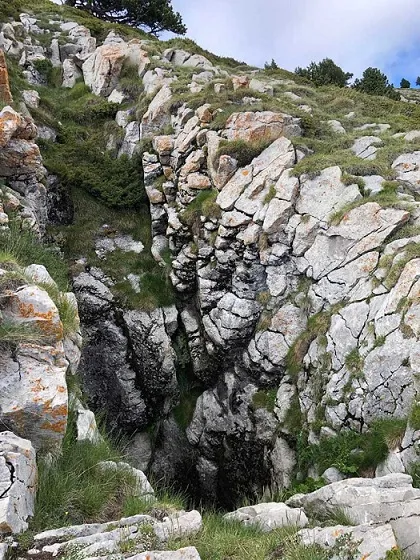
Grallera Gran del Boixeder
An 81 m deep pit in the Serra del Cadí, accessed from Josa del Cadí via the coll de Jovell and the GR 150.1.
EspeleoWorld
Grallera Gran del Boixeder
An 81 m deep pit in the Serra del Cadí, accessed from Josa del Cadí via the coll de Jovell and the GR 150.1.
Josa i Tuixén · Alt Urgell
Sviluppo: 100 m · Profondità: 81 m
Scheda aggiornata
https://espeleoworld.com/it/c/grallera-gran-del-boixeder
Le informazioni possono cambiare. Verifica sempre coordinate, accesso, meteo e condizioni della cavità prima di partire.
An 81 m deep pit in the Serra del Cadí, accessed from Josa del Cadí via the coll de Jovell and the GR 150.1.
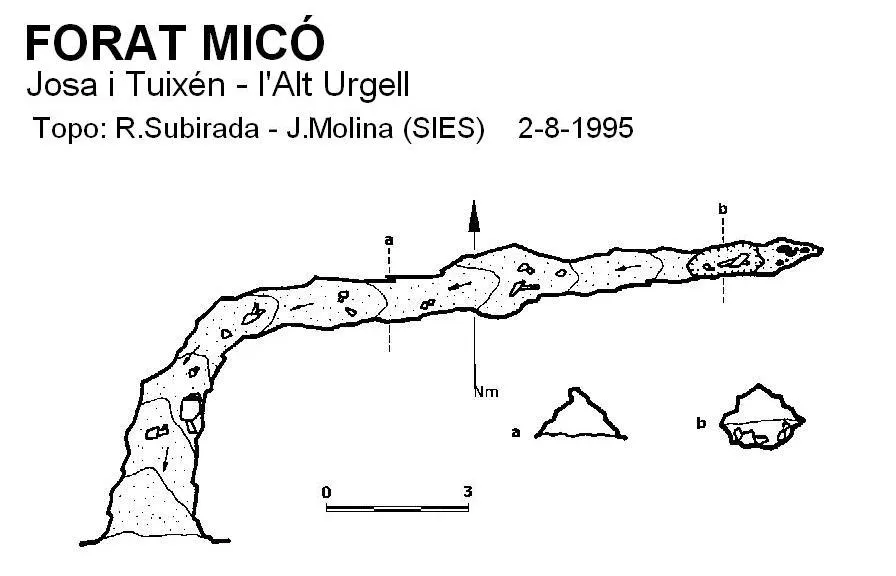
Topografia
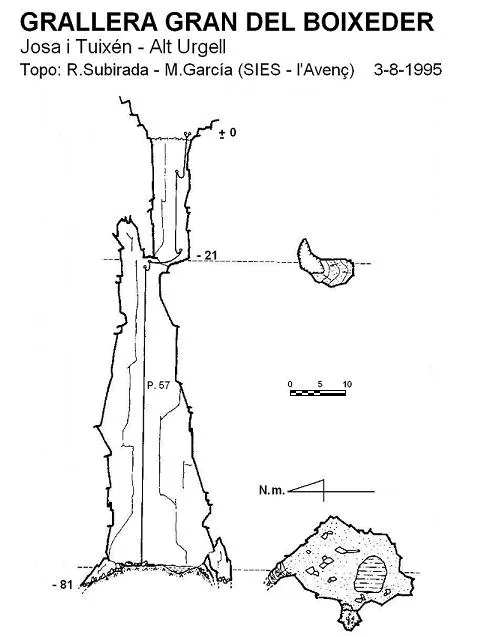
Espeleoindex · CC BY-NC 4.0, https://creativecommons.org/licenses/by-nc/4.0/ · Immagine © del suo autore.
Foto
Espeleoindex · CC BY-NC 4.0, https://creativecommons.org/licenses/by-nc/4.0/ · Immagine © del suo autore.
Descrizione
Morfologia
If we look at the entrance, with the south at our back, we will find the rigging and some remains of red paint on a block to the right of the wide entrance, about four metres in diameter.
Descending through the entrance we will go into a beautiful cylindrical shaft covered in moss that is slippery as anything. These mosses give it a bucolic appearance.
At the base of the shaft we find a ledge full of jackdaw guano, where we will also find an espit that will allow us to rig a rebelay, and access the head of the second and last shaft, 57 metres of free-hanging descent in almost its entirety, with widths of up to 10 metres. Along the shaft we find some quite generous formations, as well as some unknowns on the walls of the shaft of possible continuations, which in the future will require a pendulum or handline to access.
At the base of the shaft we will find a large quantity of guano (in some places it covers up to half a leg), as well as a water deposit.
At the ends of this shaft, two descending passages lead us to the maximum depth of 81 metres.
It should be noted that thanks to the wide entrance, and the “perfection” of the tube that forms the pit, natural light penetrates very far down, allowing one to enjoy more than generous visibility to quite a few metres of depth.
Concrezioni
Along the shaft we find some quite generous formations.
Idrologia
At the base of the shaft we will find a large quantity of guano (in some places it covers up to half a leg), as well as a water deposit.
Progressione
Attention must be paid to rubbing and a couple of rope protectors must be placed, since the rigging is situated in such a way that it cannot be avoided.
At the base of the shaft we find a ledge full of jackdaw guano, where we will also find an espit that will allow us to rig a rebelay, and access the head of the second and last shaft, 57 metres of free-hanging descent in almost its entirety, with widths of up to 10 metres.
Along the shaft we find some quite generous formations, as well as some unknowns on the walls of the shaft of possible continuations, which in the future will require a pendulum or handline to access.
At the ends of this shaft, two descending passages lead us to the maximum depth of 81 metres.
Altri dettagli
It should be noted that thanks to the wide entrance, and the “perfection” of the tube that forms the pit, natural light penetrates very far down, allowing one to enjoy more than generous visibility to quite a few metres of depth.
Storia
During the fever for the search for the phantasmagorical gouffre de la Sorcière (S.C. De Saint-Pons, 1964), there were many sweeps made in the following years across the serra del Cadí.
One of the first was led by Francisco (Helios) Chavarria (GES - CMB), Oleguer Escolà (ERE – CEC) and A. Escolà, Oleguer's father, who went along as a companion.
We will give an extract from the account that our friend Escolà has told us many times with his peculiar narrative style. On 27 to 29 June 1965 they decided to make an excursion through the upper area of the Cadí and try to see what the toponym gralleres was about, which appeared on the Alpina map and about which they had been informed previously at Josa. After completing the approach, they first descend the grallera petita and then immediately undertake the descent of the grallera gran. It should be said that for equipment they carried a 20-metre elektron ladder and a rope, supposedly 60 metres. With the ladder they reach the 20-metre ledge, but the shaft continues down. They tie the rope to the end of the ladder and Chavarria decides to do a rappel, but ... ¿Cómo subiggué, Oleguer?. The latter takes from his bag a set of jumars (devices that Chavarria had never seen in his life) that Joan Antoni Raventós had brought the previous year from a study trip to the United States. Oleguer gives him a brief explanation of how they work and Chavarria goes down the shaft. When he sees that the rope is running out, he calculates that he is about 6 metres short of reaching the bottom and decides to go back up. He installs the jumars and after a while, Oleguer hears from the ledge: ! Oleguer, egsto no sube!. Shouting, he explains again how they should be put on, but nothing, it did not work. All this aggravated by the electric headlamp that only turned on at intervals by dint of blows. The minutes pass and nothing, Chavarria down there hanging like a whip. Meanwhile, Oleguer hears that his father is talking with someone, goes up to the entrance and finds two shepherds who were grazing in those parts. He asks for help so that, among all four, they can “haul up” the ladder, the rope and Chavarria at the end. But nothing, after a first failed attempt, the shepherds vanish. He goes back down to the ledge to continue giving instructions and after quite a while hears: ! Buggo, migga que soy buggo! !Oleguer, ya subo! (naturally we have omitted all the curses that accompany the dialogue). When he reaches the ledge he explains himself; it turns out that in the dark he had put the lower jumar on the loops of the upper one and not on the rope. After almost an hour hanging, in a flash of light from the headlamp he had noticed the terrible error. This account is one more demonstration of all that should never be done in an exploration.
It seems that the following year there was a new failed attempt to descend the shaft by members of the Agrupació Científico Excursionista de Mataró. It is not until August 1968 that, in a brief campaign by the SIRE – UEC Sants, the whole pit is explored and a very schematic survey is made that places the maximum depth at 87 metres.
No further news of any other visit is had until August 1995, when during one of their campaigns in the Moixeró – Cadí, members of the SIES – l'Avenç (Esplugues de Llobregat) explore it again and make a more complete and precise survey, which, however, remained unpublished until Jordi de Valles rediscovered it in the SIES archive and it was published in the second volume of his Catàleg (2009).
Commenti degli utenti (0)
Nessun commento ancora.
Sii il primo a condividere la tua esperienza!
Esplorazioni registrate (0)
Nessuna esplorazione registrata.
Registra la tua visita a questa grotta!
Bibliografia
- Cot, M.P. (1967).- “Cadí”. Circular Agrupació Científico Excursionista de Mataró (4): 4-5. Mataró.
- Escolà, O. (1965).- “Noticia”. Cavernas (6): 197. Grup d'Espeleologia de Badalona.
- Miñarro, JM. (1972).- “Graller del Boixader”. EspeleoSie (12): 5-9. SIE del centre Excursionista Àliga. Barcelona.
- Borràs, J.; Miñarro, JM.; Talavera, F. (1978).-Catàleg Espeleològic de Catalunya. (L'Alt Urgell i la Cerdanya). Vol. 1: 166 pp. Políglota. Barcelona.
- Valles, J. de (2009).-Catàleg Espeleològic de Catalunya. Vol. 2 (Alt Urgell): 384 pp. Espeleo Club de Gràcia / Federació Catalana d'Espeleologia. Barcelona.
- Fitxa actualitzada el juliol de 2020. Fotografies de Marc Estrada Mirabent. Altres dades facilitades per Albert Caellas Cardona (http://relleus.cat) i (espeleologiacatalunya.com/alt-urgell/grallera-gran-del-boixeder).
Grotte vicine


Fonte: Espeleoindex (espeleoindex.com), modificato. CC BY-NC 4.0, https://creativecommons.org/licenses/by-nc/4.0/