
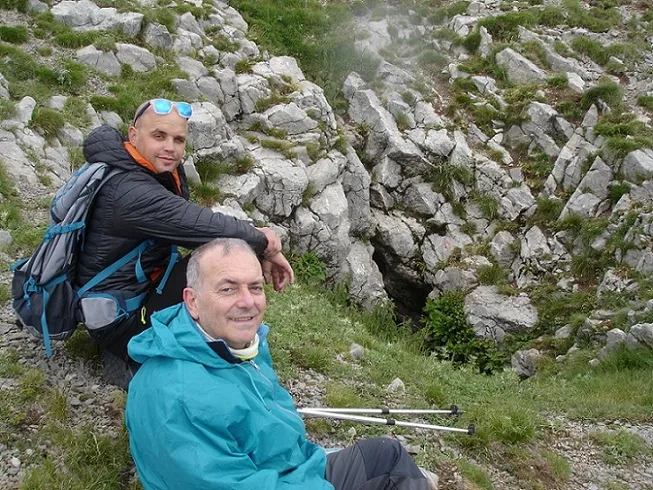
Grallera Gran de Cornellana
A 42 m deep pit in the Cadí, in la Vansa i Fórnols, with a 25 m shaft divided into two sections and a maximum drop of -41.50 m.
EspeleoWorld
Grallera Gran de Cornellana
A 42 m deep pit in the Cadí, in la Vansa i Fórnols, with a 25 m shaft divided into two sections and a maximum drop of -41.50 m.
Vansa i Fórnols, La · Alt Urgell
Sviluppo: 65 m · Profondità: 42 m
Scheda aggiornata
https://espeleoworld.com/it/c/grallera-gran-de-cornellana
Le informazioni possono cambiare. Verifica sempre coordinate, accesso, meteo e condizioni della cavità prima di partire.
A 42 m deep pit in the Cadí, in la Vansa i Fórnols, with a 25 m shaft divided into two sections and a maximum drop of -41.50 m.
Topografia
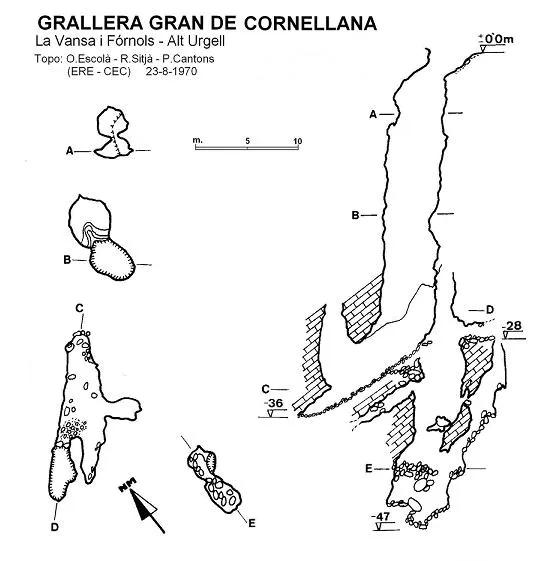

Espeleoindex · CC BY-NC 4.0, https://creativecommons.org/licenses/by-nc/4.0/ · Immagine © del suo autore.
Foto

Espeleoindex · CC BY-NC 4.0, https://creativecommons.org/licenses/by-nc/4.0/ · Immagine © del suo autore.
Descrizione
Morfologia
A depression at the Prat Nabiral gives way to a 25 metre deep shaft, divided into a first small pit of -12.30 that leaves us on a ledge full of chough excrement and with some nests of these birds on the walls. From this point a steep ramp gives access to the second section of the shaft, which has a depth of -9 metres.
Having descended this shaft, we find a ramp also full of excrement and small blocks. In a Westerly direction we find a small hollow where water sometimes accumulates. In a SE direction we find a gallery of about 8 metres, with a very low ceiling, which ends blocked by debris. To the NE we find an interesting shaft of -9 metres depth and about 4 metres in diameter.
In front we see a window that gives onto the base of a shaft. Having descended the aforementioned P-9 and passing beside a large precariously wedged block, we reach the base of a shaft where the floor is formed of large blocks. The chamber is 5X2 metres; if we go towards the North, we will see a small window through which, by an ascending crawl, one reaches the base of a shaft. This one could not be accessed due to its narrowness. On the floor we observe a small pit between blocks (P-3.60) that leads us to a lower chamber, formed beneath the aforementioned blocks and with no apparent continuation. Here the maximum drop of the Grallera occurs: -41.50 metres.
Idrologia
In a Westerly direction we find a small hollow where water sometimes accumulates.
Progressione
A depression at the Prat Nabiral gives way to a 25 metre deep shaft, divided into a first small pit of -12.30 that leaves us on a ledge. From this point a steep ramp gives access to the second section of the shaft, which has a depth of -9 metres. Having descended this shaft, we find a ramp also full of excrement and small blocks. In a SE direction we find a gallery of about 8 metres, with a very low ceiling, which ends blocked by debris. To the NE we find an interesting shaft of -9 metres depth and about 4 metres in diameter. In front we see a window that gives onto the base of a shaft. Having descended the aforementioned P-9 and passing beside a large precariously wedged block, we reach the base of a shaft where the floor is formed of large blocks. The chamber is 5X2 metres; if we go towards the North, we will see a small window through which, by an ascending crawl, one reaches the base of a shaft. This one could not be accessed due to its narrowness. On the floor we observe a small pit between blocks (P-3.60) that leads us to a lower chamber, formed beneath the aforementioned blocks and with no apparent continuation. Here the maximum drop of the Grallera occurs: -41.50 metres.
Storia
The first report about the cavity is given by Oleguer Escolà in a brief note in Cavernas no. 6, where he says that, among other cavities, they located it at the end of June 1965, on one of the many outings in search of the phantom gouffre de la Sorcière. Later, the same Escolà writes that, with a speleologist from Terrassa, he relocated it at the end of July 1970. Finally, together with other companions from the ERE – CEC they carry out the first exploration on 23 August 1970.
In 2013, members of the GEB and the ECG make an unsuccessful attempt to locate it, but it is not until 2016 that two members of the GEB finally locate it. Already in 2017 other members of the Badalona group pay a visit. In October of the same year 2017, members of various clubs (GEB, BIOSP, SIS, SIE) explore it and carry out a new survey. These decide to change the name given by the first explorers of the cavity “Grallera de Cornellana”, for that of “Grallera de Prat Nabiral”, since toponymically they consider it more appropriate. Bearing in mind that the cavity is known by the people of the area under the generic name of “la Grallera”, we consider it more convenient to continue cataloguing it with the name given to it by its first explorers and thus avoid possible confusions.
Note biospeleologiche
Collected on 23-8-1970:
Coleoptera:
Timarcha
Abax pyrenaeus
Leiocnemis espagnoli Vives, 1971
Zabrus(Iberozabrus) curtus Serv.
Coccinella septempunctata L.
Diptera:
Niphadobata catalonica Bourne, 1979
Gastropoda:
Abida secale andorrensis(Bourg.)
Cocclostoma (Obscurella) ess-eranum (Fgt.)
Both in the 1970 exploration and in that of 2017 different samples of fauna were collected, although of all of them only the presence of an apterous dipteran (that is, a species of wingless fly with a trogloxene character) need be highlighted: Chionea alpina, formerly known as Niphodobata catalonica. (O. Escolà; F. Fadrique and J. Pallisé).
Commenti degli utenti (0)
Nessun commento ancora.
Sii il primo a condividere la tua esperienza!
Esplorazioni registrate (0)
Nessuna esplorazione registrata.
Registra la tua visita a questa grotta!
Bibliografia
- Borràs, J.; Miñarro,JM.; Talavera, F: (1978).- Catàleg espeleològic de Catalunya. Vol. 1 (l'Alt Urgell i la Cerdanya): 166. Ed. Políglota. Barcelona.
- Escolà, O. (1991).- “La Grallera Gran de Cornellana” Espeleòleg (39): 23-24. ERE – Centre Excursionista de Catalunya. Barcelona.
- Coordenades, dades, topografia actualitzades i fotos extretes del web del Grup Espeleològic de Badalona (www.geb.cat) apunt del dia 22-12-2017. Text: Enric Porcel; apunts biospeleològics i climàtics: Joan Pallisé; Fotografies: Josep Cuenca, Ramon Sendra, Eduard Badiella, F. Xavier Samarra, Maria I. Alonso.
Grotte vicine
Grallera Petita de Cornellana
0.2 km · E
Vansa i Fórnols, La (Alt Urgell)
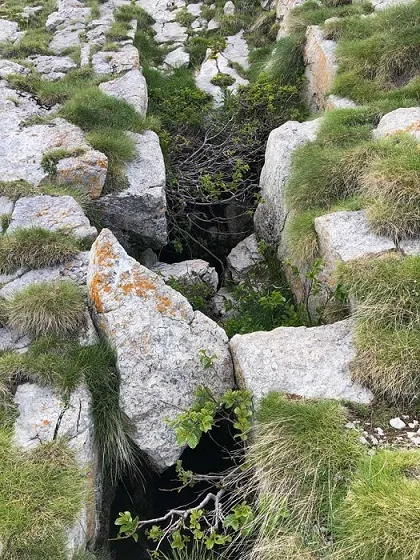
Grallera Petita del Boixeder
2.0 km · E
Josa i Tuixén (Alt Urgell)
1 topo.1 foto
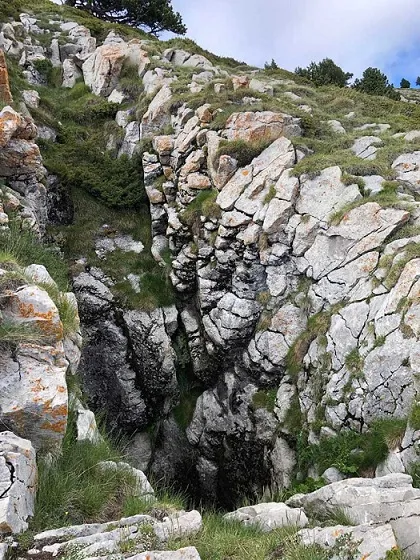
Grallera Gran del Boixeder
2.0 km · E
Josa i Tuixén (Alt Urgell)
2 topo.5 foto
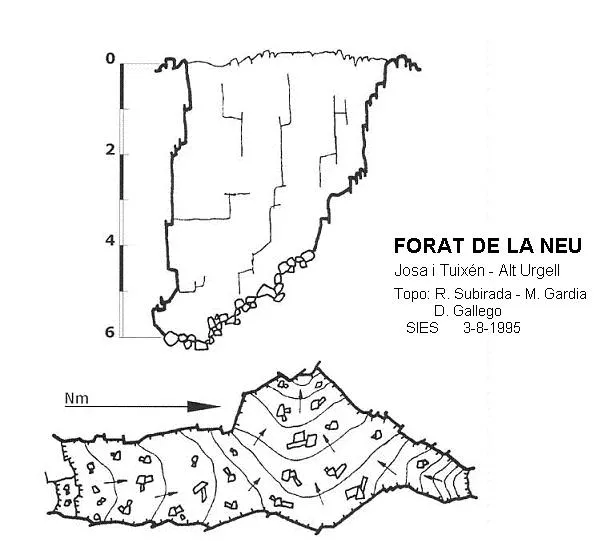
Forat de la Neu
2.9 km · E
Josa i Tuixén (Alt Urgell)
1 topo.
Fonte: Espeleoindex (espeleoindex.com), modificato. CC BY-NC 4.0, https://creativecommons.org/licenses/by-nc/4.0/