
Forat de les Gralles d'espot
A 46 m deep pit of biospeleological interest in Espot (Pallars Sobirà), opened in a doline in Devonian calcschists, with an important clastic process and a snow ramp that reaches 30 m depth.
EspeleoWorld
Forat de les Gralles d'espot
A 46 m deep pit of biospeleological interest in Espot (Pallars Sobirà), opened in a doline in Devonian calcschists, with an important clastic process and a snow ramp that reaches 30 m depth.
Espot · Pallars Sobirà
Sviluppo: 80 m · Profondità: 46 m
Scheda aggiornata
https://espeleoworld.com/it/c/forat-de-les-gralles-d-espot
Le informazioni possono cambiare. Verifica sempre coordinate, accesso, meteo e condizioni della cavità prima di partire.
A 46 m deep pit of biospeleological interest in Espot (Pallars Sobirà), opened in a doline in Devonian calcschists, with an important clastic process and a snow ramp that reaches 30 m depth.
Topografia
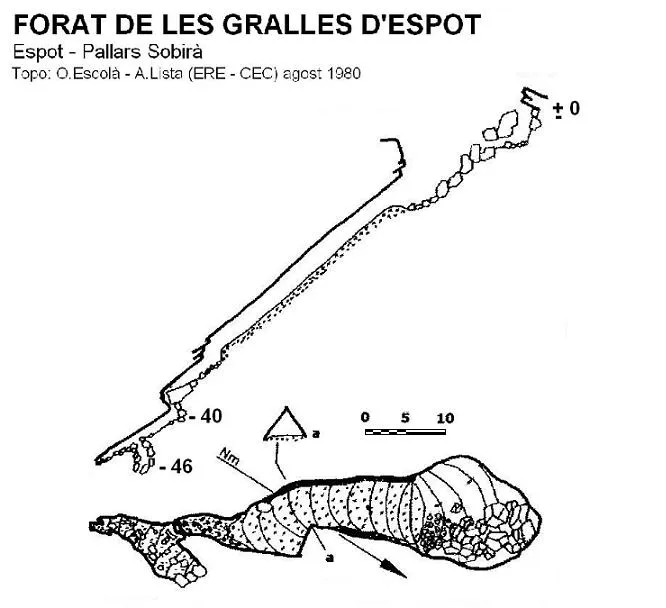
Espeleoindex · CC BY-NC 4.0, https://creativecommons.org/licenses/by-nc/4.0/ · Immagine © del suo autore.
Descrizione
Morfologia
The cavity opens in a collapse doline that continues excavated taking advantage of the stratification plane in Devonian calcschists.
From the entrance one can descend among grasses and mosses to the snow bank, where a snow ramp begins that reaches 30 metres depth. At the point where the snow ends, an important clastic process is exposed with blocks of considerable sizes. It is precisely through a narrow passage that remains between the largest block and the wall that the cavity continues. A small shaft is formed that can be overcome by opposition and that leads out into the ceiling of a ramp room, also full of blocks of different sizes. Penetrating among these blocks one can reach the point of maximum drop at the level – 46.
It seems to be a sinkhole taking advantage of the inclination of the strata as well as a fracture of NNW-SSE direction. The clastic processes are important and falls from the ceiling of large stretches of strata can be observed.
Idrologia
In years of great snowfalls the cavity can become totally buried by snow.
Progressione
From the entrance one can descend among grasses and mosses to the snow bank, where a snow ramp begins that reaches 30 metres depth. At the point where the snow ends, an important clastic process is exposed with blocks of considerable sizes. It is precisely through a narrow passage that remains between the largest block and the wall that the cavity continues. A small shaft is formed that can be overcome by opposition and that leads out into the ceiling of a ramp room, also full of blocks of different sizes. Penetrating among these blocks one can reach the point of maximum drop at the level – 46.
Storia
The first exploration took place in August 1980 by O. Escola and A. Lista (ERE – CEC) based on information provided by a person from the small village of Escart. They made the survey and the faunal collection turned out to be null.
Years later, between November 1988 and October 1990, the biospeleologists J. Fresneda and C. Hernando made three visits to the cavity and managed to capture a new species of beetle.
Note biospeleologiche
Beetles.
- Speonomus kriophilos n sp. (Fresneda and Hernando, 20-10-1990)
Commenti degli utenti (0)
Nessun commento ancora.
Sii il primo a condividere la tua esperienza!
Esplorazioni registrate (0)
Nessuna esplorazione registrata.
Registra la tua visita a questa grotta!
Bibliografia
- Fresneda, J.; Hernando, C. (1991).- “Speonomus kriopilos n sp. (Coleoptera, Cholevidae) nuevo Bathysciinae del Pirineo Catalán”. Ilerda, Ciències (49): 259-264. Lleida.
- Valles, J. de (2008).- “Catàleg Espeleològic de Catalunya”. Vol. 1: 319 pp. Espeleo Club de Gràcia / Federació Catalana d'Espeleologia. Barcelona.
- Dades inèdites extretes d'un document aportat pels seus primers exploradors, Oleguer Escolà i Antoni Lista (ERE – CEC). Situació facilitada pel mateix Oleguer Escolà.
Grotte vicine

Fonte: Espeleoindex (espeleoindex.com), modificato. CC BY-NC 4.0, https://creativecommons.org/licenses/by-nc/4.0/