
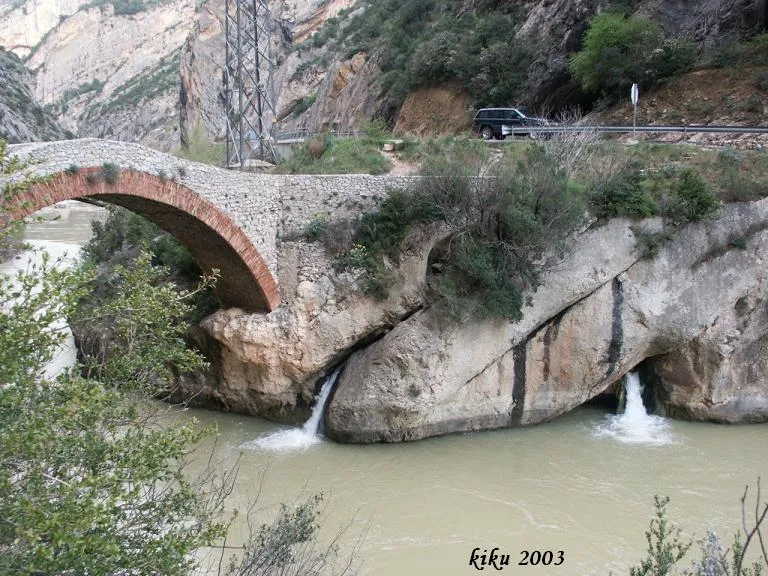
Forat de l'Or
Important spring of 2,213 m of passage in the Terradets gorge (Camarasa), with 1,400 m submerged when in flood and a vertical range of 93.5 m.
EspeleoWorld
Forat de l'Or
Important spring of 2,213 m of passage in the Terradets gorge (Camarasa), with 1,400 m submerged when in flood and a vertical range of 93.5 m.
Camarasa · Noguera
Sviluppo: 2213 m · Profondità: 93 m
Scheda aggiornata
https://espeleoworld.com/it/c/forat-de-l-or
Le informazioni possono cambiare. Verifica sempre coordinate, accesso, meteo e condizioni della cavità prima di partire.
Important spring of 2,213 m of passage in the Terradets gorge (Camarasa), with 1,400 m submerged when in flood and a vertical range of 93.5 m.
Topografia
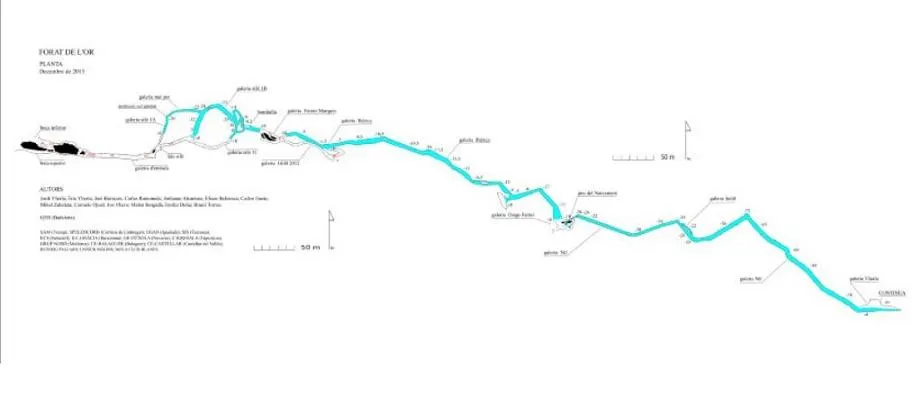
Espeleoindex · CC BY-NC 4.0, https://creativecommons.org/licenses/by-nc/4.0/ · Immagine © del suo autore.
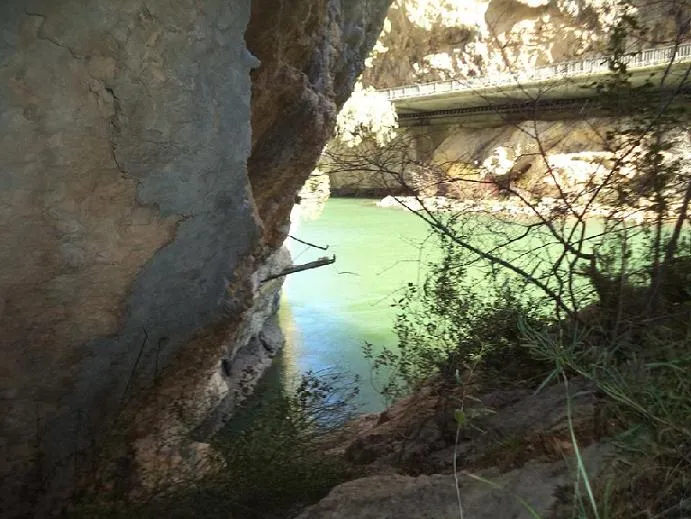
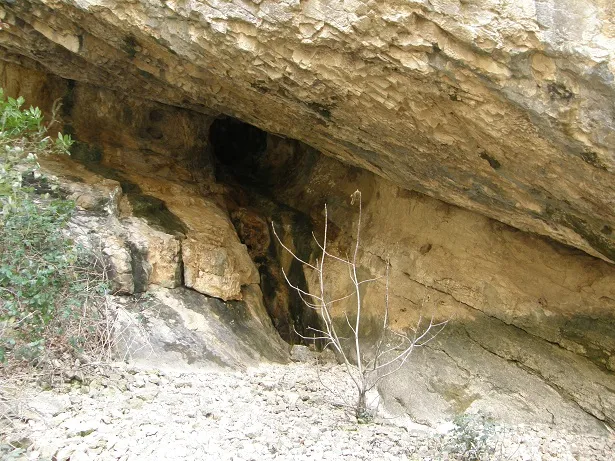
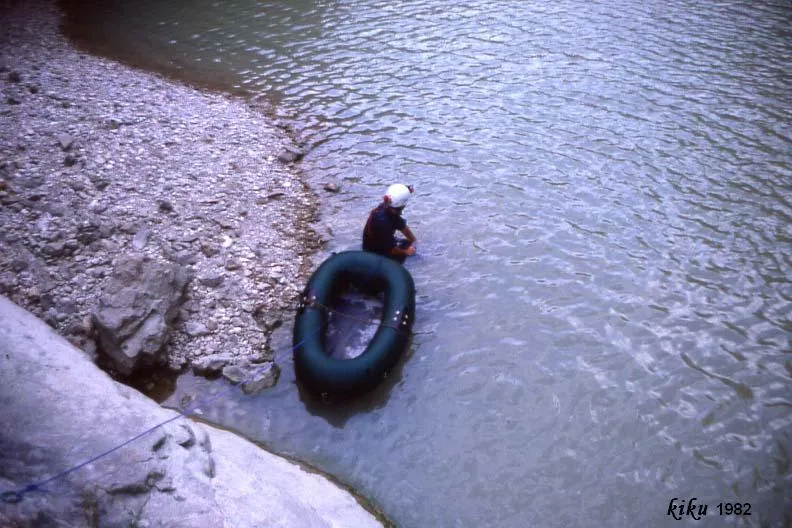
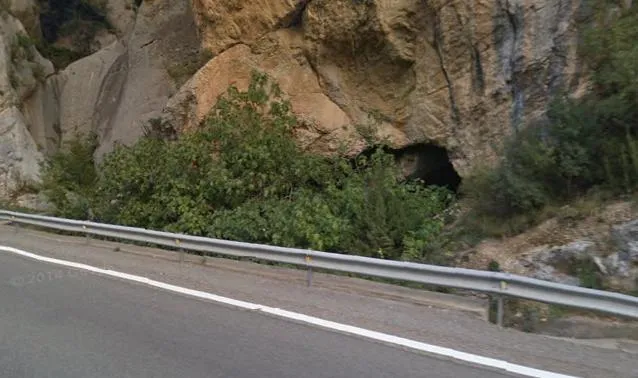
Foto
Espeleoindex · CC BY-NC 4.0, https://creativecommons.org/licenses/by-nc/4.0/ · Immagine © del suo autore.
Descrizione
Morfologia
The two entrances of the cave open on an inclined bedding plane; from these emerge two galleries that connect after 37 metres by means of a low passage. The lower gallery, which is the one that acts as a spring, can still be followed for about fifteen metres until it becomes extremely narrow. Through the upper gallery one can progress for 40 metres along a conduit that in some places becomes somewhat narrower, until it meets the gallery that leads to the spring. The gallery continues for 82 metres; at this point is the first sump when it is at its highest, since it is a temporary sump. This can be passed in times of flood by an elevated passage, although after a few metres it sumps again. At times when the sump is at its lowest, one passes through the lower part of this double conduit since it is a false sump, finding two galleries, one on the left that descends steeply for some 20 metres of passage until reaching the water, (sump 1A on the survey); in this conduit there are abundant sand sediments that at some times almost fill the gallery. The gallery on the right, which we can consider the main gallery, descends gently for 40 metres until reaching the sump (sump 1B) located at -14 metres relative to the cave entrance; at this point on the right side of the gallery we find a conduit of smaller dimensions, which we can follow for 65 metres; this first rises and then descends until reaching a new sump (sump 1C). Starting the dive through sump 1B, which is the main gallery, this descends rapidly; on reaching -22 metres we find that the gallery coming from sump 1A arrives from the left; the gallery continues descending until reaching -33 metres (-47 metres when the cave is in flood). From this point the gallery begins to ascend; on reaching -16 metres we find that the gallery is crossed by the gallery coming from sump 1C; at -11 metres we again meet the previous gallery after it has made a 180º turn; at -9 metres we find a new gallery also coming from a branch of sump 1C; immediately afterwards one reaches an air bell, and a little further on one emerges into an air-filled gallery, Galeria Ferran Marqués, 62 metres long. At the end of this we find two continuations, an upper one that is air-filled, Galeria GEB 2012, and a lower one, Galeria Ibèrica, which sumps again. Continuing along the Galeria GEB 2012, we can follow it for a passage of 214 metres and a vertical range of +20.5 metres; at this point a section of the gallery ends at a point pending exploration while another section continues descending to end up meeting the water again at the Galeria Ibèrica about fifty metres from its start. Entering via the Galeria Ibèrica and once the connection with the Galeria GEB 2012 has been passed, this descends to the -19.5 metre level, then rises again until reaching the -5 metre level; at this point and following a few metres to the right we emerge into an air bell. Continuing again along the gallery, this descends again until reaching the -17 metre level, then rises again to the 0 metre level after having covered the 422 metres of the Galeria Ibèrica. Once we have reached the 0 metre level we enter a new air-filled gallery, the Galeria Diego Ferrer, 34 metres long; in this gallery one must climb a little to the access to the Pou del Naixement, (S3); to reach it at low level, one must install a ladder or else stirrups in order to overcome the distance of one and a half metres until reaching the water. The shaft descends rapidly to its base, located at -22 metres; here begins the Galeria Nil, which soon reaches the -28 metre level; the gallery rises to -20 metres, then begins a gentle descent until reaching -41 metres of depth where the gallery makes a 90º turn to the right and, a few metres further on, on the left, we find a gallery that runs parallel to the main one but narrower, Galeria Inútil; this gallery a few metres further on rejoins the main gallery; this stretch runs between -22 and -28 metres of depth. From this point, the Galeria Nil makes a change of direction of almost 90º to the left, and continues descending until reaching -73 metres of depth (-87 metres when the cave is in flood); this is so far the lowest point of the cave. At this point the gallery makes another change of direction of 90º, this time to the right, then beginning the ascent until reaching the 0 metre level and emerging into a new air-filled gallery, Galeria Yherla; this one, however, ends in front of an inclined wall some 6 metres high; this wall has been rigged underwater during an exploration carried out while the cave was in flood in order to facilitate access when the water level is low. At this point, however, we find that beneath the water there is a gallery that continues for 27 metres of sump at -2 metres; this emerges into a new air bell, bombolla Jordi Mateo (B4); this is 25 metres long and 16 metres high, in the shape of an inverted “U”. Here, once (S4) has been passed, the Galeria Carlos Gasio begins; this was explored in 2018 and at low flow we would find the sumps (S5 and S6); in total 213 new metres of gallery were covered. In 2022 a new exploration again passes the bombolla Jordi Mateo (B4) and 74 metres of gallery are explored with a vertical range of -40 metres; the exploration stops at this point for lack of diving equipment to overcome this drop. According to the data we have, the passage of the cave is currently 2,213 metres, (1,400 metres submerged with the cave in flood), while the vertical range would be 93.5 metres (-73 metres counted from the -14 metre level +20.5 metres of the Galeria GEB 2012. If we count it from the 0 metre level to the entrance, we must deduct 16 metres from the +20.5 of the Galeria GEB 2012, which would leave it with a height of +6.5 metres relative to the entrance, which added to the -87 metres of the sump in flood still gives these 93.5 metres of vertical range. The +2 metres of the entrance gallery are not counted since they are lower than the +6.5 metres of the Galeria GEB 2012.
Idrologia
The lower gallery acts as a spring. The first sump is temporary and can be passed in times of flood by an elevated passage, although after a few metres it sumps again. At times when the sump is at its lowest, one passes through the lower part of this double conduit since it is a false sump. Sump 1B is located at -14 metres relative to the cave entrance. When the cave is in flood, sump 1B reaches -47 metres. Sump 1C is a new sump. The Galeria Ibèrica sumps again. The Pou del Naixement (S3) descends to -22 metres. The Galeria Nil reaches -73 metres of depth (-87 metres when the cave is in flood). Beneath the water there is a gallery that continues for 27 metres of sump at -2 metres. In 2018, at low flow, the sumps (S5 and S6) are found.
Progressione
The first known speleological visit is that of the biospeleologists Jeannel and Racovitza on 31 August 1910, who visit the entrance galleries and attribute to it a passage of some 200 metres. It is not until the 70s that the first attempts begin to overcome the flooded galleries by means of diving techniques. Diego Ferrer (†) (GEB), at the end of the 70s, explored more than 100 metres of flooded gallery. On 26 September 1992 Xavier Garza (ECG) explores the sump, managing to emerge on the other side into an air bell. On 11 March 1998, Fritz Kunzel (†) (ECG), Xavi Alemany (ECG) and Josep Guarro (SIE) attempt to look for a continuation past the low point of the sump (-33 m); the water level is about 50 cm higher than the minimum point of the sump and visibility is fair (2 m). On 23 March 1998, Josep Guarro accompanied by members of the SEPS (Poble Sec, Barcelona) makes a new attempt. On 12 February 2012, Jordi Yherla and Joel Borrazás reach the air bell where they suppose Xavier Garza arrived, ascend and connect with another gallery that already has a guide line, they follow it until after some 30 metres it ends under an air bell, they place new line and in some 20 metres they emerge at the surface in a gallery some 50 metres long by 4 metres wide and 6 metres high; from this gallery several branches emerge, they follow one for some 400 metres without finding the end, and they also find a pool that they follow for some 300 metres; they decide to name the explored gallery Galeria Ibèrica, to name the air-filled gallery Galeria Ferran Marqués, and they explore an air-filled gallery that begins a few metres higher up for some 150-200 metres which they call Galeria GEB 2012. On 3 March 2012 the sump is entered again where the Galeria Ibèrica is explored in its entirety; they also enter a new air-filled gallery, which they call Galeria Diego Ferrer, and discover the continuation of the cave in the Pou del Naixement. On 10 March 2012, after rigging the Pou del Naixement, the Galeria Nil is explored down to -73 metres of depth. The exploration of 3 April 2012 is devoted to surveying and checking the connection between sumps 1 and 2, whose designation they change to that of 1A, 1B and 1C in the case of sump 3. In the exploration of 6 October 2012 the surveying work continues along with the connection and survey of sump 1C. On 12/13 October 2012 the surveying work continues and advantage is taken to record videos for the TV3 programme “Temps d'Aventura”; exploration also continues from the -73 metre limit, exploring 175 metres of passage and placing the exploration limit at -45 metres. The cave is entered again on 31 October and 1,2 November 2013; the whole Galeria Nil is explored, emerging into a new flooded air-filled zone, with a depth of 4.5 metres, facing a semi-inclined wall some 6-7 metres high. They return on 10 April 2014 with the cave in flood, and therefore at maximum depth (-87 metres); Jordi Yhèrla after crossing the whole sump reaches the inclined wall, this is at -6 metres, he rigs it for future explorations; he takes the opportunity to explore some 23 more metres of submerged gallery from this point, in a very collapsed zone where one must crawl along the floor with a lot of sand, and with very reduced visibility of 1-2 metres. On 20 to 22 March 2015 the cave is entered again, the last exploration limit reached by Jordi Yhèrla is passed and 4 metres further on, after covering 27 metres of sump, one emerges into a new air bell, bombolla Jordi Mateo; this is 25 metres long and 16 metres high, in the shape of an inverted “U”; the gallery ends in front of a new sump that will need to be rigged with a handline to access it. In the exploration and material hauling tasks begun in 2012 and until 2015, the following groups have participated: GE Badalona; EC Gràcia, SAM, SpeleoCorb, EGAN, SIS del CET, EC Sabadell, GE Otxola, C-KRESALA, Grup Nord, CE Balaguer, CE Castellar, Busseig Pallars, UniSub Molins, Mola Club Blanes, GE Tritón, APA. Between 22 and 25 December 2018 with the participation of 35 people including divers and surface team in which the clubs Otxola, GERS, GIRES, GELL, UNISUB, SAM, EGAN, GEB, SIRE, ECMB, TDP participate. In this exploration with the high water level the bombolla Jordi Mateo is passed and 213 metres of new gallery are covered, passing what would be sumps S5 and S6 at low water level. On 2 to 4 December 2019 a new exploration is organised in which the clubs Otxola, SAM, GEB, EGAN participate. Due to the poor visibility of the water they have to abort the exploration. They return again on 25-04-2022, where they manage to pass the bombolla Jordi Mateo again, covering 74 more metres of the Galeria Carlos Gasio (†) reaching the -40 metre level, having to interrupt the exploration for lack of sufficient equipment to descend to greater depth.
Storia
Cave known since time immemorial, due to being located on the old path of the Terradets gorge where remains from the Romanesque appear; in fact we find bibliographic references from the 17th century (Jeroni Pujades, 1609) (Francisco de Zamora, 1788) (Pascual Madoz 1845-1850) and obviously it is present in the old catalogues: Puig y Larraz (1897); Font i Sagué (1898); Faura i Sans (1909) who mention it as Forat de l'Orb.
Note biospeleologiche
Speneomus puncticollis Jeann. 5 specimens of both sexes collected by Francesc Rubinat in 1981.
Commenti degli utenti (0)
Nessun commento ancora.
Sii il primo a condividere la tua esperienza!
Esplorazioni registrate (0)
Nessuna esplorazione registrata.
Registra la tua visita a questa grotta!
Bibliografia
- Cardona i Oliván, Ferran.(1989).-Grans Cavitats de Catalunya (Primer Volum):1-198. Espeleo Club de Gràcia. Barcelona.
- Escolà i Boada, Oleguer (1970).- “Catálogo Espeleológico del Montsec”. Espeleòleg (11-12):453-541. ERE del CEC. Barcelona.
- Garza, Xavier.(1991)”El sifón del Forat de l'Or”. Exploracions (15):33-34. Espeleo Club de Gràcia. Barcelona.
- Gàzquez i Pons, Josep Lluís.(1995).-”Catàleg Espeleològic de la Noguera”. Grallera (3-4):1-90. GELL – CE Lleida.
- GELL (1984).-”Fitxes de cavitats”. Grallera (1):50-51. GELL-CE Lleida.
- Miret Pérez, Francesc.(2010).-”Exploracions al segle XVII en el Montsec i a la Conca de Meià (Pallars Jussà i Noguera)”. Exploracions (19):93-104. Espeleo Club de Gràcia. Barcelona.
- Rubinat,
Francesc.(1981).-”El Forat de l'Or” Gours
(8):15-18.
GEFOMA.
Barcelona. - Valles, Jordi de (2008).-”Alt Urgell, Noguera, Pla d'Urgell, Segarra, Solsonès, Urgell”. Catàleg Espeleològic de Catalunya (vol.2) EC Gràcia/FCE.
- Yherla, Jordi; Borrazás, Joel.(2013).-”El Forat de l'Or (Serra del Montsec.Noguera, Lleida)”. EspeleoCat (10):4-11.FCE.
- Yherla, Jordi.(2014).-”Forat de lOr 2014”. EspeleoCat (11):30-31. FCE.
- Dades corresponents a les immersions, facilitades per Josep Guarro Safont (SIE – Freàtic).
- Dades i fotografies extretes del blog (www.espeleobloc.com.es), posts dels dies (15-02-2012)(1-3-2012)(8-3-2012)(15-3-2012)(22-10-2012)(3-12-2012).
- Dades extretes de la web (www.geb.cat), posts dels dies (29-10-2013), (12-11-2013), (7-3-2014), (4-4-2014), (11-4-2014), (8-4-2015), (13-05-2022).
- Dades i fotografies extretes del blog (otxola.blogspot.com) posts dels dies (6-12-2018), (19-12-2019), (10-05-2022).
Grotte vicine


Fonte: Espeleoindex (espeleoindex.com), modificato. CC BY-NC 4.0, https://creativecommons.org/licenses/by-nc/4.0/