
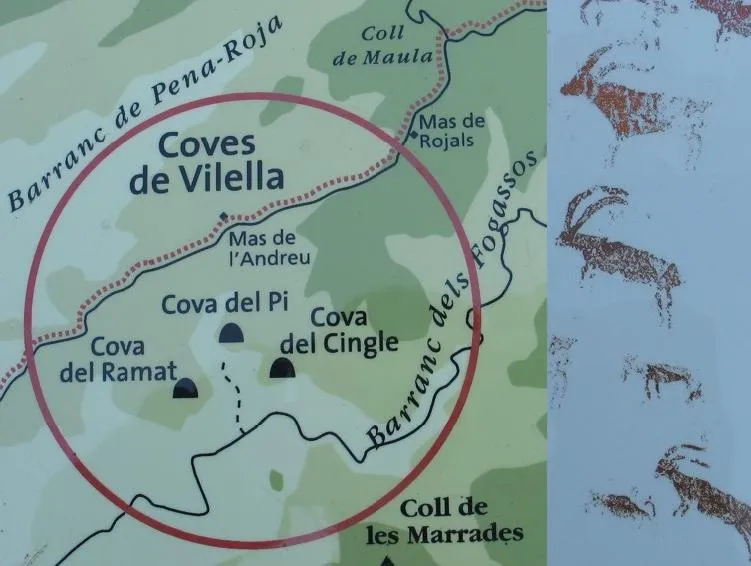
Cova del Ramat
Small cave with rock paintings in Tivissa, known as the Cova del Ramat, within the coves de la Vilella.
EspeleoWorld
Cova del Ramat
Small cave with rock paintings in Tivissa, known as the Cova del Ramat, within the coves de la Vilella.
Tivissa · Ribera d'Ebre
Sviluppo: 8 m
Scheda aggiornata
https://espeleoworld.com/it/c/cova-del-ramat
Le informazioni possono cambiare. Verifica sempre coordinate, accesso, meteo e condizioni della cavità prima di partire.
Small cave with rock paintings in Tivissa, known as the Cova del Ramat, within the coves de la Vilella.
Topografia
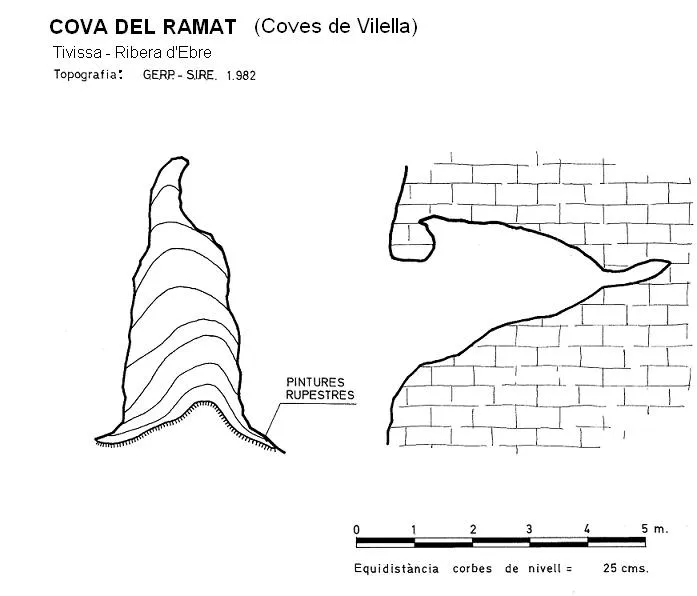
Espeleoindex · CC BY-NC 4.0, https://creativecommons.org/licenses/by-nc/4.0/ · Immagine © del suo autore.
Foto
Espeleoindex · CC BY-NC 4.0, https://creativecommons.org/licenses/by-nc/4.0/ · Immagine © del suo autore.
Descrizione
Morfologia
The Cova del Ramat is actually a shelter about 15 metres long, 6 m maximum height and about 8 m deep. At the right end of this shelter there is a small concavity, about 3 m from the ground. The dimensions are 2 m high by 2.5 m deep and long. The paintings are located precisely in this concavity, oriented to the N-NE, exactly on its right wall.
Altri dettagli
The frieze represents a herd in movement made up of 11 figures: 10 caprids, 9 of them with large curved horns and another that seems to correspond to a young animal, and remains of pigment. The style is clearly naturalistic, presenting, however, different degrees of stylization. The colour of all the pictographs is predominantly chestnut with different reddish tones.
Storia
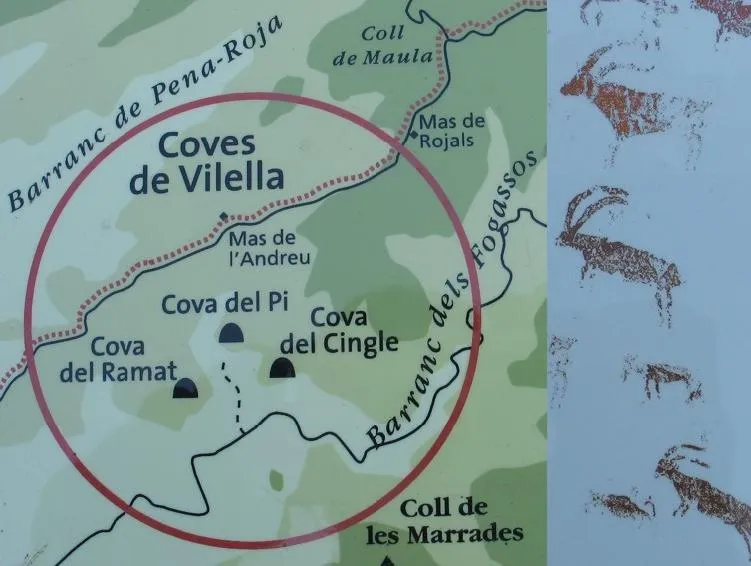
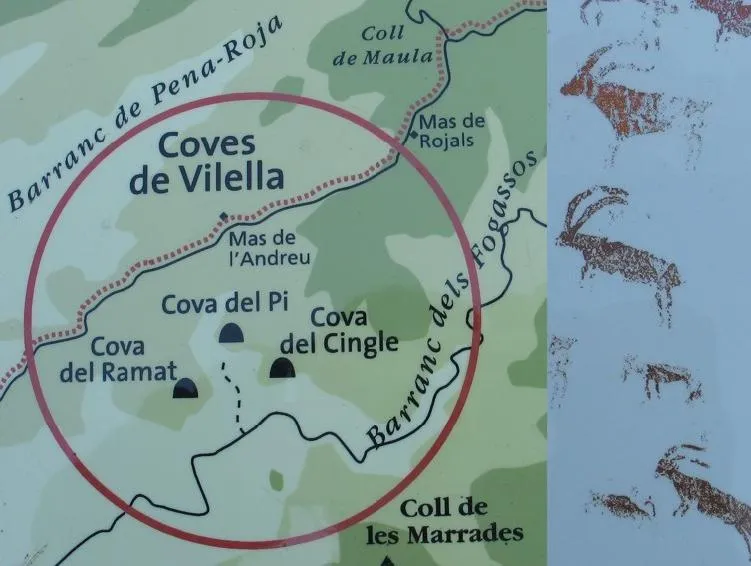
In September 1921 the rock paintings of the Cova del Pi were discovered by Mr. Poch. A month later, a commission headed by professor Hernández-Pacheco and the discoverer himself, Mr. Poch, went there from Madrid to draw them and take all the data of their location. In November of the same year, the Institut d'Estudis Catalans (IEC) learned of the discovery and sent Mr. Colominas who, together with Mr. Lluís Brull, went to see the discovered paintings and discovered four more, two of which are the paintings of the Cova del Ramat and the Cova del Cingle. The group of these three cavities is known as the coves de la Vilella.
Catalogued as UNESCO World Cultural Heritage in 1998.
Commenti degli utenti (0)
Nessun commento ancora.
Sii il primo a condividere la tua esperienza!
Esplorazioni registrate (0)
Nessuna esplorazione registrata.
Registra la tua visita a questa grotta!
Bibliografia
- Bosch Gimpera, P., Colominas, JM. (1921-1926): “Pintures i gravats rupestres”, Arqueologia I, Història de l’art. (Annuari IEC VII):1-26. Barcelona.
- Tivissaalaxarxa.blogspot.com.es posts dels dies 11/4 i 8/5 de 2008. Textos de Carles Torné i Micola.
- Cultura.gencat.cat.
- Institut Català d'Història Natural. http://ichn.iec.cat
Grotte vicine


Fonte: Espeleoindex (espeleoindex.com), modificato. CC BY-NC 4.0, https://creativecommons.org/licenses/by-nc/4.0/