
EspeleoWorld
De Basaura
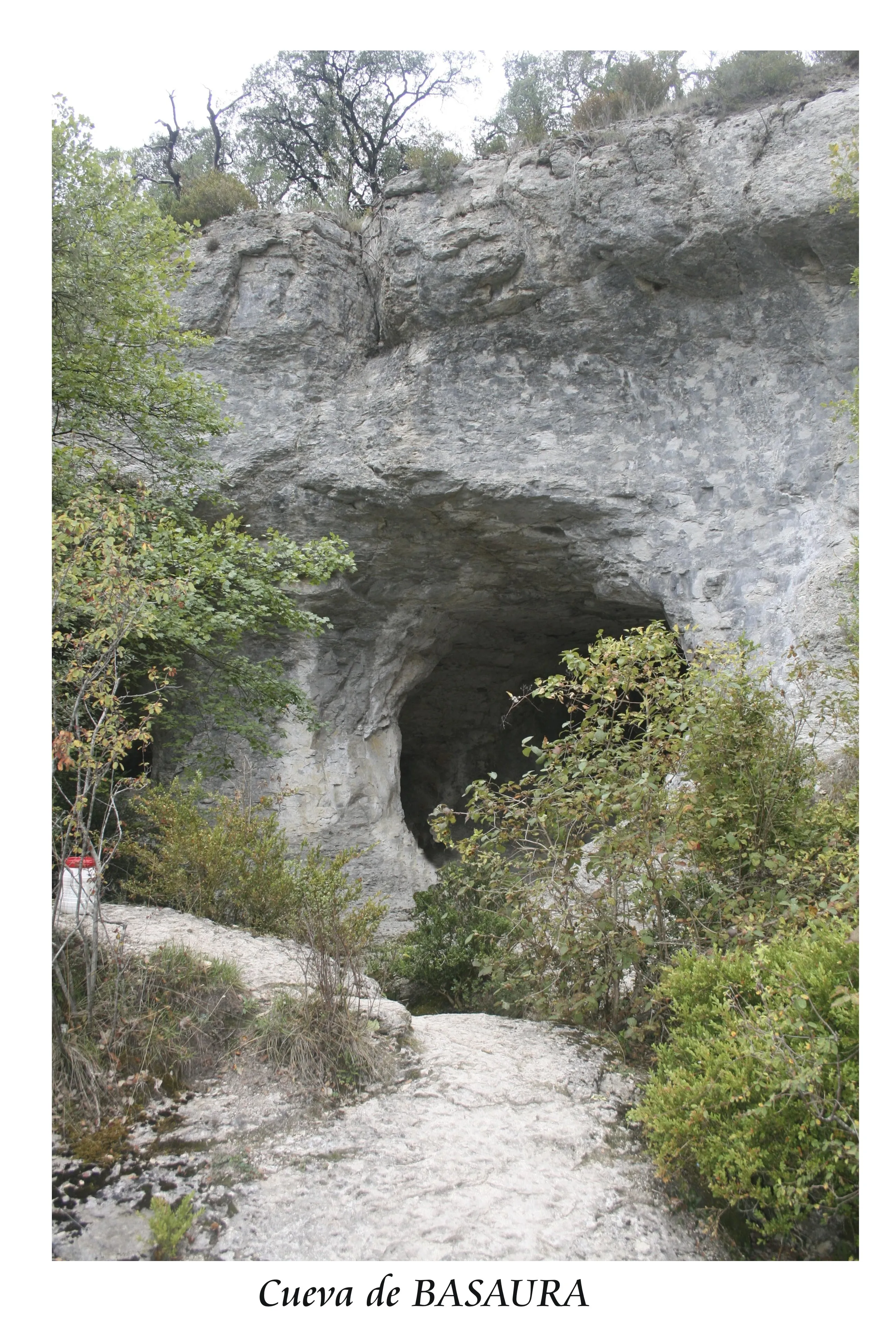
Cavity discovered in 1965 in Baríndano, on the right bank of the Urederra river, with a complex network of galleries on several levels and cave paintings.
Sierra de Lokiz
Longueur: 5075 m · Profondeur: 25 m
Fiche actualisée
https://espeleoworld.com/fr/c/de-basaura-sierra-de-lokiz
Les informations peuvent changer. Vérifiez toujours les coordonnées, l'accès, la météo et l'état de la cavité avant de partir.
Cavity discovered in 1965 in Baríndano, on the right bank of the Urederra river, with a complex network of galleries on several levels and cave paintings.
Photos

CC BY 4.0, https://creativecommons.org/licenses/by/4.0/ · Información geográfica propiedad del Gobierno de Navarra · https://administracionelectronica.navarra.es/geologiaVisor/?cavity=NA-0058
Description
Morphologie
The entrance, of great amplitude, is found in a strong slope and in a meander of the same, and gives way to a complex network of galleries developed on several levels, with several kilometers of horizontal route.
Hydrologie
The limestone canyon that must be ascended to gain access has previously been the natural course of its waters and currently, in times of great floods, circulation has been known in it. The lower part of the cavity has water circulation in its active galleries, which gives to the exterior the Itxako spring.
Autres détails
D. Isaac Santesteban published in 1971 a study in the magazine 'Príncipe de Viana' ("Pinturas rupestres en Navarra") in which he confirmed the abandonment and progressive deterioration of the 'Galería de Pinturas' of de Basaura. "The painting represents an animal that appears to be a feline fallen into a hunting trap. Clearly appreciating the head and part of the body. Of the same, and with a length of about 70 cm, in its middle part can be distinguished what would be a curved and pointed weapon that pierces its body in a vertical direction. The animal raises its head and opening its jaws because of the pain".
Histoire
It was discovered in 1965 by members of the speleology section of the Institución Príncipe de Viana. In 1953 Institución Príncipe de Viana. In 1992 G.E.Estella. In archaeology, cave painting and bone remains are documented.
Bio
Basaura-Baríndano.- Chiroptera, Mollusca, Crustacea, Myriapoda, Arachnida, Diptera, Collembola, Coleoptera.
Commentaires des utilisateurs (0)
Aucun commentaire pour le moment.
Soyez le premier à partager votre expérience !
Explorations enregistrées (0)
Aucune exploration enregistrée pour le moment.
Enregistrez votre visite dans cette cavité !
Grottes à proximité
Source : Gobierno de Navarra – Catálogo espeleológico de Navarra (datosabiertos.navarra.es), avec modifications. CC BY 4.0, https://creativecommons.org/licenses/by/4.0/ Gobierno de Navarra · données de 2022 · Source : Inventario Español de Lugares de Interés Geológico (IGME) (info.igme.es), avec modifications. LicenseRef-IGME-reuse-2022, https://info.igme.es/media/Pdfs/LicUsoIGME_GENERICA_2022.pdf ©CN Instituto Geológico y Minero de España (IGME), Inventario Español de Lugares de Interés Geológico (IELIG) · noms · obtenu le 2026-11-10 · https://info.igme.es/ielig/LIGInfo.aspx?codigo=CV070 · données de 2026