
Tunnel de l'Atlantide
System Cueva de los Verdes
EspeleoWorld
Tunnel de l'Atlantide
Submerged volcanic tunnel forming the final stretch of the La Corona lava tube, in the Malpaís de La Corona, with endemic fauna of Lanzarote.
Haría
System length: 6000 m · System depth: 60 m
Updated record
https://espeleoworld.com/en/c/tunnel-de-l-atlantide-haria
Information can change. Always verify coordinates, access, weather, and cave conditions before setting out.
Submerged volcanic tunnel forming the final stretch of the La Corona lava tube, in the Malpaís de La Corona, with endemic fauna of Lanzarote.
Description
Morphology
The tunnel is the final submerged stretch of the La Corona lava tube, fed by the Volcán de La Corona. Published dates for that eruption differ: IGME places it at around 25,000 years and the UNED cites Carracedo and colleagues for an age close to 21,000 years. The rise in sea level after the glacial period flooded the outer stretch of the tube, 1.6 km, and created the tunnel. The La Corona tube exceeds 7.6 km in length and its last 1.6 km lie beneath the current sea level.
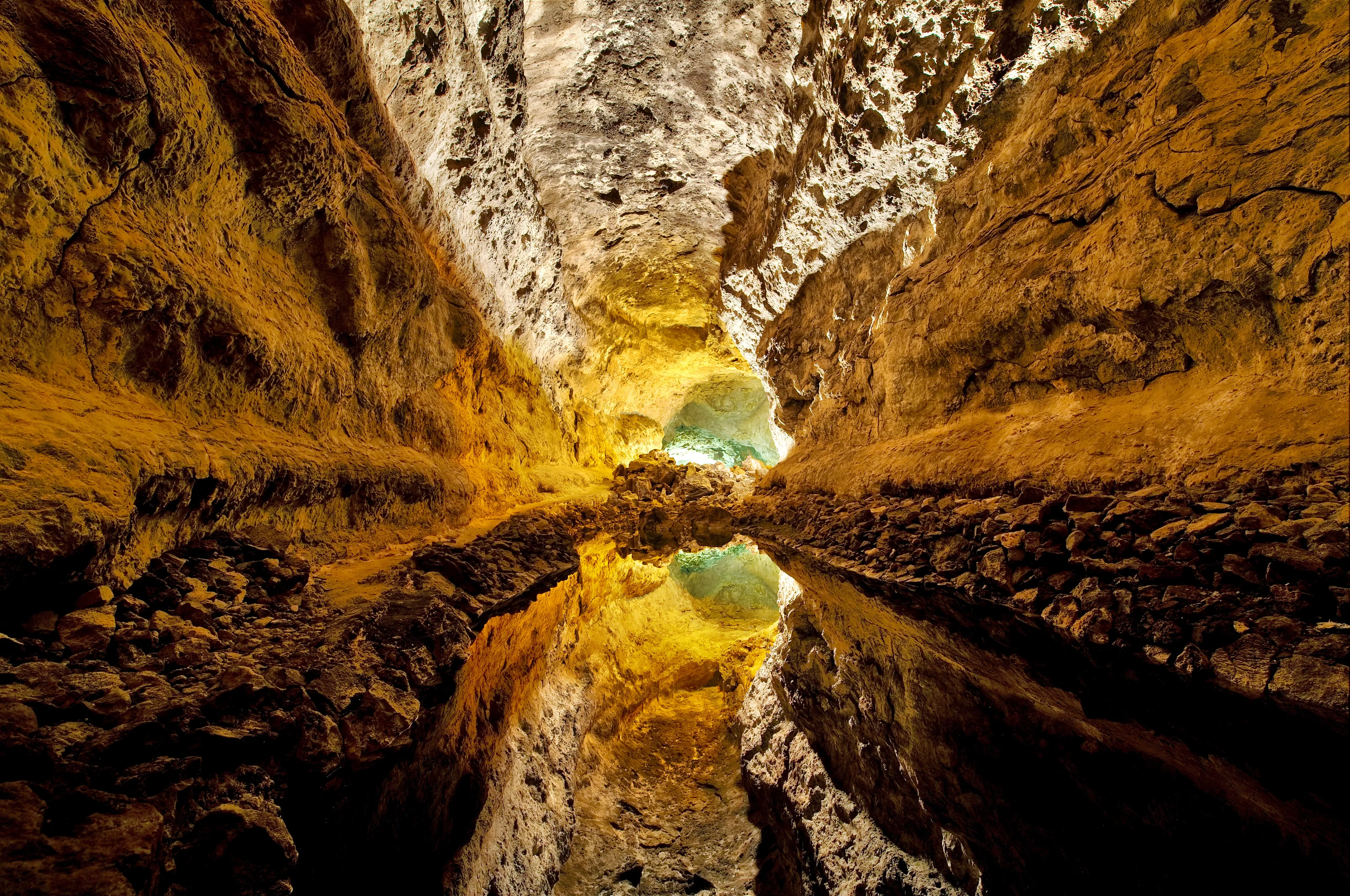
The Geopark describes galleries and superimposed levels, with vaults of up to 20 by 20 m and small interior basins. The tunnel has a main gallery and a narrower upper gallery, the Lago Escondido, connected to the main one at three points. The main gallery ends about 1,600 m from the entrance at a semicircular wall, with the floor at 64 m and the ceiling at about 55 m. At about 700 m, a fissure in the ceiling feeds a marine Sand dune about 20 m high, the Montaña de Arena. At about 560 m the ceiling rises to about 12 m and gives way to upper galleries with semi-consolidated marine Sands, the Montaña Fósil. The terminal chamber is interpreted as a widening produced by the rapid cooling of the lava on contact with the sea.
Speleothems
The cave walls present stalactites, lava shelves, lava ropes and carbonate crusts.
Hydrology
The water salinity is approximately 35.8 per thousand and the dissolved oxygen about 4.9 ml per litre, with tidal currents of 0.5 to 2.5 m per second. The tides inside the tunnel are delayed by about one hour relative to the open sea and can reach up to 3 m.
Other details
The tunnel is described as the longest known submerged volcanic lava tube on Earth. An international research laboratory with equipment is installed in the lava tube. The Cueva de los Verdes and the Jameos del Agua are dry, collapsed stretches of the same tube and operate as visitable attractions. The entrance lake lies at the foot of the Jameo Chico, within the visitable complex of the Jameos del Agua.
History
In 1972 the Guerra brothers reached 370 m in the main gallery. In 1981 Italian divers reached 410 m during a technical stop of the Alyan-Mondo Sommerso expedition, and the Grupo Standard de Madrid advanced to 820 m and a depth of 32 m. In 1983 a US cave-diving team reached 1,377 m and a depth of 53 m. Divers from the STD de Madrid surveyed 1,578 m and stopped a few metres from the end. In 1986 the GLPS and a Franco-Belgian team completed the sump at 1,618 m and a depth of 64 m. In 1987 STD divers returned to the terminus and confirmed that the passage did not continue. In 2008 a team led by Texas A&M reached 1,000 m and collected samples that led to the description of new species. In 2011 a Canarian team organised with the University of Copenhagen and with the backing of the Cabildo reached 750 m. In 2019 the UNED team led by Javier Lario reached the end of the tunnel for the first time since 1987.
Bio
The tunnel forms an anchialine ecosystem that supports 36 endemic species of Lanzarote. The jameito, Munidopsis polymorpha, is a blind white shrimp endemic to the anchialine waters of Lanzarote. Morlockia ondinae and Munidopsis polymorpha are listed as threatened in the Canarian and Spanish catalogues of protected species. Two species of remipedes have been described from the tunnel, Morlockia ondinae and Morlockia atlantida. Artificial light at the entrance allows algae to grow in the first 20 to 30 m; beyond that, the tunnel is totally dark. The Montaña de Arena is the only interstitial marine sediment habitat in the cave and hosts a distinctive animal community.
User Comments (0)
No comments yet.
Be the first to share your experience!
Registered Explorations (0)
No explorations registered yet.
Register your visit to this cave!
Nearby caves
Contains information from Grottocenter (Wikicaves), grottocenter.org, made available under the Open Database License (ODbL 1.0, https://opendatacommons.org/licenses/odbl/1-0/), modified. · https://grottocenter.org/ui/entrances/72762 · data as of 2026 · Text written by Espeleoworld from public sources. Please ask us before reusing it. · adapted by Espeleoworld (normalized, translated); the adaptation is licensed Our own text, written from public sources. Please ask us before reusing it. · data as of 2026 · The derived data is available on request under the ODbL: [email protected]