
Trou d'Iko
An interstitial cavity formed by stress-relief fissures parallel to the slope, developed on two levels of passages bounded by debris cones, whose terminal fissure is no longer passable.
EspeleoWorld
Trou d'Iko
An interstitial cavity formed by stress-relief fissures parallel to the slope, developed on two levels of passages bounded by debris cones, whose terminal fissure is no longer passable.
Asson
Length: 85 m · Depth: 24 m
Updated record
https://espeleoworld.com/en/c/trou-d-iko-asson
Information can change. Always verify coordinates, access, weather, and cave conditions before setting out.
Approximate location: no map or coordinates are printed for this cave. The source marks this entrance position as unverified.
An interstitial cavity formed by stress-relief fissures parallel to the slope, developed on two levels of passages bounded by debris cones, whose terminal fissure is no longer passable.
Photos
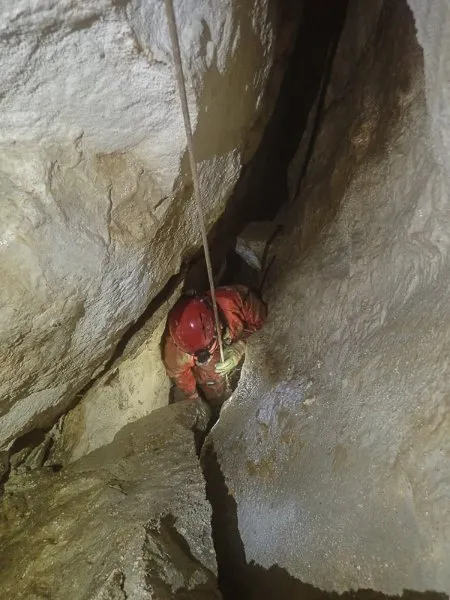
© Degouve (GSHP) · CC BY-NC-SA (version not stated by the source), https://www.karsteau.org/karsteau/index.php · Karsteau: Fracture MO42 · https://www.karsteau.org/karsteau/recherche/entree/recherche_entree.php?entree=20163
Description
Morphology
Morphologically, it is an interstitial cavity formed by stress-relief fissures parallel to the slope. The entrance shaft (7 m) pierces the roof of a fairly spacious gallery (2 m x 2 m). This first level continues north for about fifteen metres to a debris cone. To the south, a small 3 m step followed by a 5 m shaft allows descent into the fissure and reaches a second level of passages (-13 m), also bounded to the north by debris cones. To the south, after a widening followed by a low passage, a 4 m shaft allows further descent into the fissure; this continues downward for another 7 m, becoming increasingly narrow. It is still possible to progress south at the bottom of the P.4, but there too the fissure eventually becomes impassable. Its end lies less than 10 m from the small MO-43 pit, also dug along a fissure but impassable at -3 m.
Progression
The entrance of the cavity was discovered by the GSHP (J.L. Lacrampe) on 13 January 2018. It was enlarged the same day and a first reconnaissance down to -12 m was made (S. Degouve). Exploration and surveying were continued on 28 January following (P. and S. Degouve).
Other details
The air current (temp. 9.8°C) observed in both cavities is explained by the presence of these multiple entrances, which must mark out the fissure stretching near the surface.
User Comments (0)
No comments yet.
Be the first to share your experience!
Registered Explorations (0)
No explorations registered yet.
Register your visit to this cave!
Nearby caves

Source: Karsteau (Fédération Française de Spéléologie et Canyon) (www.karsteau.org), modified. CC BY-NC-SA (version not stated by the source), https://www.karsteau.org/karsteau/index.php Karsteau (Fédération Française de Spéléologie et Canyon) · Text by Karsteau (FFS) contributors · adapted by Espeleoworld (normalized, translated); the adaptation is licensed CC BY-NC-SA (version not stated by the source), https://www.karsteau.org/karsteau/index.php · https://www.karsteau.org/karsteau/recherche/entree/recherche_entree.php?entree=20163 · data as of 2026