
Torca de los Viejos Mendrugos
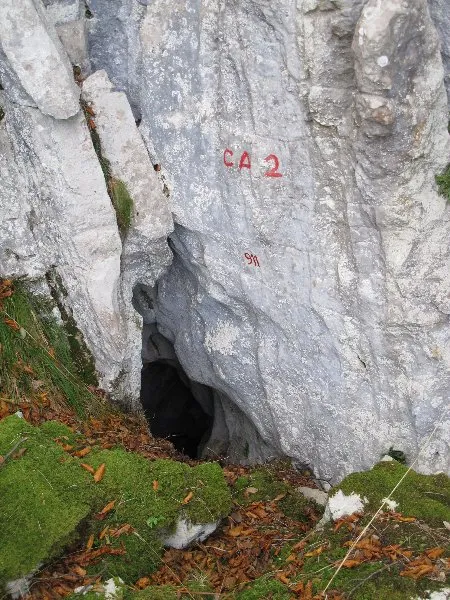
The large porch of the torca de los Viejos Mendrugos (10 m x 8 m) opens on the lapiaz-covered flank of a vast grassy doline between Bucebron and Buzulucueva, and continues as a 13 m shaft.
EspeleoWorld
Torca de los Viejos Mendrugos
The large porch of the torca de los Viejos Mendrugos (10 m x 8 m) opens on the lapiaz-covered flank of a vast grassy doline between Bucebron and Buzulucueva, and continues as a 13 m shaft.
Arredondo
Length: 665 m · Depth: 296 m
Updated record
https://espeleoworld.com/en/c/torca-de-los-viejos-mendrugos-arredondo
Information can change. Always verify coordinates, access, weather, and cave conditions before setting out.
Approximate location: no map or coordinates are printed for this cave. The source marks this entrance position as unverified.
The large porch of the torca de los Viejos Mendrugos (10 m x 8 m) opens on the lapiaz-covered flank of a vast grassy doline between Bucebron and Buzulucueva, and continues as a 13 m shaft.
Description
Morphology
The porch of the torca (10 m x 8 m) is reached through a fracture that cuts the lapiaz over a length of about twenty metres. This entrance, visible from afar, continues as a 13 m shaft, blocked at the start by large blocks forming a ledge at -5 m. At this point, the ceiling is pierced by two openings communicating with the overlying lapiaz (upper entrances +15 m). At the bottom of the shaft, one arrives in a chamber occupied by a scree slope and a large collapse cone returning beneath the entrance. A few metres from the bottom, on a small flat step, a drop of a few metres continues in depth as a narrow joint traversed by a draught of aspirating air.
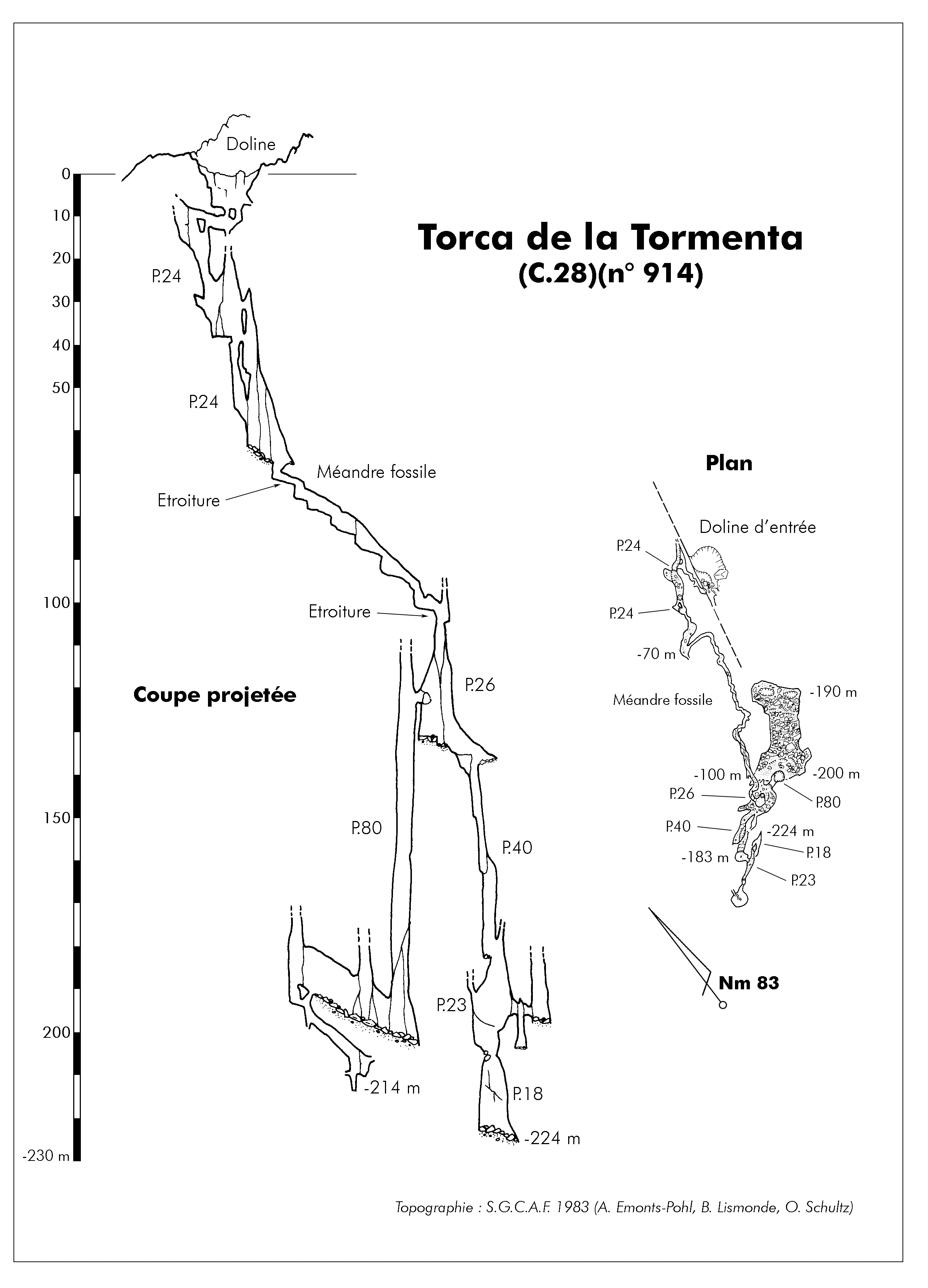
The following shaft (22 m) pierces the ceiling of a fine fossil gallery (10 m x 12 m). The latter, which appears to be an upstream section, continues roughly horizontally for about forty metres while keeping the same proportions. At a right-angled bend, it rises abruptly, heading east. This ramp, which must be rigged, is cut by a deep meander coming from 2 ascending shafts. At the top, one of them joins a 20 m shaft that drops back into the fossil gallery via a lateral meander. But the logical continuation of the fossil conduit seems rather to be on the right, where a short passage has been dug out through the thick fill that almost entirely choked the conduit. Behind it, after a 2 m drop, one reaches a small chamber partly filled in. On the floor, a very narrow joint (fracture) could be recognised over a depth of about ten metres. The continuation, hardly any wider, would require some work, but the draught of air there is not obvious (-85 m).
In the horizontal part of the fossil gallery several shafts are encountered. The first, about twenty metres from the base of the P.22, measures 14 m and reaches a chamber blocked by scree at -110 m. The second, more discreet, opens just below the ramp and begins with a meander quickly barred by a 3 m drop. Two shafts of 6 and 18 m follow and end in a chamber choked by scree and clay (-134 m). Shortly before, and slightly higher up, a third opening leads to the base of the 20 m shaft mentioned above at the top of the ramp.
The shafts and the junction with the torca del Pozo Negro: these start at the very base of the P.22, behind a large block. The first vertical (29 m) is topped by chimneys whose origin could be linked to the P30 encountered at the beginning of the pit (branch of -67 m). It continues as a short meander (R.3) that discharges into a P.20, the first of a series of shafts that follow one another down to -230 m (P.47 and P.44). At the bottom of the last one, the conduit has clearly gained in size and the ceiling is lost in a succession of ascending shafts. On the left, a meander descends to the impassable lip of a shaft sounded to about fifteen metres (no draught of air). Continuing straight on, a scree slope descends to -240 m and entirely blocks the conduit. One must then climb 6 m to find a shaft of larger dimensions (P14). It is here that the great shaft of the Pozo Negro (165 m) arrives, the point of convergence of the two pits.
The continuation is limited to a 34 m shaft whose bottom is entirely choked with clay. Only a small horizontal conduit, passable for about ten metres, allows one to observe the mirror of a fine fault that is the probable origin of the great shaft of the torca del Pozo Negro. At 10 m from the bottom of the P.34, a large scree-covered ledge rises to the top of a parallel shaft of 10 m followed by another of 5 m (-281 m).
Hydrology
Spring: Cubiobramante
Progression
But the continuation is not here, and to reach it one must climb the P.13 back up to the first ledge (large blocks). From there, a horizontal traverse gives access to a fine meander where a strong draught of aspirating air is felt. This quickly discharges into a 17 m shaft that splits in two at mid-height. At the bottom, continuing straight on, after a drop of a few metres, one reaches a drop of a few metres followed by another of 30 m whose top has been enlarged. A last small shaft of 5 m ends this branch, where the draught of air is almost non-existent (-67 m).
Returning to the bottom of the P.17, slipping between the wall and blocks (R.3), one reaches a narrow and winding fossil meander where the draught of air is found again. After a few well-marked bends, one arrives at the top of a 4 m drop at the bottom of which the major work began. Two narrowings separated by a drop have been enlarged with great efforts. Behind the second, a more comfortable ramp leads to a 10 m shaft followed by a meander interspersed with small vertical steps. At -61 m, the ceiling suddenly lowers. The crawl that follows has also been enlarged. It opens at the top of a small shaft of 3 m quickly followed by another of 2 m, also dug out. A final 4 m drop ends the narrow zone at -70 m.
From there, 2 options are open to the visitor: either continue the descent in a shaft of fine dimensions, or stay at the same level by following the fossil gallery.
Other details
Geology: Level 3-4: Limestones of Bucebron and of Peña Lavalle (Aptian).
User Comments (0)
No comments yet.
Be the first to share your experience!
Registered Explorations (0)
No explorations registered yet.
Register your visit to this cave!
Nearby caves
Source: Karsteau (Fédération Française de Spéléologie et Canyon) (www.karsteau.org), modified. CC BY-NC-SA (version not stated by the source), https://www.karsteau.org/karsteau/index.php Karsteau (Fédération Française de Spéléologie et Canyon) · Text by Karsteau (FFS) contributors · adapted by Espeleoworld (normalized, translated); the adaptation is licensed CC BY-NC-SA (version not stated by the source), https://www.karsteau.org/karsteau/index.php · https://www.karsteau.org/karsteau/recherche/entree/recherche_entree.php?entree=22103 · data as of 2026