
Source du Grand Pré
Spring at the foot of a steep bank in the Grand Pré, in the commune of Panneçot, whose roof, exposed in 1993, offers a low, aquatic passage limited by an abrupt drop in the roof.
EspeleoWorld
Source du Grand Pré
Spring at the foot of a steep bank in the Grand Pré, in the commune of Panneçot, whose roof, exposed in 1993, offers a low, aquatic passage limited by an abrupt drop in the roof.
Limanton
Length: 80 m
Updated record
https://espeleoworld.com/en/c/source-du-grand-pre-limanton-nievre
Information can change. Always verify coordinates, access, weather, and cave conditions before setting out.
Approximate location: no map or coordinates are printed for this cave. The source marks this entrance position as unverified.
Spring at the foot of a steep bank in the Grand Pré, in the commune of Panneçot, whose roof, exposed in 1993, offers a low, aquatic passage limited by an abrupt drop in the roof.
Topographic
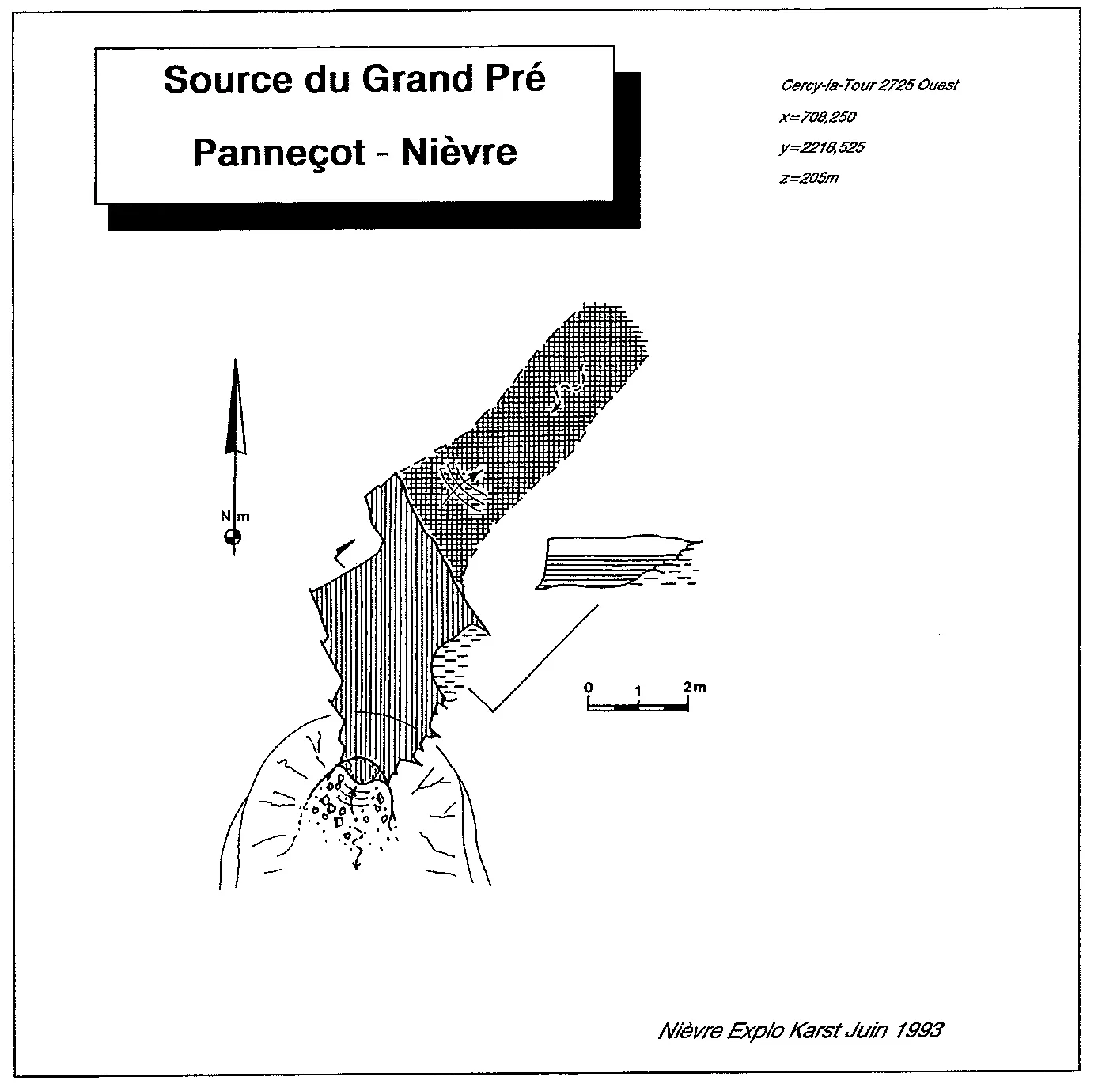
© N.E.K. · CC BY-NC-SA (version not stated by the source), https://www.karsteau.org/karsteau/index.php · Karsteau: Topographie Source du Grand Pré · https://www.karsteau.org/karsteau/recherche/entree/recherche_entree.php?entree=24227
Photos
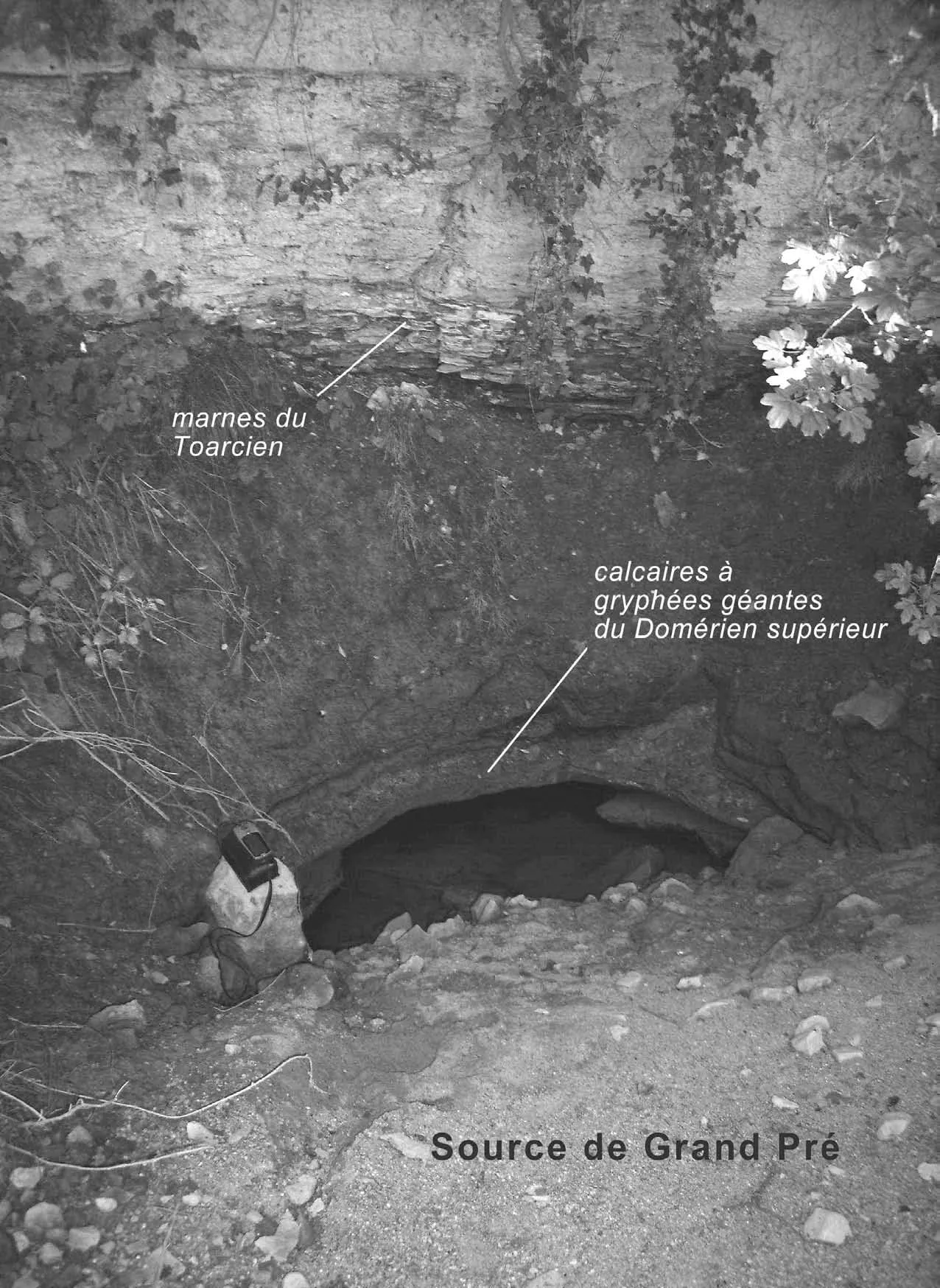
© Simonnot · CC BY-NC-SA (version not stated by the source), https://www.karsteau.org/karsteau/index.php · Karsteau: Contexte géologique de l'entrée de la Source des Grands Prés · https://www.karsteau.org/karsteau/recherche/entree/recherche_entree.php?entree=24227
Description
Morphology
The spring's opening measures 1 m wide by 0.30 m high. It leads into a sort of low chamber (H: 1 m), yet fairly wide (3 m on average). At 4.5 m from the entrance, an abrupt drop in the roof stops progress, while a fully flooded conduit appears to continue beyond. Note the regularity of the roof, which is almost perfectly flat. The flooded gallery has a cross-section barely narrower than that of the entrance. The cavity is established at the roof of the giant gryphaea limestones, at the boundary with the Toarcian marls; this geological setting is unique in Burgundy. The cavity sometimes has unsafe ceilings.
Hydrology
The entrance chamber is occupied by a pool of stagnant water. Various accounts from local inhabitants state that during heavy floods, water gushes from the spring and falls back only more than ten metres further on; to date we have not had the privilege of such a spectacle. This spring is connected with the loss of the perte de la Tuilerie. In February 2001, after a flood, we witnessed a spectacular tracing: at the mouth of the emergence, dozens of frogs, swept along by the flow, lay strewn on the ground.
Progression
On 23 May 1993, after a brief clearing of the stones that partially obstructed the spring's opening, then inactive, the roof was exposed, offering a low and aquatic passage, yet still penetrable. Jean Luc ROUSSEAU and François BILLON then slipped through the opening into the low chamber. The same day, François BILLON made a first reconnaissance dive of 5.5 m into a gallery whose cross-section is barely narrower than that of the entrance; the turbidity of the water due to pollution and to the swirls caused since the entrance made visibility nil, and does not allow any precise indication of the real dimensions of the flooded gallery, nor of its continuity. On 6 June 93, a pumping operation was organised by the whole N.E.K team to assess whether it was possible to empty the sump completely with a small thermal pump, kindly lent by Lionel FISCHER, marble worker at Châtillon en Bazois; after two hours, the level had dropped by 0.60 m, almost completely drying out the entrance chamber, but, pressed for time, the pumping was interrupted. On 13 June 93, a new attempt using the same pump was rendered futile because of the local rainfall that had raged the previous week. We await fine weather, and the opportune moment to carry out a more powerful pumping operation, which should allow us to explore the gallery... perhaps in the direction of the Perte de la Tuilerie!
Other details
This spring connected with the loss of the perte de la Tuilerie was the subject of a pumping operation (pers. comm. Billon March 2001). Progress was possible over about 80 m, limited by the equipment used.
History
Source: Sous le Plancher - ASE no. 15 2001-2005 p.37. Extract from Sous le Plancher-ASE 1994, no. 9 p.162.
Bio
Note that F. Billon had reported the presence of live frogs 300 m inside the loss.
User Comments (0)
No comments yet.
Be the first to share your experience!
Registered Explorations (0)
No explorations registered yet.
Register your visit to this cave!
Nearby caves


Source: Karsteau (Fédération Française de Spéléologie et Canyon) (www.karsteau.org), modified. CC BY-NC-SA (version not stated by the source), https://www.karsteau.org/karsteau/index.php Karsteau (Fédération Française de Spéléologie et Canyon) · Text by Karsteau (FFS) contributors, Karsteau (FFS) contributors (Géologie) · adapted by Espeleoworld (normalized, translated); the adaptation is licensed CC BY-NC-SA (version not stated by the source), https://www.karsteau.org/karsteau/index.php · https://www.karsteau.org/karsteau/recherche/entree/recherche_entree.php?entree=24227 · data as of 2026