
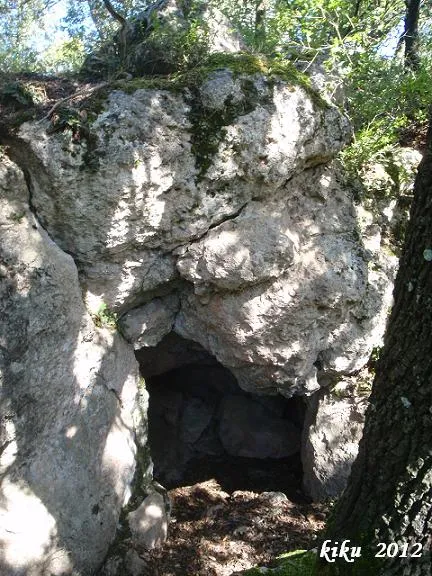
Querant de Picalts
Avenc de 27 metres de fondària prop de Lluçars (Vilanova de Meià).
EspeleoWorld
Querant de Picalts
Avenc de 27 metres de fondària prop de Lluçars (Vilanova de Meià).
Vilanova de Meià · Noguera
Length: 110 m · Depth: 27 m
Updated record
https://espeleoworld.com/en/c/querant-de-picalts
Information can change. Always verify coordinates, access, weather, and cave conditions before setting out.
A 27-metre-deep pit near Lluçars (Vilanova de Meià), with a sloping gallery, a drop of just over 2 metres and a main chamber with two parallel fissures in its lower part.
Topographic
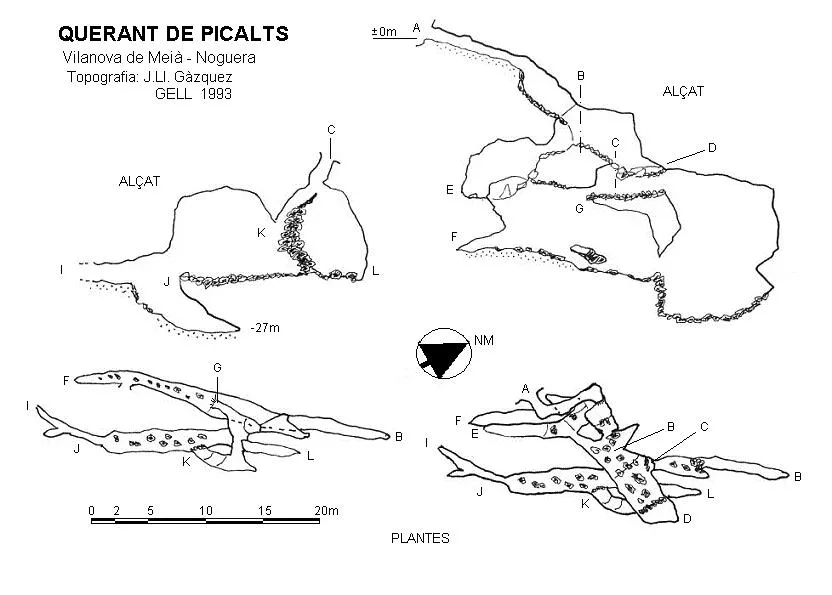

Espeleoindex · CC BY-NC 4.0, https://creativecommons.org/licenses/by-nc/4.0/ · Image © its author.
Photos

Espeleoindex · CC BY-NC 4.0, https://creativecommons.org/licenses/by-nc/4.0/ · Image © its author.
Description
Morphology
A small, sloping gallery leads to a drop of just over 2 metres, which places us in the main chamber in the upper part of the cavity; a collapse at the N end allows access to the two parallel fissures that form the lower part, by way of four tight passages. The cavity is filled with blocks that form some pseudogalleries; many of these blocks are in a rather precarious state of equilibrium.
History
The first record of this cavity is through Mn. Joan Serra i Vilaró, who in 1923 published the results of his archaeological finds in the cavity.
Mn. Joan Serra learned of the existence of the cavity upon receiving a letter informing him that some hunters had found some pots in a cave. When Mn. Joan Serra arrived at Artesa de Segre, the rector of that village informed him that the story was false and that Josep Colominas i Roca of the Institut d'Estudis Catalans had already visited it and had found nothing of importance. Nevertheless Mn. Joan Serra, accompanied by Antoni Llorenç and a young man from the village whom they hired because he knew where the cave was, decided to visit it; curiously he found a large part of the archaeological material right at the foot of the first drop, which leads us to think that Josep Colominas did not actually enter, probably due to the narrowness of the entrance and the fact that there was a vertical section.
Mn. Joan Serra i Vilaró makes the mistake of citing the cavity with the toponym “Bòfia”, understandable however if we take into account that he is rector of Solsona, and there pits are called by that name. In time, the cavity came to be called “Querant”, which is the usual toponym for citing pits in this part of the Noguera.
In 1995, J.Ll. Gàzquez in the Catàleg Espeleològic de la Noguera, cites the cavity as Querant de Picalts or dels Carrers de Lluçars, mentioning that just before reaching the cavity the path passed by a fissure to which this name is given. This relationship does not quite fit, since Dr. Español together with J. Villalta, on 12 April 1936, had visited the Balma dels Carrers de Lluçars, referring to it as a shelter with some dark passage.
In the book “El Montsec i muntanyes veïnes” by Manuel Cortès, published in 1984, in which precisely J.Ll. Gàzquez collaborates in the part devoted to speleology, they cite the Cova dels Carrers, near Lluçars, adding that it is a shelter.
After Dr. Español's visit, Josep de la Vega published in 1981 “Aplec de documents arqueològics de les coves del Montsec i llur projecció a les comarques i serres properes”, in which he locates the Balma dels Carrers de Lluçars, also called Cova dels Moros, in the barranc de la Tartera, not too far from the Querant de Picalts, which also appears in the same publication, presenting a survey that uses the elevation published in Speleon 21 by D. Campillo and R. Viñas and a plan made by him and his son.
In 2009, Jordi de Valles, in the Catàleg Espeleològic de Catalunya 2, echoes the name cova dels Carrers de Lluçars, citing it as a synonym of the Querant de Picalts, and from there, in the history, he places the first exploration of the cavity as the one carried out by the Club Muntanyenc Barcelonès around 1940; it is evident that this is the reference of Dr. Español and J. Villalta (CMB) made in 1936 at the Balma dels Carrers de Lluçars, while the Querant de Picalts had already been explored before 1923 by Mn. Joan Serra i Vilaró. These are therefore two clearly distinct cavities.
As for the Balma dels Carrers de Lluçars, it was inhabited until around 1925.
User Comments (0)
No comments yet.
Be the first to share your experience!
Registered Explorations (0)
No explorations registered yet.
Register your visit to this cave!
Bibliography
- Campillo Valero,D;Viñas Vallverdú,R.(1974).-”Estudio antropológico de dos cráneos de la Bòfia de la serra dels Picals”. Speleon (21):103-118, CE Catalunya.
- Cortés i Ribelles, Manuel.(1984).- El Montsec i Muntanyes Veïnes. Centre Excursionista de Lleida.
- Escolà i Boada, Oleguer (1970).- “Catálogo Espeleológico del Montsec”. Espeleòleg (11-12):453-541. ERE del CEC. Barcelona.
- Gàzquez i Pons, Josep Lluís (1995).-”Catàleg Espeleològic de la Noguera”. Grallera (3-4):1-90.GELL-CE Lleida.
- Serra Vilaró, Mn Joan,(1923).-”El vas campaniforme a Catalunya i les coves sepulcrals”. Musaeum Archaeologicum Diocesanum pp:81-83. Solsona.
- Vega, Josep de la. (1981).-”Aplec de documents arqueològics de les coves del Montsec i llur projecció a les comarques i serres properes”. Mediterrània (12): 1-359.
- Valles, Jordi de.(2009).-”Alt Urgell, Noguera, Pla d'Urgell, Segarra, Solsonès, Urgell”. Catàleg Espeleològic de Catalunya (2):1-384. EC Gràcia – FCE.
Nearby caves
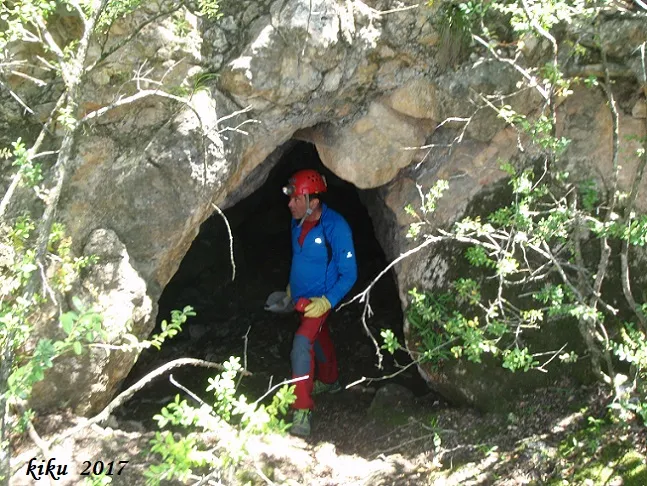
Cova Fosca de Vilanova
0.9 km · W
Vilanova de Meià (Noguera)
1 topo.9 photos
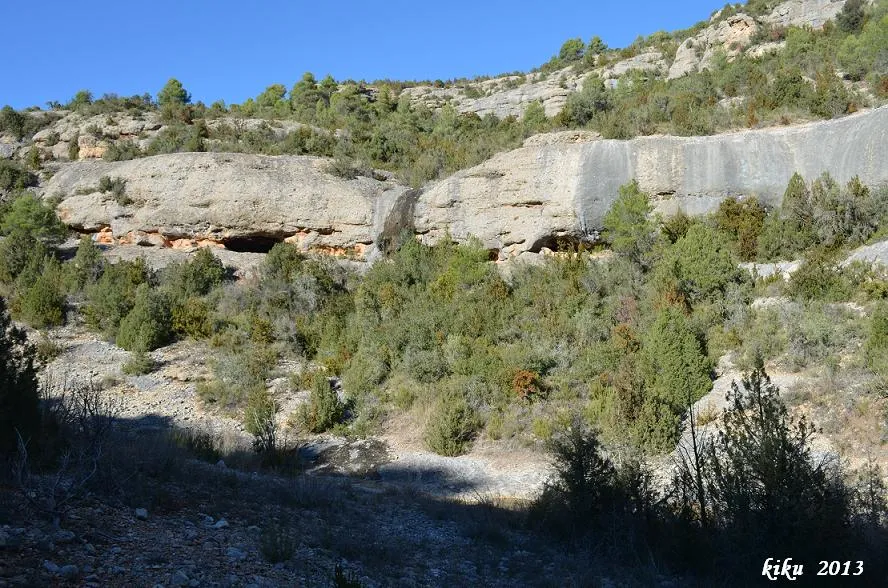
les Tres Coves
1.1 km · E
Vilanova de Meià (Noguera)
1 topo.4 photos
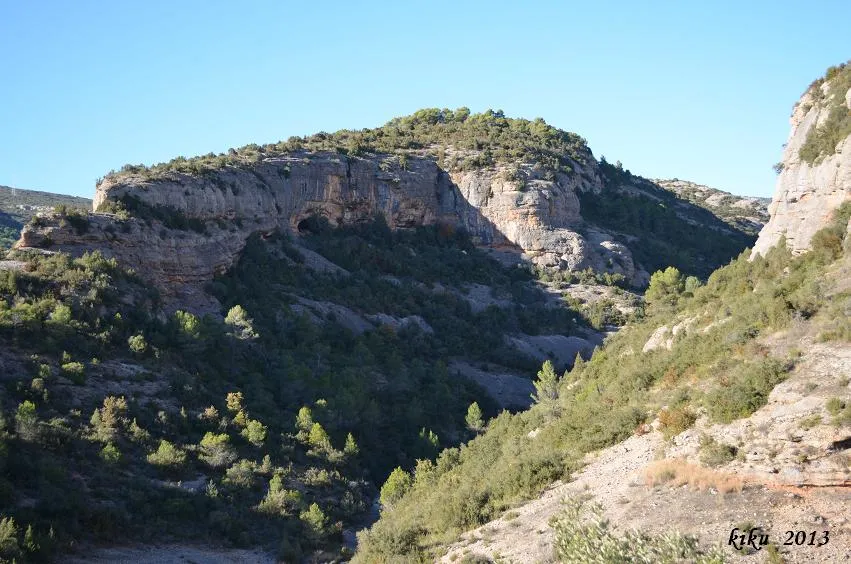
Cova dels Carrers de Lluçars
1.2 km · E
Vilanova de Meià (Noguera)
1 topo.8 photos
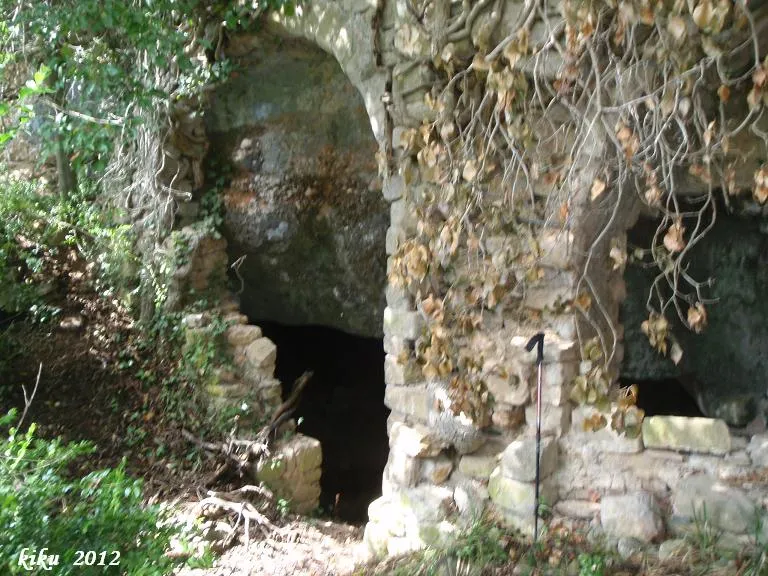
Cova de l'Ermita de la Vansa
1.5 km · E
Vilanova de Meià (Noguera)
2 topo.4 photos
Source: Espeleoindex (espeleoindex.com), modified. CC BY-NC 4.0, https://creativecommons.org/licenses/by-nc/4.0/