
Pouetons de les Agulles
Important i mítica cavitat montserratina de 125 m. de fondària
EspeleoWorld
Pouetons de les Agulles
Important i mítica cavitat montserratina de 125 m. de fondària
Bruc, El · Anoia
Length: 529 m · Depth: 125 m
Updated record
https://espeleoworld.com/en/c/pouetons-de-les-agulles
Information can change. Always verify coordinates, access, weather, and cave conditions before setting out.
Mythical cavity in Montserrat 125 m deep, with two entrances, pits, gours, flowstone and galleries such as the Quim-Avent. History from 1789 and explorations until 2020.
Topographic
Espeleoindex · CC BY-NC 4.0, https://creativecommons.org/licenses/by-nc/4.0/ · Image © its author.
Photos
Espeleoindex · CC BY-NC 4.0, https://creativecommons.org/licenses/by-nc/4.0/ · Image © its author.
Description
Morphology
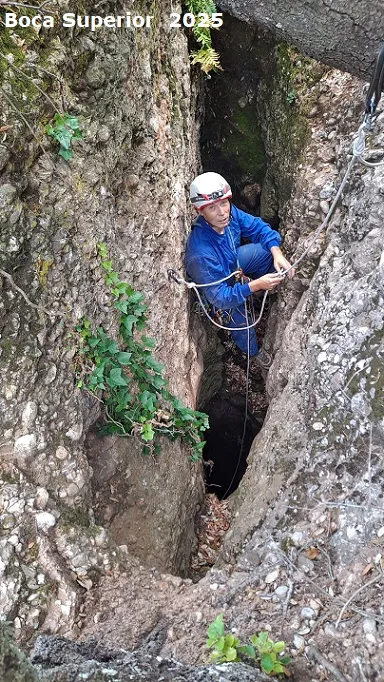
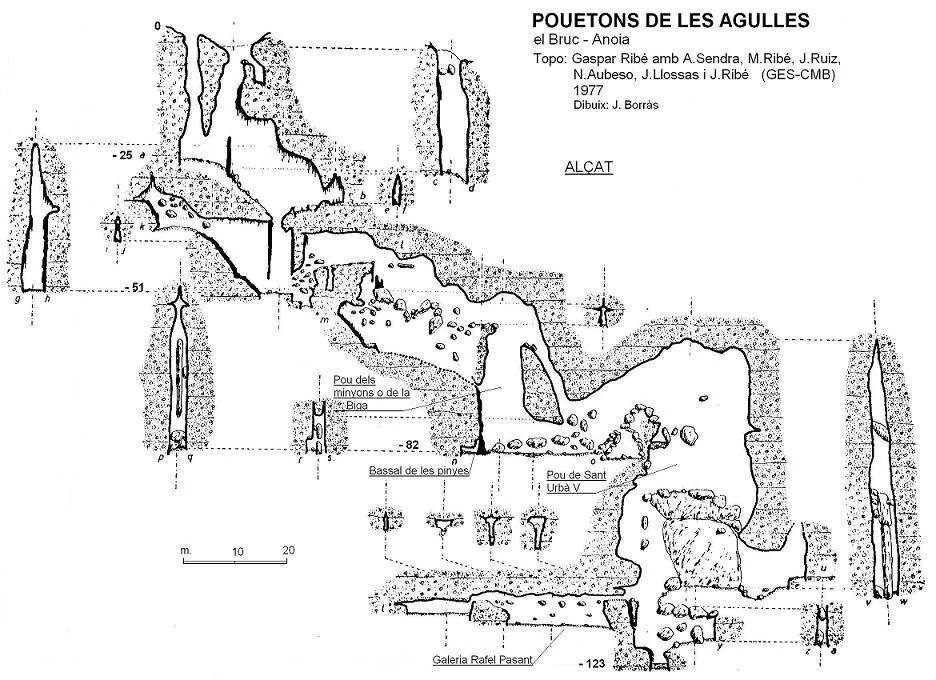
The cavity has two entrances a few metres apart. Descending through the slightly higher one, you enter a 25-metre pit that leaves you at the top of a steeply sloping ramp and which, beside some magnificent gours, drops into a second vertical of 16 metres. If you enter through the lower entrance (the more usual route), the pit has a drop of 32 metres and passes close to the end of the ramp to link directly with the second pit. Its base is fairly wide, but you have to squeeze through a narrow vertical fissure followed by an 8-metre drop. It continues along a joint-controlled gallery full of blocks. Shortly after a widening you reach a new vertical (Pou del Minyons o de la Biga), of 25 metres. At the bottom of the pit there is a beautiful pool (Bassal de les Pinyes) and a wide, long corridor begins, made awkward by a multitude of wedged blocks. After a narrow section you have to climb a clastic ramp and then descend it again at the other end until you reach an 11-metre little pit that leads to a large area, made up of a false floor generated by an accumulation of blocks. The pit continues through a wide opening between the wall and the blocks and, at 20 metres of descent, a corridor more than 20 metres long is formed, divided by a large vertical slab. At the other end, a new pit, of 14 metres and between large blocks, leads to the deepest point, occupied by a pool of water. Before descending this pit, by an easy traverse, you can reach a gallery (Galeria Rafel Pasant) about 50 metres long. Nova Galeria Quim-Avent: From almost the final point of the pit you can reach the Quim-Avent gallery, by down-climbing a narrow 3.40 m drop and afterwards you will find another narrow passage from which we will see a tight bend to our left, into which we will go into the gallery through which a small stream flows, which we will follow for some 13 m in a straight line to the deepest point, from where progress is impenetrable. At this point we will climb two metres to reach an upper level of the same gallery, along which we will advance stretched out through narrow sections to its maximum extent. Using the topography published in 1976 by the GGG of 123 m depth, the newly discovered gallery has been drawn in such a way that the new estimated depth of the cavity stands at 124.60 m.
Speleothems
Gours and a splendid flowstone (la Llengua de Gat).
Hydrology
A pool of water at the deepest point, significant depending on the season. A small stream in the Quim-Avent gallery.
Progression
Descending through the higher entrance, you enter a 25-metre pit that leaves you at the top of a steeply sloping ramp and which, beside some magnificent gours, drops into a second vertical of 16 metres and which is descended alongside a splendid flowstone (la Llengua de Gat), practically to the bottom of the pit. If you enter through the lower entrance (the more usual route), the pit has a drop of 32 metres and passes close to the end of the ramp to link directly with the second pit. Its base is fairly wide, but you have to squeeze through a narrow vertical fissure followed by an 8-metre drop. It continues along a joint-controlled gallery full of blocks, which must be overcome for some metres by opposition in the upper part, while below the joint continues. Shortly after a widening you reach a new vertical (Pou del Minyons o de la Biga), of 25 metres and where many years ago there had been an iron beam to facilitate the rigging. At the bottom of the pit there is a beautiful pool (Bassal de les Pinyes) and a wide, long corridor begins, made awkward by a multitude of wedged blocks. After a narrow section you have to climb a clastic ramp and then descend it again at the other end until you reach an 11-metre little pit that leads us to a large area, made up of a false floor generated by an accumulation of blocks. The pit continues through a wide opening between the wall and the blocks and, at 20 metres of descent, a corridor more than 20 metres long is formed, divided by a large vertical slab. At the other end, a new pit, of 14 metres and between large blocks, leads us to the deepest point, occupied by a pool of water, significant depending on the season. Before descending this pit, by an easy traverse, you can reach a gallery (Galeria Rafel Pasant) about 50 metres long. Nova Galeria Quim-Avent: From almost the final point of the pit you can reach the Quim-Avent gallery, by down-climbing a narrow 3.40 m drop and afterwards you will find another narrow passage from which we will see a tight bend to our left, into which we will go into the gallery through which a small stream flows, which we will follow for some 13 m in a straight line to the deepest point, from where progress is impenetrable. At this point we will climb two metres to reach an upper level of the same gallery, along which we will advance stretched out through narrow sections to its maximum extent.
Other details
Using the topography published in 1976 by the GGG of 123 m depth, the newly discovered gallery has been drawn in such a way that the new estimated depth of the cavity stands at 124.60 m.
History
Known since time immemorial and laden with stories and legends (witches' lair, of the devil himself and the grave of the Regirarocs, among others). From the investigations carried out in recent years by our colleague F. Miret we have been able to learn that the first mentions of this pit are those provided in the Diari de Francisco de Zamora in 1789, as well as the plates commissioned by him from the artists Remart and Montanya, who drew the entrances of the little pits among other illustrations of the mountain. Years later, some of these mentions appear in the controversial manuscript of P. Gerard Joana (1801), giving rise to a work by abbot Muntadas (1867) in which the information is distorted and which until not many years ago was taken as certain that P. Joana had sounded, at least, the first pit. Certainly, the first exploration of the Pouetons de les Agulles was carried out on 27 July 1908 by Faura i Sans, Có de Triola, P. Marcet, Serradell and others, descending the first two pits and considering the exploration finished. A few days later, on 12 August 1908, Faura and P. Marcet returned accompanied by the eminent French naturalist J. Maheu, his wife and his nephew. It is not until 25 May 1952 that, on a routine visit by members of the GES-CMB (Brusotto, Lamarca and Serra), they discover an ascending fissure which they partially climb. They do not give much importance to this discovery and it remains forgotten. On 11 October 1954 a group of boy scouts of the SEDAC (Igualada) visit the pit and rediscover the ascending passage at its bottom and reach the bottom of the Pou de la Biga, but lacking equipment, they have a small accident and turn back. The following day, in Montserrat, they speak with Lluís Muntan and Oscar Andrés and offer them the possibility of continuing the exploration. On 19 December of the same year, members of the GES make a first entry and reach the final point of the Igualada group, confirming the continuation of the cavity. Finally, on 23 January 1955, a GES team reaches the bottom of the pit and makes a first survey that places the bottom at elevation -144, in a flooded pit. Shortly afterwards they returned with the divers of the ERE, confirming that the 'final lake' was a simple closed pit that at that time had little more than 5 metres from the water level. Between 1976 and 1977, by chance, three Catalan groups (GGG; GES and SIE) resurvey the cavity individually and all three agree in fixing the elevation of maximum penetration at '-123 metres'. On 29 September 1991 the CPCE (Centre de Protecció de les Cavernes i Entorn), with the support of the Federació Catalana d'Espeleologia, organised the cleaning of the graffiti on the walls of the 'Pou de la Biga', in which 13 cavers from different caving groups took part. During the chiropterological study carried out in 2019-2020 by Avent Sandoval, one of the exploration colleagues, Quim Pesqué, noticed a fissure at the bottom of the cavity into which they went and, after several digs, they managed to discover this gallery of 29 m in length and 3.60 m of drop. In the course of these digging and surveying prospections have participated: Avent Sandoval, Quim Pesqué, Artsiom Skarabahaty, Jaume Sandoval, Rosa Domínguez, Toni Macià, Jordi Llorca, Emilia Doña, Juanjo Rios and Andreu Florit.
User Comments (0)
No comments yet.
Be the first to share your experience!
Registered Explorations (0)
No explorations registered yet.
Register your visit to this cave!
Bibliography
Andrés, O. (1956).-'Primera exploraciónn total al Avenc dels Pouetons. Región de les Agulles. Montserrat'. Ciencia y Montaña (1r. trim.). ClubMuntanyenc Barcelonés. Barcelona.
Armengou, J.Mª. (1955).-'L'Avenc dels Pouetons'. Cordada (2): 4-5. Barcelona.
Cardona, F. (1977).-'El avenc dels Pouetons de les Agulles'. Exploraciones (1): 32-38. GG Gràcia. Barcelona.
Cardona, F. (1990).- Grans cavitats de Catalunya, vol 2. 484 pp. EC Gràcia. Barcelona.
CPCE. 1993.- Butlletí nº7.
Faura, M. (1911).-'La espeleología de Cataluña. Mem. Real Soc. Esp. Hist. Nat. (6): 167 pp. Museo de Ciencias Naturales. Madrid.
Maheu, J. (1912).-'Exploration et flore souterraine de cavernes de Catalogne et des illes Balear'. Spelunca T. VIII (67-68): 108 pp. Bulletin & Mémoires de la Société de Spéléologie. París.
Miret, F. (2004).- 'Exploracions a la cova del Salnitre (1789-1808) Collbató. Baix Llobregat'. Actes del 1er. Congrés Català d'Espeleologia: 171-181. Federació Catalana d'Espeleologia. Barcelona.
Serradell, B. (1909).-'L'avenc dels Pouetons de les Agulles a la montanya de Montserrat (terme del Bruc)'. Sota Terra (I): 117-168. Club Muntanyenc. Barcelona.
Dades i topografia de la nova Galeria 'Quim-Avent', facilitades per Avent Sandoval (març 2020).
Fotografias 'Espeleo y Fotografia' de Rat Penat, 2023. (espeleoyfotografia.blogspot.com).
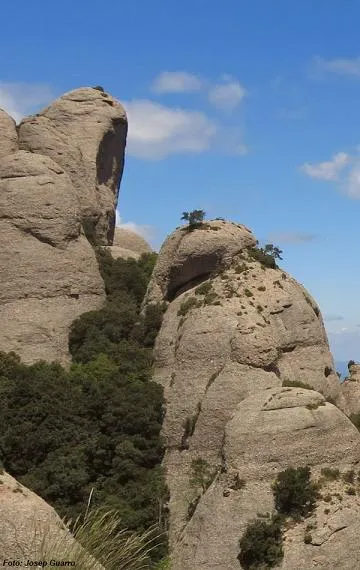
Actualització de coordenades i fotografia boca superior facilitades per Josep Guarro, juliol de 2025.
Nearby caves


Source: Espeleoindex (espeleoindex.com), modified. CC BY-NC 4.0, https://creativecommons.org/licenses/by-nc/4.0/