
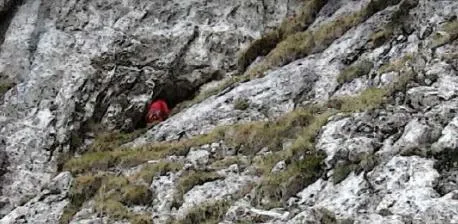
Grallera del Carabasser
Important avenc de 166 m. de fondària al Pedraforca (Saldes)
EspeleoWorld
Grallera del Carabasser
Important avenc de 166 m. de fondària al Pedraforca (Saldes)
Saldes · Berguedà
Length: 470 m · Depth: 166 m
Updated record
https://espeleoworld.com/en/c/grallera-del-carabasser
Information can change. Always verify coordinates, access, weather, and cave conditions before setting out.
A 166 m deep pit in the Pedraforca (Saldes), known as the Grallera del Carabasser, with a route that begins with a 34 m pitch and reaches the -166 level.
Topographic
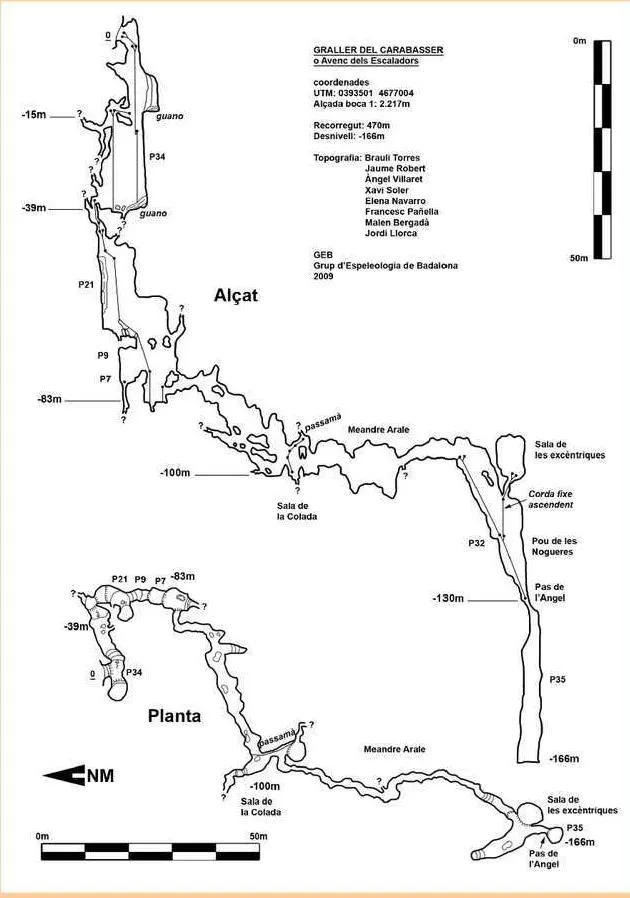
Espeleoindex · CC BY-NC 4.0, https://creativecommons.org/licenses/by-nc/4.0/ · Image © its author.
Photos
Espeleoindex · CC BY-NC 4.0, https://creativecommons.org/licenses/by-nc/4.0/ · Image © its author.
Description
Morphology
The entrance, lateral in form, gives way to a 34 metre pitch that widens towards its base, covered by a considerable thickness of chough guano, as is the ledge located at the –17 level, slightly offset from the vertical. At the E end of the bottom of the pitch, by means of a small step and a narrow passage, one enters a second vertical of 21 metres, reaching the –63 level, where to the volume of this second pitch is added that of a blind-vaulted cavity located at the SW end. A third pitch, elongated in form, with a drop of 9 metres, gives way to two small pitches and at the bottom of the larger of them the maximum penetration level was reached until 2008 (-83 m, GEB survey revision).
About 4 metres from the last pitch of the pit there is a window which, once passed, allows entry into a bottomless meander (Meandre Arele), which little by little gains depth (at some point it exceeds the –100 level) and at the middle of its course presents a chamber of larger dimensions (Sala de la Colada). In the last stretch, the meander climbs a little and connects with a 32 metre pitch (Pou de les Nogueres). At the middle of this, by climbing, one can reach a chamber located in the upper part (Sala de les Excèntriques). At the bottom of the Pou de les Nogueres there is a really very narrow passage (Pas de l'Àngel) that allows entry into a new vertical, of 32 metres, at the bottom of which (level –166) the progression currently ends.
New branches have also been explored in the 'old' zone of the pit, notably a lateral zone in the middle part of the entrance pitch. Following the exterior fissure and about 50 metres higher up, the members of the GE Badalona were able to clear the mouth of a new cavity (Avenc Superior) and in which they were able to descend to a depth of 20 metres. Everything seems to indicate that it may be directly related to the grallera, but for the moment the passage between the two is not possible.
Speleothems
The walls of the second pitch are draped with magnificent flowstone. The base of the third pitch is covered by a stalagmitic crust.
Progression
The progression described is as follows: lateral entrance, 34 metre pitch, ledge at the –17 level, second vertical of 21 metres down to the –63 level, third pitch with a drop of 9 metres, two small pitches and bottom of the larger one (maximum penetration level -83 m until 2008). About 4 metres from the last pitch there is a window that leads to the Meandre Arele, which gains depth (exceeds the –100 level) and presents the Sala de la Colada; the meander climbs and connects with the Pou de les Nogueres (32 m). At the middle of this pitch, by climbing, one reaches the Sala de les Excèntriques. At the bottom of the Pou de les Nogueres is the Pas de l'Àngel, which allows entry into a new vertical of 32 metres and at the bottom of which (level –166) the progression currently ends.
Other details
Toponymy: Although for many years the words graller and grallera have been mixed and used interchangeably, it seems that the most correct would be, and thus Joan Coromines confirms in his Diccionari Etimològic i Complementari de la Llengua Catalana, that the word grallera would be the correct one throughout the Pyrenean zone from the Llobregat to the Segre, and from there westwards the term graller would prevail (starting from the most common: lo graller). Curiously, when we go into Aragonese lands and from the Éssera basin onwards (not in the Franja, which continues to use graller), the toponym grallera is used again.
History
The first speleological news of the pit was provided by the climbers who informed Daniel Vergés (GES – CMB) of its existence, who together with his wife, Cristina Masriera, carried out the first exploration in July 1966. Only a brief note appeared in the magazine Geo y Bio Karst remains as a record, and they decided to name it Avenc dels Escaladors.
It is not until early May 1973 that a team from the SIE – CEA explores the cavity again and makes the first survey, reaching the same point as those of the GES seven years earlier and where it seemed to be closed at a little more than 80 metres of depth.
In Saldes, talking with different villagers, they find out that some have known the cavity for many years and that even one of them, Josep Casadesús, had descended, helped with ropes and by a group of friends, around the year 1930 to collect guano (from the explanations it seems he had reached the ledge of the first pitch). During the conversation it can also be learned that the pit is called the Grallera and to differentiate it from the Grallera on the N face of the Pollegó Superior, they add del Carabasser, which is how the Pollegó Inferior is popularly known (or was known).
35 years had to pass to have new news of the cavity. A group of members of the Grup d'Espeleologia de Badalona went for a recreational visit to the pit on 17 May 2008. Once at the bottom, they observe that about 4 metres above there seems to be a window. Once passed, they can access new galleries through a bottomless meander. Two weeks later they return and at the end of the meander they find and descend a 32 metre pitch and at its bottom, a very narrow passage that must be cleared. The clearing is carried out the following week and due to the extreme narrowness, only one member of the team can pass it, managing to descend a 35 metre pitch where the point of maximum depth of the pit is reached.
They do not return until early May 2009 and throughout the summer and well into December they make a total of five visits to fully survey the cavity, review different unknowns (both inside and outside the pit) and remove the equipment.
User Comments (0)
No comments yet.
Be the first to share your experience!
Registered Explorations (0)
No explorations registered yet.
Register your visit to this cave!
Bibliography
- AA.- (1967).- “Primera exploración a una sima en el Pedraforca”. Geo y Bio Karst (10): 23. Ed. J.Mª Armengou. Barcelona.
- Borràs,J; Miñarro,J.M; Talavera,F.(1980).-”l'Urgell, el Solsonès, la Segarra i el Berguedà”. Catàleg Espeleològic de Catalunya (vol. 5): 1-233. Ed. Políglota. Barcelona.
- Miñarro, JM. (1974).- “ Apuntes para el conocimiento espeleológico del Pedraforca”. EspeleoSie (15): 23-53. SIE – Centre Excursionista Àliga. Barcelona.
- Valles, J. de (2009).- Catàleg Espeleològic de Catalunya. Vol. 3: 381 pp. Espeleo Club de Gràcia / Federació Catalana d'Espeleologia. Barcelona.
- Totes les dades, coordenades, topografia (2009) i fotografies són extretes del web: geb.cat del Grup d'Espeleologia de Badalona i on es poden trobar més detalls de les darreres exploracions realitzades (2008-2009).
Nearby caves
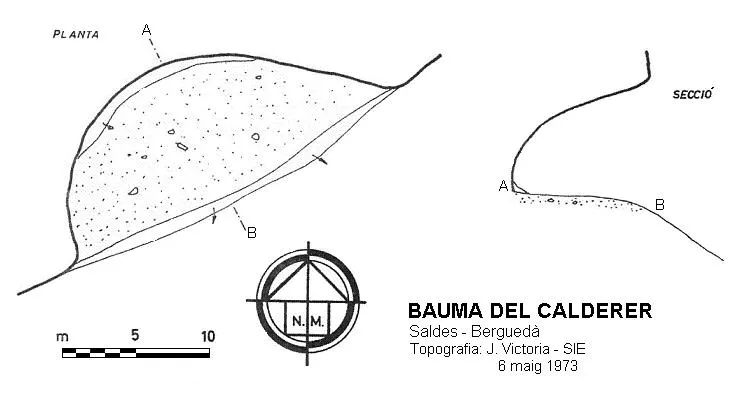
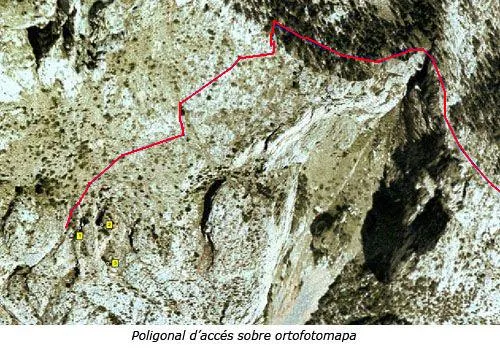


Source: Espeleoindex (espeleoindex.com), modified. CC BY-NC 4.0, https://creativecommons.org/licenses/by-nc/4.0/