
Forat de l'Obaga de la Maçana
A cavity with 45 metres of vertical drop in Camarasa, with 142 metres of passage and developed lithogenesis.
EspeleoWorld
Forat de l'Obaga de la Maçana
A cavity with 45 metres of vertical drop in Camarasa, with 142 metres of passage and developed lithogenesis.
Camarasa · Noguera
Length: 142 m · Depth: 45 m
Updated record
https://espeleoworld.com/en/c/forat-de-l-obaga-de-la-macana
Information can change. Always verify coordinates, access, weather, and cave conditions before setting out.
A cavity with 45 metres of vertical drop in Camarasa, with 142 metres of passage and developed lithogenesis.
Topographic
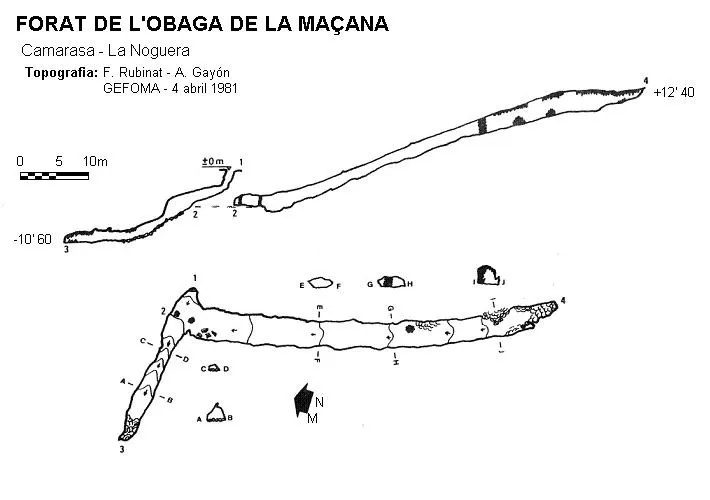
Espeleoindex · CC BY-NC 4.0, https://creativecommons.org/licenses/by-nc/4.0/ · Image © its author.
Photos
Espeleoindex · CC BY-NC 4.0, https://creativecommons.org/licenses/by-nc/4.0/ · Image © its author.
Description
Morphology
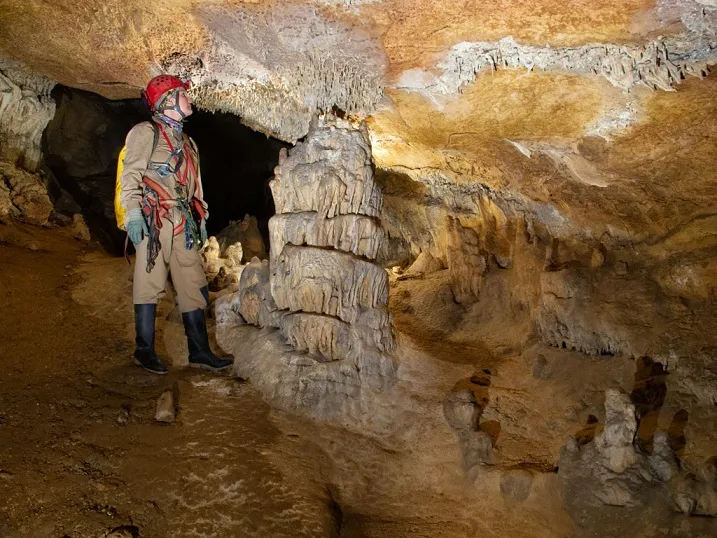
An entrance of 1x1.5 metres that gives way to a 2-metre pitch in which no rigging is necessary. The base of the pitch meets a passage that, if we continue descending in a NW direction, continues for a few metres until ending at -10 metres of depth. If, on the other hand, we continue in a SE direction, the gallery climbs back up until reaching a narrow passage that has been cleared; after another narrow passage the gallery continues until reaching the base of a 6-metre-high flowstone, where there is a fixed rope installed. At the upper part of the flowstone the gallery continues until it becomes closed; a few metres before, on one side and on the ceiling, we find a narrow impenetrable passage through which daylight from outside can be seen; through this opening in winter a good draught of air comes out. The vertical drop of the cavity is 45 m (-10/+35) and the passage is 142 metres.
Speleothems
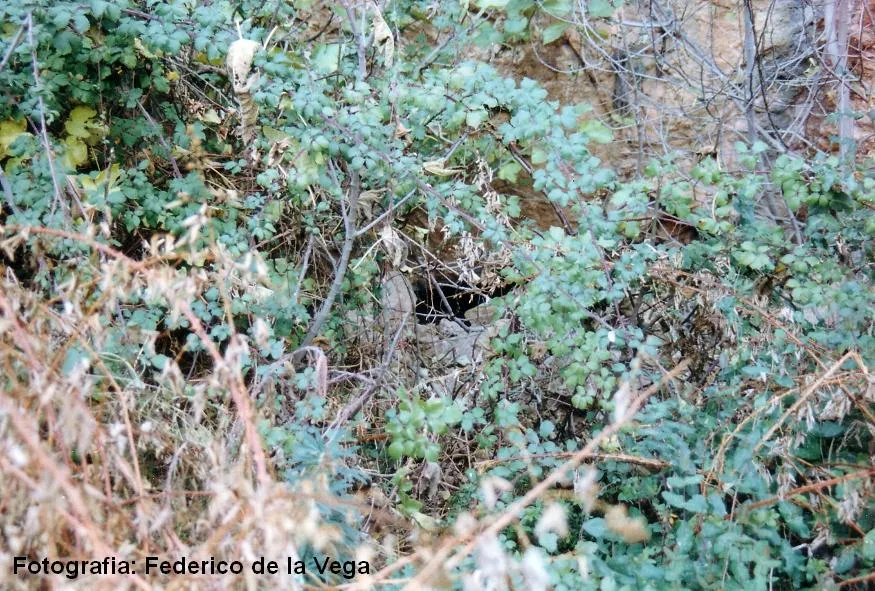
Lithogenesis is quite developed throughout the cavity, although fairly damaged in the part before the clearing carried out in the gallery. The upper opening has not been cleared in order to preserve the conservation of the cavity.
Progression
On 26 November 2022 Jordi Soria and Xavi Gómez make a first visit to the cavity and observe that at the end of the ascending gallery there is a small hole through which the arm barely passes. They rig up a kind of pole, a “selfie stick” type, with a branch to which they tie the mobile phone with the rubber band of a headlamp and take some video of the interior; what they see encourages them to continue. They return on 27 and 28 November armed with a hammer and chisel and spend some 8 hours over the two days widening the hole; in the end they manage to get through a very narrow hole, but another passage with formations blocks their way. They return again on 6 December, this time bringing a percussion hammer, they widen the passage further and open the next narrow passage, gaining access to a gallery with plenty of formations until reaching a flowstone that blocks their way; they have to go out to look for a rope and, back at the flowstone, they climb exploring what remains of the gallery, observing almost at the end a small hole through which light enters; they descend on a double rope and remove it. On 7 January 2023 they set out again for the cavity, locate the small forat bufador (blowing hole); it could be cleared, but they think it is not necessary and it will serve to better conserve this fragile ecosystem. They survey the cavity and leave a 6-metre rope fixed in place to be able to get past the flowstone.
History
A combination of circumstances has meant that the name of this cavity has ended up being quite a headache.
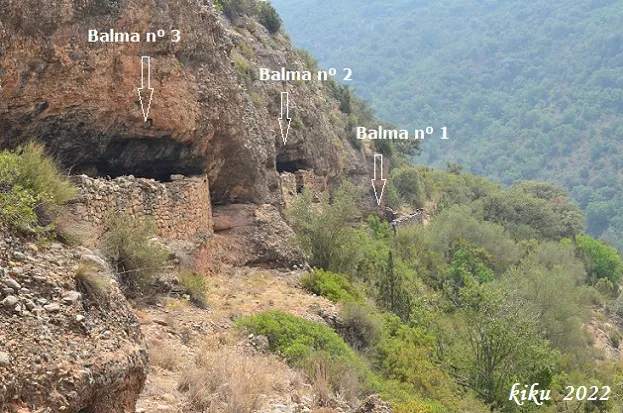
The first mentions we have of this cavity are, on the one hand, from Oleguer Escolà, who cites it as Cova de la Maçana in the ERE's Catàleg del Montsec and published in Espeleòleg (11-12) in 1970. On the other hand, Jesús Serrate and Xavier Corrià of the GELL publish a note in a bulletin of the Centre Excursionista de Lleida also in 1970, but citing it as Cova de l'Obaga. In the early 70s the GEFOMA, having learned of the existence of the cavity, approached Ca l'Urcola, who was the one who made the track from the Camarasa dam to la Maçana with the intention that a housing development and a nautical club be built in the area (fortunately it did not go ahead). This gentleman indicated to them where the cavity was, calling it Forat de l'Obaga. On arriving at the entrance they found a large piece of graffiti on which could be read “Forat de l'Obaga de la Massana”, supposedly made by the members of the GELL; at present (2009) no trace of the graffiti remains. The Cova de la Maçana or Cova-Casa de la Maçana is already cited by Jeannel and Racovitza in 1912; in 1911 Faura cites it; both citations refer to the explorations carried out by Jeannel and Racovitza between 1909 and 1911. At present this la Cova (the cave) lies beneath the waters of the Camarasa reservoir. According to Jeannel and Racovitza, as well as old citations, there was a two-storey house at the entrance. Popular legends say that it was an inn for muleteers, and that one of them had disappeared while sleeping, his remains ending up inside the cave, which was about 60 metres long. Recently, we have located an article on the website caminsdemuntanya.com about the construction of the Camarasa dam and power station, where a photograph of the Cova de la Maçana appears before it was submerged in the Camarasa reservoir. The photograph has been included in the 'Photos' section, so that it remains as a testimony to its existence. On the other hand, in the book “El Montsec i Muntanyes veïnes” by Manuel Cortès, on page 46, referring to the caves where medieval remains have been found, the cova de la Maçana is cited; it is evident that it refers to the cave that today is beneath the reservoir. In the same book, on page 324, the cova de la Maçana is cited again, but this time it is given a location and description very similar to the forat de l'Obaga. The conclusion we draw from all this is that the Cova-casa de la Maçana or cova de la Maçana, at present beneath the waters of the reservoir, bears this name because it is geographically close to the now abandoned village of la Maçana. While the Forat de l'Obaga de la Maçana is another cavity; probably the original name was Forat de l'Obaga and that later, through geographical proximity, the “de la Maçana” was assimilated, even though in reality where it is geographically located is in the Obaga de les Figueretes.
User Comments (0)
No comments yet.
Be the first to share your experience!
Registered Explorations (0)
No explorations registered yet.
Register your visit to this cave!
Bibliography
- Faura, M. (1911).- “Excursiones espeleológicas realizadas durante el año 1910 en la región catalana”. Boletín Real Sociedad Española Historia Natural. (11):354-376. Madrid.
- Jeannel, R. Et Racovitza, EG.(1912).-“Enumération des grottes visitées, 1909 -1911. (Quatrième série)”. Biospeologica. (XXIV).
- Rubinat, Francesc.(1981).-“Forat de l'Obaga de la Maçana”. GOURS (8):35-38. GEFOMA. Barcelona.
- Cortès i Ribelles, Manuel.(1984).-El Montsec i Muntanyes veïnes. Centre Excursionista de Lleida.
- Gazquez, J.Ll.(1995).-”Catàleg Espeleològic de la Noguera”. Grallera (3-4):1-90. GELL-CEL. Lleida.
- Gàzquez Fàbregas, Àngel.(1999).-“Notes d'Espeleologia tretes dels butlletins del Centre”. Grallera. (5):57-72. GELL – C.E.Lleida.
- Valles, Jordi de (2009).-”Alt Urgell, Noguera, Pla d'Urgell, Segarra, Solsonès, Urgell”. Catàleg Espeleològic de Catalunya (vol.2):1-384, EC Gràcia/FCE.
- www.camins de muntanya.com (la construcció de la presa i central de Camarasa). Foto propietat de Paquito Gessé.
- Dades, coordenades, topografia actualitzada i fotos facilitades per Jordi Soria i Xavi Gómez.
- Dades i fotografies extretes del web: espeleodijous.cat post del 26-01-2023.
Nearby caves


Source: Espeleoindex (espeleoindex.com), modified. CC BY-NC 4.0, https://creativecommons.org/licenses/by-nc/4.0/