
Exsurgence de Mortefemme
Temporary emergence completely flooded in high water, beginning with an inclined 65° shaft whose bottom is today once again obstructed.
EspeleoWorld
Exsurgence de Mortefemme
Temporary emergence completely flooded in high water, beginning with an inclined 65° shaft whose bottom is today once again obstructed.
Saint-Germain-des-Bois
Length: 14 m · Depth: 6 m
Updated record
https://espeleoworld.com/en/c/exsurgence-de-mortefemme-saint-germain-des-bois-nievre
Information can change. Always verify coordinates, access, weather, and cave conditions before setting out.
Approximate location: no map or coordinates are printed for this cave. The source marks this entrance position as unverified.
Temporary emergence completely flooded in high water, beginning with an inclined 65° shaft whose bottom is today once again obstructed.
Topographic
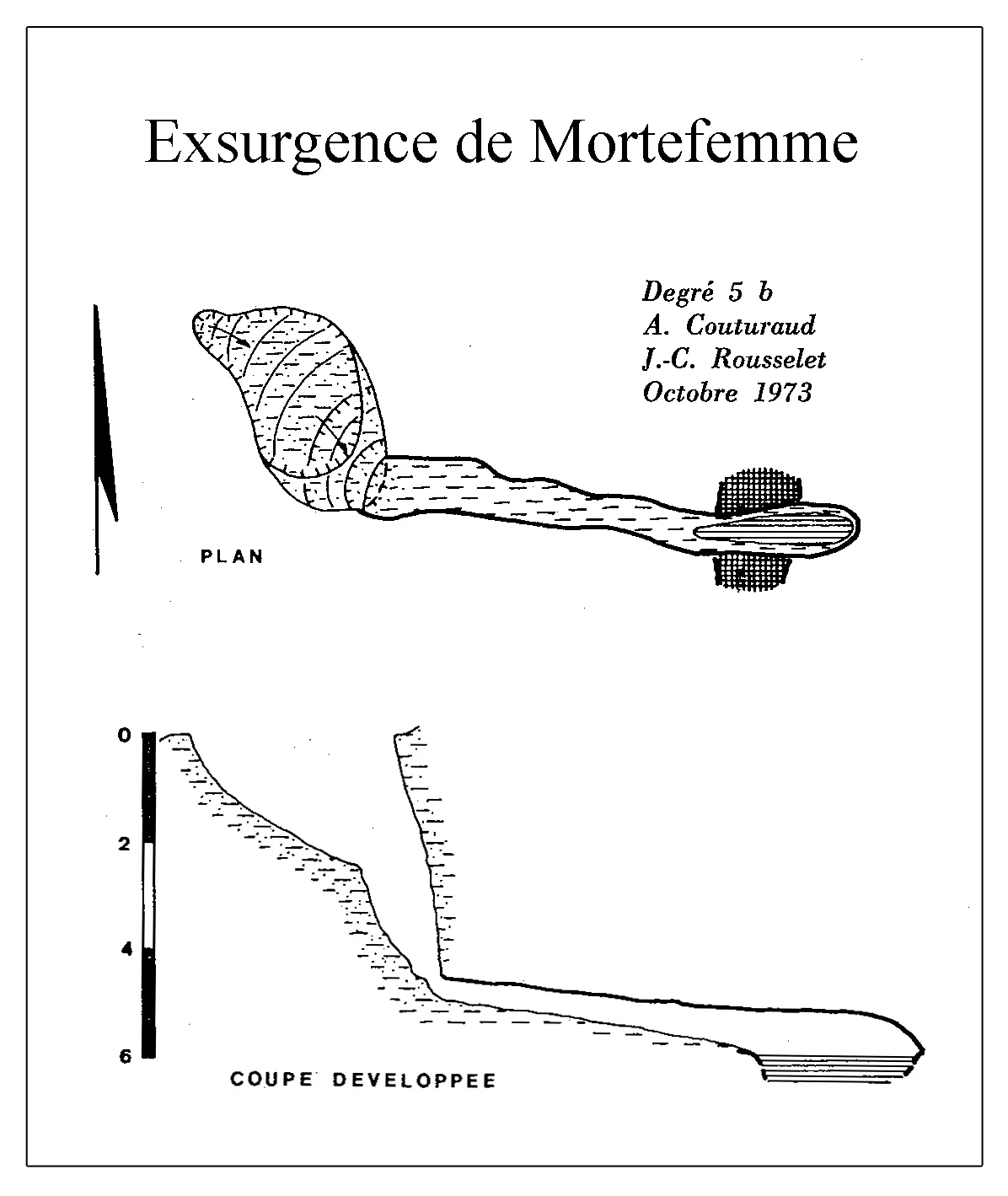
© Couturaud, Rousselet · CC BY-NC-SA (version not stated by the source), https://www.karsteau.org/karsteau/index.php · Karsteau: Topographie Exsurgence de Mortefemme · https://www.karsteau.org/karsteau/recherche/entree/recherche_entree.php?entree=24297
Description
Morphology
The emergence springs from the bottom of a hole 4 to 5 m deep. The cavity begins with an inclined 65° shaft that is easily descended. The bottom of the entrance shaft is a mixture of clay and pebbles; it is today once again obstructed.
Hydrology
It is a temporary emergence that can discharge around 200 l/s in flood. The cavity is completely flooded during high-water periods. The gallery discovered at Easter 1961 ended 6 m further on at a sump whose water comes from a perpendicular gallery, inaccessible because of its narrowness.
Progression
The hole had been covered by a grate fixed on four stone slabs. During a flood, the remaining opening being insufficient, the water managed to break through the floor over an area of 4 to 5 m2; the slabs came loose. In 1960, Jean-Claude Rousselet and the Spéléo-Club de Lutèce took an interest in the emergence; their first work, named “Opération Morte-femme”, consisted of removing the unstable slabs and the grate: installing a 500 kg pulley block and a makeshift hoist was necessary to remove the slabs from the hole. The bottom was dug out for about a year (1960-1961) by the Spéléo-Club de Lutèce, which, at Easter 1961, discovered a gallery.
Other details
Geology: Lower Bathonian.
History
In 1960, Jean-Claude Rousselet and the Spéléo-Club de Lutèce took an interest in the emergence; their first work, named “Opération Morte-femme”, consisted of removing the unstable slabs and the grate. The bottom was dug out for about a year (1960-1961) by the Spéléo-Club de Lutèce, which, at Easter 1961, had the pleasure of discovering a gallery.
User Comments (0)
No comments yet.
Be the first to share your experience!
Registered Explorations (0)
No explorations registered yet.
Register your visit to this cave!
Nearby caves

Source: Karsteau (Fédération Française de Spéléologie et Canyon) (www.karsteau.org), modified. CC BY-NC-SA (version not stated by the source), https://www.karsteau.org/karsteau/index.php Karsteau (Fédération Française de Spéléologie et Canyon) · Text by Karsteau (FFS) contributors, Karsteau (FFS) contributors (Géologie) · adapted by Espeleoworld (normalized, translated); the adaptation is licensed CC BY-NC-SA (version not stated by the source), https://www.karsteau.org/karsteau/index.php · https://www.karsteau.org/karsteau/recherche/entree/recherche_entree.php?entree=24297 · data as of 2026