
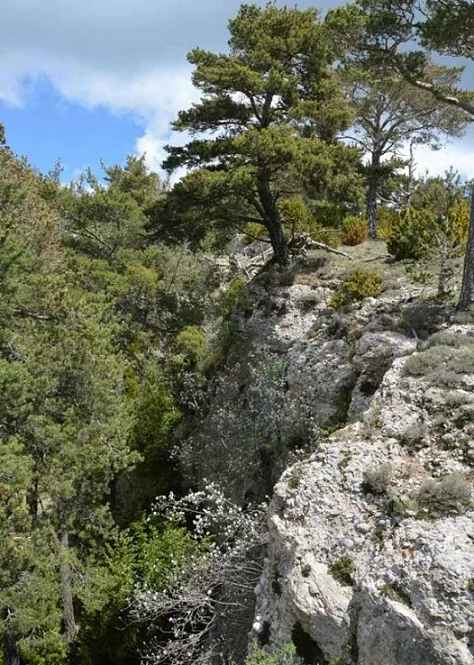
Escletxa Gran de Corrubí
Important conjunt d'esquerdes a la zona dels Rasos de Tubau (Ripollès)
EspeleoWorld
Escletxa Gran de Corrubí
Important conjunt d'esquerdes a la zona dels Rasos de Tubau (Ripollès)
Llosses, Les · Ripollès
Length: 445 m · Depth: 63 m
Updated record
https://espeleoworld.com/en/c/escletxa-gran-de-corrubi
Information can change. Always verify coordinates, access, weather, and cave conditions before setting out.
Important group of fissures at the Rasos de Tubau (Ripollès), with l'Escletxa Gran as the main feature, in a conglomerate stratum over plastic materials.
Topographic
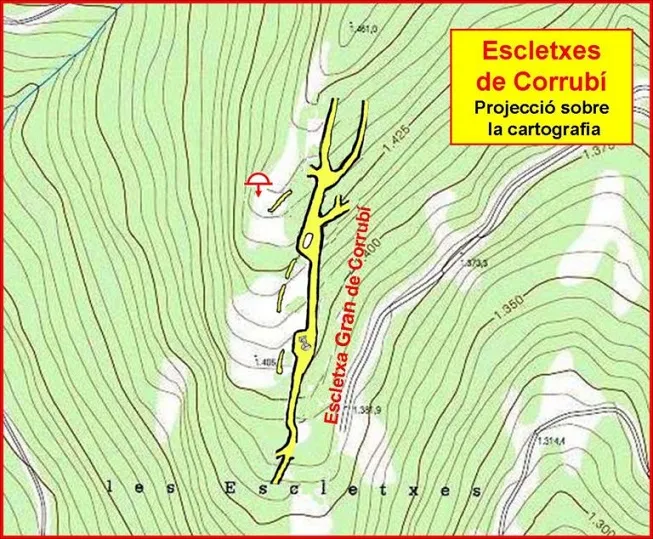

Espeleoindex · CC BY-NC 4.0, https://creativecommons.org/licenses/by-nc/4.0/ · Image © its author.
Photos

Espeleoindex · CC BY-NC 4.0, https://creativecommons.org/licenses/by-nc/4.0/ · Image © its author.
Description
Morphology
Basically, it is a long main fissure (l'Escletxa Gran), fairly straight and with an N-S alignment, with one or another minor branch. The straight-line distance between both ends of the fissure is 375 metres, overcoming a height difference of 63 metres.
The fissure forms a strong scar on the mountain in a spot close to a ridge, which it follows. Being in the middle of a forest of pines and oaks with a dense undergrowth of box makes it barely visible, passing almost unnoticed in the landscape.
The western lip of the fissure is well defined, easy to follow on the ground, being higher than the eastern lip, which does not always have a well-defined line, since in some sectors it becomes blurred and even locally disappears.
The most complex part of l'Escletxa Gran is found around what we have called “la Torre” (an isolated rocky mass surrounded by fissures). Here we find the highest walls (about 15 metres) and the most complex configuration of the bottom of the fissure due to the accumulation of blocks, which come to form passages.
In addition to l'Escletxa Gran, we find secondary fissures, not connected to one another, generally narrow and not always passable.
The fissures have formed in a conglomerate stratum. This, with a thickness of the order of 20 metres, rests on plastic materials (marls and clays). The conglomerate stratum presents a marked network of fissures that break the continuity of the rocky mass.
The coincidence of different factors, such as the dip of the stratum in favour of the topographic slope, the existence of a cliff that bounds the ridge to the west and the main system of fissures parallel to it, have created the optimum conditions for the conglomerate mass to open along the main fissures and the resulting blocks to move towards the E taking advantage of the sliding surface of the plastic materials on which they rest.
Progression
The fissure system is difficult to traverse, both because of obstacles in the form of blocks and steps and because of the dense and lush vegetation it harbours, with fallen tree trunks that must be overcome being frequent.
History
Known as “Les Escletxes” by the people of the area. Also known to some hikers, but from the speleological point of view they have not been the object of attention until recent times. In fact they do not appear in any of the speleological catalogues published so far.
The cataloguing work was done on 6 May 2017 and 11 June 2018 by members of EC Barcelonès and GE Badalona.
User Comments (0)
No comments yet.
Be the first to share your experience!
Registered Explorations (0)
No explorations registered yet.
Register your visit to this cave!
Bibliography
- Totes les dades, topografia i fotografies han estat extretes del web: geb.cat (del GE Badalona). Apunt del 26-6-2018. Autors de les dades: F. Cardona (EC Barcelonès), J. Cuenca i X. Samarra (GE Badalona)
Nearby caves
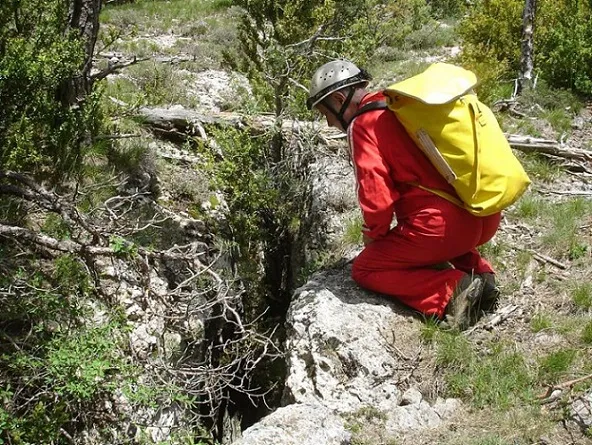
Avenc de l'escletxa Petita de Corrubí
0.3 km · N
Llosses, Les (Ripollès)
2 topo.3 photos
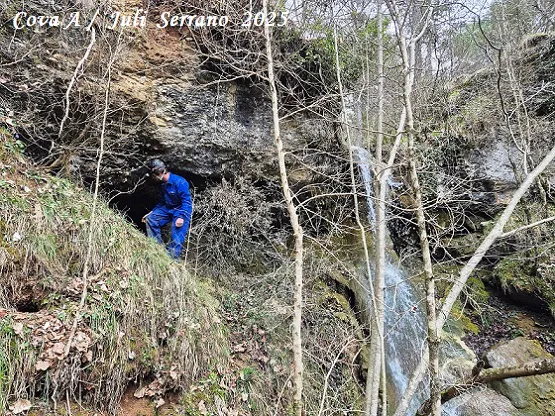
Coves de l'Aigua de Caselles
0.7 km · SE
Llosses, Les (Ripollès)
1 topo.13 photos
Esquerda Nº1 del Clot de l'infern
1.1 km · E
Llosses, Les (Ripollès)
1 topo.9 photos
Cova d'en Nil de la Riba
1.2 km · E
Llosses, Les (Ripollès)
1 topo.11 photos
Source: Espeleoindex (espeleoindex.com), modified. CC BY-NC 4.0, https://creativecommons.org/licenses/by-nc/4.0/