
Cueva Perilde
EspeleoWorld
Cueva Perilde
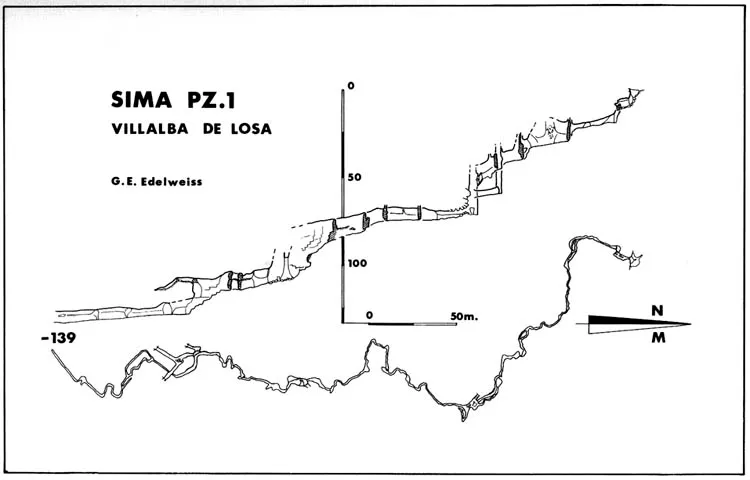
Cueva Perilde, in the Junta de Villalba de Losa (Burgos), is the upper entrance of the Pozalagua System, which links it with Goba Haundi (Álava): 13,036 m surveyed and about 200 m of vertical extent.
Junta de Villalba de Losa
Length: 13036 m · Depth: 196 m
Updated record
https://espeleoworld.com/en/c/cueva-perilde-junta-de-villalba-de-losa
Information can change. Always verify coordinates, access, weather, and cave conditions before setting out.
Cueva Perilde, in the Junta de Villalba de Losa (Burgos), is the upper entrance of the Pozalagua System, which links it with Goba Haundi (Álava): 13,036 m surveyed and about 200 m of vertical extent.
Description
Morphology
El Meandro de las Tejeras is a canyon more than 20 m high and frequently less than 1 m wide. Most of the system's vertical extent is here. La Galería Fósil, to the east, is dry, more than 5 m in diameter and about 700 m long. The Perilde entrance leads to a high, narrow gallery, with gours shortly afterwards.
The rock is Coniacian limestone. The galleries mainly follow west-to-east fractures.
Speleothems
There are gours pools almost along the entire route. The best known is the Lago Verde, large and round.
Hydrology
The usual outlet is lower down, in the Tertanga stream, at an altitude of about 370 m. Goba Haundi is an old outlet that only works in floods. The Perilde entrance today lies above the level of the underground river.
The main collector begins in the sinks of the Lloréngoz depression and the water flows east. One of them, El Hoyo, is full of sediments and rubbish, and the waste reaches the cave river.
Progression
The through trip between the two entrances has been possible since 1988. The route is about 4,500 m, with 180 m of vertical extent. From the Perilde entrance, the lowest point is at -201 m according to the catalogue and monograph of the Grupo Edelweiss. A summary by the same group gives -196 m.
History
In September 1988 the Grupo Edelweiss connected Cueva Perilde with Goba Haundi. The FEE list of large cavities gives 13,036 m for the system, dated December 1995.
The stages of study were: GEMI from 1958 to 1961, GEA in 1962, Grupo Espeleológico Edelweiss in 1971, Edelweiss with GIEX in 1986 and again Edelweiss from 1987 to 1989. In 1986 a stretch that floods easily was passed, in the axis of Goba Haundi.
In 1987 a sheep skeleton was found inside, well above the rivers, a datum that points to another upper opening.
Bio
Bones of Pleistocene vertebrates have been found in a sediment terrace that is today isolated from Cueva Perilde. In its day, that terrace fed the cave.
User Comments (0)
No comments yet.
Be the first to share your experience!
Registered Explorations (0)
No explorations registered yet.
Register your visit to this cave!
Nearby caves
Contains information from Grottocenter (Wikicaves), grottocenter.org, made available under the Open Database License (ODbL 1.0, https://opendatacommons.org/licenses/odbl/1-0/), modified. · https://grottocenter.org/ui/entrances/19925 · data as of 2026 · Text written by Espeleoworld from public sources. Please ask us before reusing it. · Text by José Luis Membrado Julián (Grandes Cavidades Españolas 2024), Grupo Espeleológico Edelweiss (Cueva Perilde (Sistema de Pozalagua, Sistema Cueva Perilde-Goba Haundi) - Catálogo del Grupo Espeleológico Edelweiss), Miguel Angel Martín Merino; Teresiano Antón Palacios (El Sistema de Pozalagua - Grupo Espeleológico Edelweiss), Grupo Espeleológico Edelweiss; Diputación Provincial de Burgos (Las cavidades del sector Pozalagua de Sierra Salvada (Kaite 7, 1998, pp. 145-196)), Blog Sierra Sálvada (Sierra Sálvada: Goba Haundi y Goba Txiki) · adapted by Espeleoworld (normalized, translated); the adaptation is licensed Our own text, written from public sources. Please ask us before reusing it. · The derived data is available on request under the ODbL: [email protected]