
Cueva del Tercero Ojo
EspeleoWorld
Cueva del Tercero Ojo
The Cueva del Tercero Ojo has two discreet entrances (675 and 676) leading to a network of parallel galleries, whose progression stops definitively at -95 m in the Montparnasse chamber.
Soba
Length: 1220 m · Depth: 97 m
Updated record
https://espeleoworld.com/en/c/cueva-del-tercero-ojo-soba
Information can change. Always verify coordinates, access, weather, and cave conditions before setting out.
The Cueva del Tercero Ojo has two discreet entrances (675 and 676) leading to a network of parallel galleries, whose progression stops definitively at -95 m in the Montparnasse chamber.
Description
Morphology
The cueva del Tercero Ojo has two discreet entrances (Cueva 675 and 676) that lead to a network of parallel galleries (E-W direction) cut along the dip, like the other cavities of the Fraile.
The entrance fissure of cueva 676 (1.00 x 3.00 m) is quickly blocked by a 6 m shaft. At the bottom of the P.6, the galerie du Crâne Percé is small (1.00 x 1.20 m), and a few narrow passages punctuate the crawling that continues for about fifty metres.
From -18 m, several chimneys help give the passage more scale (4 m x 6 m). At the bottom of one of them, on the right, a low, draughting crawl gives access to the galerie Parallèle, which doubles the network for about 300 metres. From this diffluence, the galerie du Crâne Percé keeps comfortable proportions.
At -45 m (200 metres from the entrance), an important tributary joins the main drain, on the left bank. It comes from the second entrance of the cavity (cueva 675) and develops parallel to the entrance galleries only a few tens of metres apart.
From this confluence, the galerie du Crâne Percé gradually changes morphology. A small stream appears, and the sandstones are now more visible. At -89 m, a boulder-filled chamber corresponds to the arrival, on the right bank, of the Galerie Parallèle. Going up it, one crosses several small tributaries ending in narrow passages (draught).
Downstream of the chamber, the boulder pile completely masks the gallery and a two-metre climb is needed to reach a small upper crawl where all the draught rushes in. Fifteen metres further on, a 7-metre vertical drop allows one to reach the main passage, which is increasingly chaotic. At this point, it develops on 4 distinct levels, each cut in a different stratigraphic level (limestone, marl and sandstone). The result hardly facilitates exploration, and at -95 m a last chamber cluttered with sandstone and marl blocks puts a definitive end to progression (salle Montparnasse). Sliding between them, one finds the stream in places (lowest point of the cavity: -97 m).
Hydrology
The cavity, like its neighbour the torca del Jabato, develops on a sandstone level located about a hundred metres above the upstream passages of the Gandara network (cuevas de la Fuente de Bustalveinte, des Calligraphes etc.). However, there is little doubt that this is the same network, even if the speleological connection remains very problematic.
Progression
The crossing of the 6 m shaft gives access to a short meander. After a 3-metre step and a few bends, one arrives at the top of a shaft about a dozen metres deep that communicates with the galerie du 675 (second entrance of the network).
Other details
Survey: see the "Documents" tab of this Grottocenter entry no. 168654 or directly
Source: Karstexplo > Spain > Sector 10: PICÓN DEL FRAILE > Cueva del Tercero Ojo (no. 675 and 676)
History
August 1988: the entrance of cave 676 is spotted by the SCD.
14 July 1993: the entrance of cueva 675 is discovered after a short dig. Fifty metres of low galleries are recognised (S. Degouve). The same day, cueva 676 is visited for 300 metres.
16 July 1993: the main gallery is explored and surveyed up to the top of the P.6. The connection with cueva 675 is made by going up a tributary (survey: 670 m) (P. and S. Degouve, C. Lecas).
26 July 1993: the P.6 is descended, but progression is blocked by boulder chokes (180 m surveyed) (P. and S. Degouve, C. Lecas, C. and D. Lefebvre).
User Comments (0)
No comments yet.
Be the first to share your experience!
Registered Explorations (0)
No explorations registered yet.
Register your visit to this cave!
Nearby caves
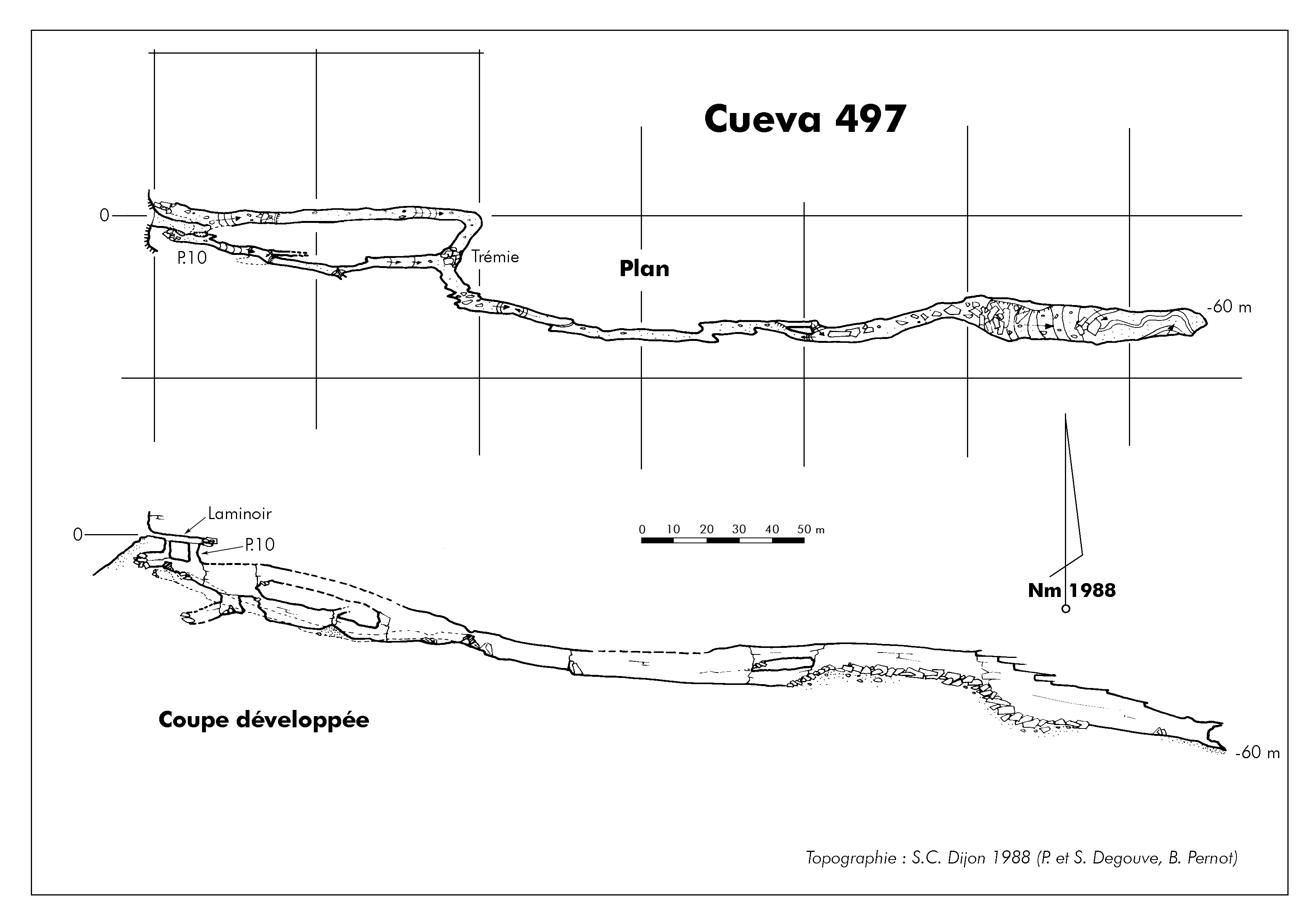
Contains information from Grottocenter (Wikicaves), grottocenter.org, made available under the Open Database License (ODbL 1.0, https://opendatacommons.org/licenses/odbl/1-0/), modified. · https://grottocenter.org/ui/entrances/168654 · data as of 2026 · Source: Grottocenter (Association Wikicaves), worldwide collaborative cave database (grottocenter.org), modified. CC BY-SA 3.0, https://creativecommons.org/licenses/by-sa/3.0/ Grottocenter (Wikicaves) · Text by BTH (Description générale), BTH (Topographie), BTH (Hydrogéologie), BTH, KDD122 (Situation et accès) · adapted by Espeleoworld (normalized, translated); the adaptation is licensed CC BY-SA 3.0, https://creativecommons.org/licenses/by-sa/3.0/ · https://grottocenter.org/ui/entrances/168654 · data as of 2026 · The derived data is available on request under the ODbL: [email protected]