
Cueva de los Huesos
Dry cave with a strong draught of indrawn air, developed along a bedding joint overdeepened by a meander, ending in a choke of sandstone blocks.
EspeleoWorld
Cueva de los Huesos
Dry cave with a strong draught of indrawn air, developed along a bedding joint overdeepened by a meander, ending in a choke of sandstone blocks.
Arredondo
Length: 180 m
Updated record
https://espeleoworld.com/en/c/cueva-de-los-huesos-arredondo
Information can change. Always verify coordinates, access, weather, and cave conditions before setting out.
Approximate location: no map or coordinates are printed for this cave. The source marks this entrance position as unverified.
Dry cave with a strong draught of indrawn air, developed along a bedding joint overdeepened by a meander, ending in a choke of sandstone blocks.
Topographic
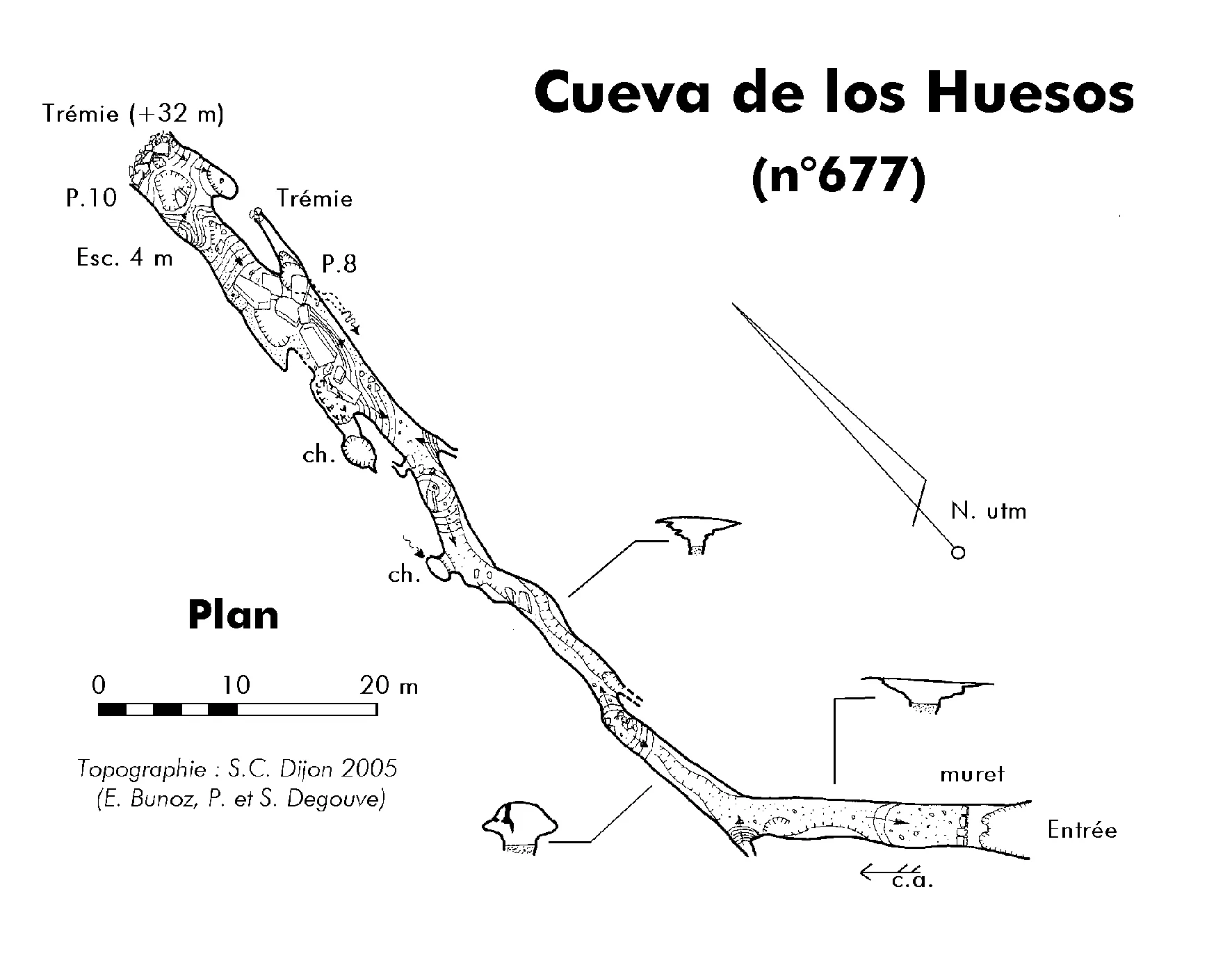
© S.C.Dijon août 2005 · CC BY-NC-SA (version not stated by the source), https://www.karsteau.org/karsteau/index.php · Karsteau: Topographie de la cavité n°677 (numérotation SCD) · https://www.karsteau.org/karsteau/recherche/entree/recherche_entree.php?entree=21399
Description
Morphology
The cave begins with a low porch (1 m x 2 m) barred by a small wall and opening onto a dry gallery traversed by a strong draught of indrawn air. The passage develops along a bedding joint overdeepened by a meander partly filled by the fill. After a low passage, the cave gains in size (2 m x 3 m). Several shafts line the route; the highest, 120 m from the entrance, measures about ten metres in height. A little further on, after large collapsed blocks, one reaches a widening. To the right, an 8 m pit reaches a short meander that becomes impenetrable. To the left, after climbing a clayey slope, a 4-metre step requires a climb to reach the top of the gallery (+ 32 m), entirely barred by a choke of sandstone blocks; just before it, a pit of about ten metres continues via impenetrable fissures.
Geology: Level 7: Sandstone and marls of the Porra (Aptian).
Speleothems
An old concretion and the remains of a suspended stalagmitic floor attest that the latter must have been more extensive at one time (see section on the survey).
Hydrology
Spring: ?
Other details
Numerous animal bones scattered all along the gallery and doubtless brought there by a predator.
History
The cueva was known to the shepherds who built a small wall at the entrance. It was located and partly explored by the S.C. Dijon on 17 July 1993 (P. and S. Degouve, C. Lecas). The exploration and the survey were carried out in August 2005 (E. Bunoz, P. and S. Degouve).
User Comments (0)
No comments yet.
Be the first to share your experience!
Registered Explorations (0)
No explorations registered yet.
Register your visit to this cave!
Nearby caves

Source: Karsteau (Fédération Française de Spéléologie et Canyon) (www.karsteau.org), modified. CC BY-NC-SA (version not stated by the source), https://www.karsteau.org/karsteau/index.php Karsteau (Fédération Française de Spéléologie et Canyon) · Text by Karsteau (FFS) contributors · adapted by Espeleoworld (normalized, translated); the adaptation is licensed CC BY-NC-SA (version not stated by the source), https://www.karsteau.org/karsteau/index.php · https://www.karsteau.org/karsteau/recherche/entree/recherche_entree.php?entree=21399 · data as of 2026