
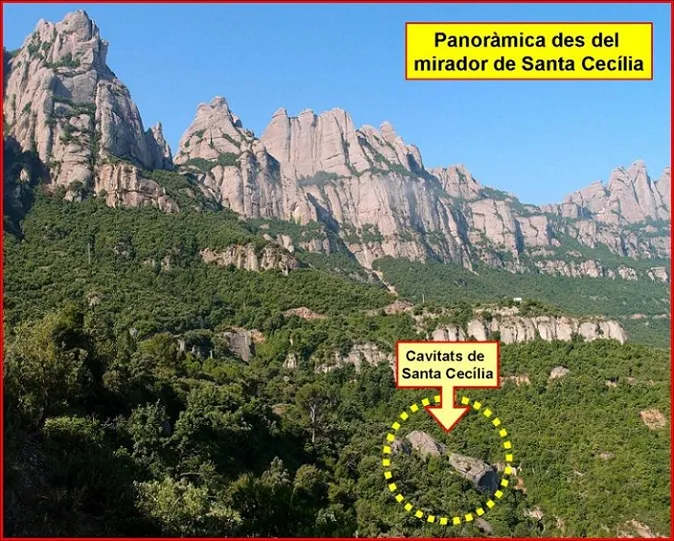
Coves de Santa Cecília
A group of clastic-origin cavities NW of the monastery of Santa Cecília (Montserrat): cova Gran, cova Petita, cova Petitona, pit and rock shelter of Santa Cecília.
EspeleoWorld
Coves de Santa Cecília
A group of clastic-origin cavities NW of the monastery of Santa Cecília (Montserrat): cova Gran, cova Petita, cova Petitona, pit and rock shelter of Santa Cecília.
Marganell · Bages
Length: 47 m
Updated record
https://espeleoworld.com/en/c/coves-de-santa-cecilia
Information can change. Always verify coordinates, access, weather, and cave conditions before setting out.
A group of clastic-origin cavities NW of the monastery of Santa Cecília (Montserrat): cova Gran, cova Petita, cova Petitona, pit and rock shelter of Santa Cecília.
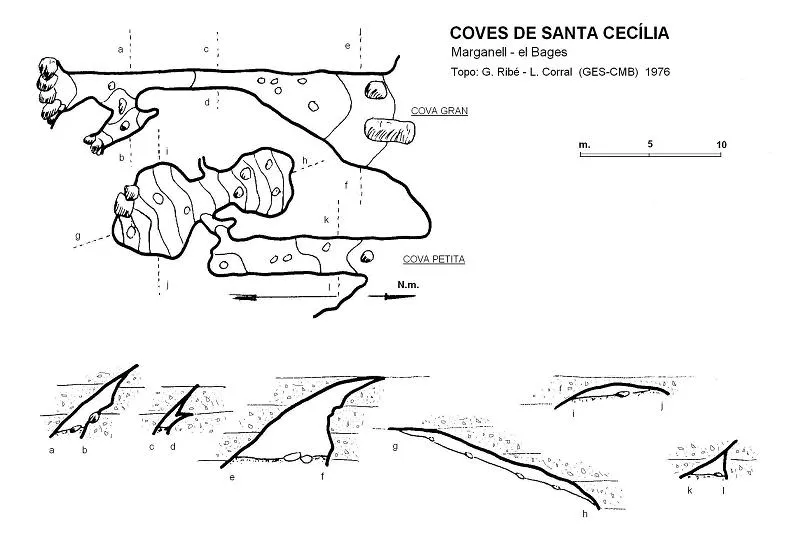
Topographic
Espeleoindex · CC BY-NC 4.0, https://creativecommons.org/licenses/by-nc/4.0/ · Image © its author.
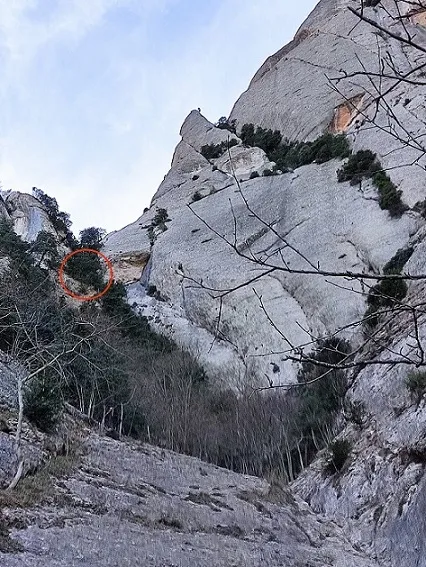
Photos
Espeleoindex · CC BY-NC 4.0, https://creativecommons.org/licenses/by-nc/4.0/ · Image © its author.
Description
Morphology
Cova Gran: the entrance is quite large, triangular in appearance and about 8 m wide. It forms a relatively flat and comfortable vestibule that narrows to continue along a straight gallery with the wall-ceiling inclined 45 degrees. The gallery ends in an accumulation of blocks, among which the outside light is visible through a narrow hole through which only a hand could pass. Shortly before the end, we can climb the left-hand wall and reach a small side chamber where there is also an impassable hole to the outside. From the right-hand side of the entrance vestibule a 6 m crawlway begins that communicates directly with the balma de Santa Cecília, which is why this forms part of the cavity and, in fact, constitutes a second entrance.
Cova Petita: it forms a straight gallery 16 m long by an average width of 4.5 m. The right-hand wall-ceiling is inclined about 40 degrees. The floor is very flat, though stony. We can walk upright through almost the whole cave. At the end, the gallery widens slightly to the left and the ceiling rises to almost 5 metres. Also towards the end there is the start of a crawlway that becomes totally impassable at two metres, although the GES survey (1976) marks an access to a small sloping room with a low ceiling.
Cova Petitona: the cave presents itself as a rock shelter 6 m wide by 4 m maximum depth. From the right-hand side, next to a block, a crawlway begins that allows us to go 5 metres further in.
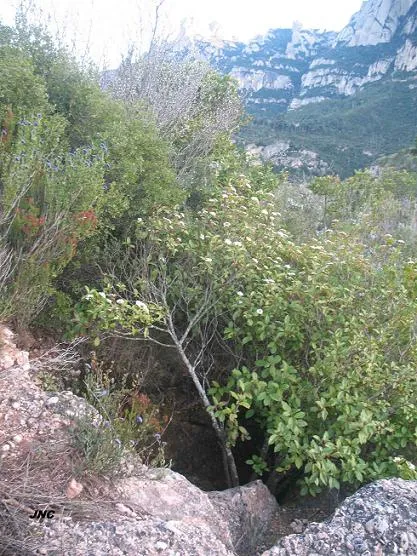
Avenc de Santa Cecília: the entrance is split in two by a block. It gives way to a series of verticals and passages between blocks. The cavity is occupied by a chaos of blocks that form something like three superimposed levels, with small rooms between the blocks. There are three crawlways that communicate with the outside, the last one allows us to exit the cavity by the lowest point.
Balma de Santa Cecília: the rock shelter is formed by the 45-degree overhang of one of the faces of an enormous block. The floor is very flat. In front of the entrance, and along its entire length, there is an accumulation of large blocks that form a kind of clastic barrier that delimits the whole surface sheltered by the rock shelter, forming an enclosed and sheltered space. Near one of the ends of the rock shelter a crawlway begins that in 6 m places us in the vestibule of the cova Gran, which is why both cavities are, in fact, one and the same cavity. In this way the rock shelter is nothing other than a second entrance of the cova Gran.
Progression
Cova Gran: route 47 m.
Cova Petita: total route 19 m.
Cova Petitona: total route 7 m.
Avenc de Santa Cecília: we descended the verticals and passages between blocks without using equipment, but at some points it is not a bad idea to place a rope since there is some rather committing downclimbing. Vertical drop: - 10 m. Route: 45 m.
History
Known since time immemorial. In 1922 a series of archaeological operations were carried out on the mountain of Montserrat directed by Josep Colomines and under the auspices of the Institut d'Estudis Catalans, among them the Coves de Santa Cecília.
During the work for the “Catálogo espeleológico de la provincia de Barcelona”, Vol. 3 (which was never published), members of the GES-CMB made the survey of the cova Gran and cova Petita de Santa Cecília.
Finally, in June 2020, members of the ECM Barcelonès and the GE Badalona reviewed the whole group of cavities, carrying out a complete cataloguing work.
User Comments (0)
No comments yet.
Be the first to share your experience!
Registered Explorations (0)
No explorations registered yet.
Register your visit to this cave!
Bibliography
- Colomines, Josep (1925).- Prehistòria de Montserrat. Monestir de Montserrat
- Topografies 1976, arxiu GES - CMB
- Actualització de dades, topografies 2020 i fotografies, extretes del web: geb.cat (del Grup d'Espeleologia de Badalona). Apunts 29-6-2020 i6-7-2020. Dades: Ferran Cardona (ECM Barcelonès); Josep Cuenca, Ana Ruiz, Jordi Llorca i Emília Doña (GE Badalona)
Nearby caves


Source: Espeleoindex (espeleoindex.com), modified. CC BY-NC 4.0, https://creativecommons.org/licenses/by-nc/4.0/