
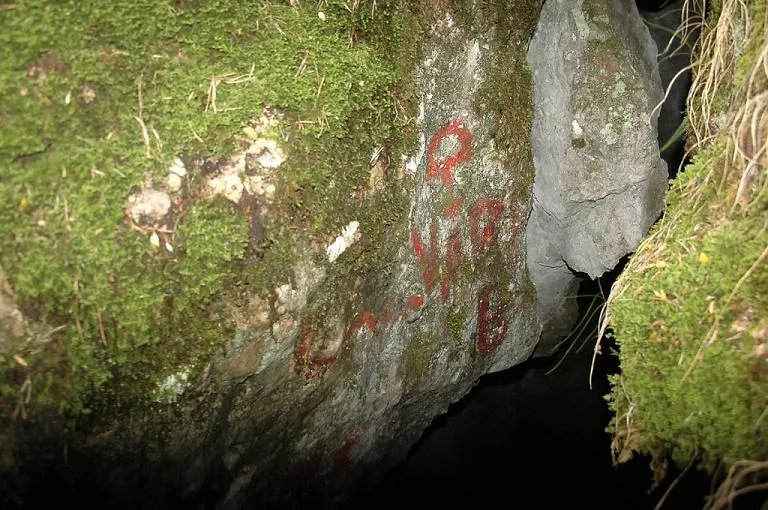
Cova i Avenc del Calvari
Small system with 193 m of passage in Vilada (Berguedà), with three entrances, a vertical range of -28 m and cataloguing work by the GE Badalona in 2013.
EspeleoWorld
Cova i Avenc del Calvari
Small system with 193 m of passage in Vilada (Berguedà), with three entrances, a vertical range of -28 m and cataloguing work by the GE Badalona in 2013.
Vilada · Berguedà
Length: 193 m · Depth: 29 m
Updated record
https://espeleoworld.com/en/c/cova-i-avenc-del-calvari
Information can change. Always verify coordinates, access, weather, and cave conditions before setting out.
Small system with 193 m of passage in Vilada (Berguedà), with three entrances, a vertical range of -28 m and cataloguing work by the GE Badalona in 2013.
Topographic
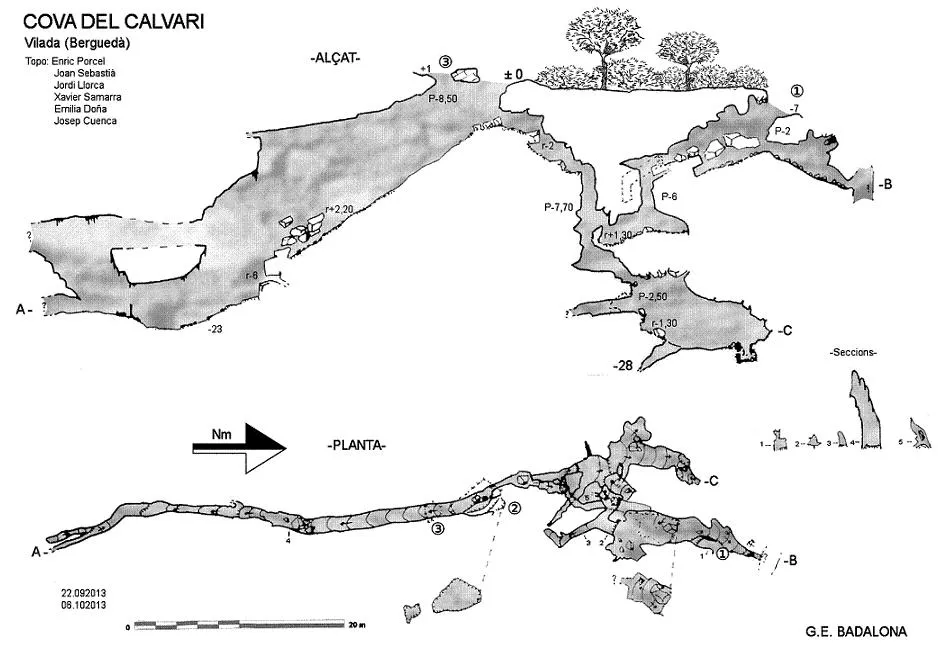
Espeleoindex · CC BY-NC 4.0, https://creativecommons.org/licenses/by-nc/4.0/ · Image © its author.
Photos
Espeleoindex · CC BY-NC 4.0, https://creativecommons.org/licenses/by-nc/4.0/ · Image © its author.
Description
Morphology
We enter through entrance no. 1, also known as avenc del Calvari, an entrance 1.5×1 m leads to a small P-2. At the base of the small pit, we find a gallery; if we continue down it about 6 metres and on a steep slope, we reach a narrow passage blocked by the rocks of the ramp; at this point a dig was carried out removing blocks and widening the passage, but it was not possible to get through, although the continuation is evident, since there is a pit behind; a more forceful dig would be needed to continue the exploration.
If we go upwards we find a pile of blocks; a narrow passage on the right and below the blocks leads us to a small chamber with no continuation.
Returning to the base of the small pit, we climb an r+0.70 above a block; at three metres, we see on the right a fissure between blocks that allows communication with a lower zone, which we will discuss later.
Four and a half metres further on, a passage 0.6×0.7 metres between blocks leads us two metres lower to intercept a corridor 0.5 metres wide and 1 metre high. If we follow it to the left, at 5 metres it turns suddenly to the right and ends 2 metres further on.
If we follow it to the right, at 2.5 metres we find a pit of -6 metres. Descending this pit, at -1.9 we observe an ascending ramp that communicates with the sector mentioned before.
At the base of the pit we find a joint 1.4 metres wide, heading N, which ends at 3 metres of passage; on the other hand, heading S, at 4 metres we notice a strong air current coming from a raised passage. We climb a block (r+1.30) and 1 metre later by means of a window we connect to a pit that turns out to be the junction with entrances 1 and 2, hence the air current.
If we head 20 metres towards the S we will find entrance number 2.
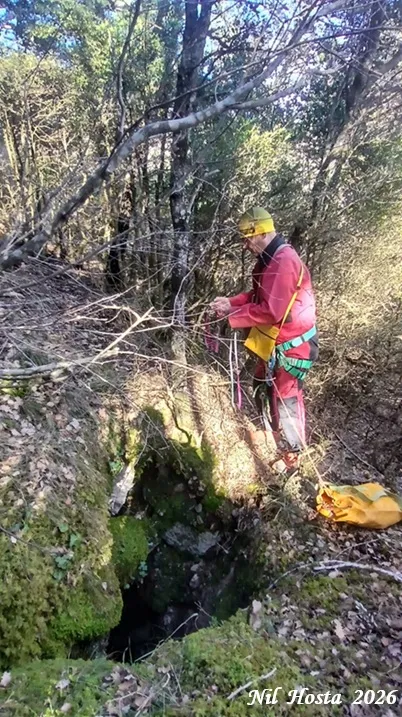
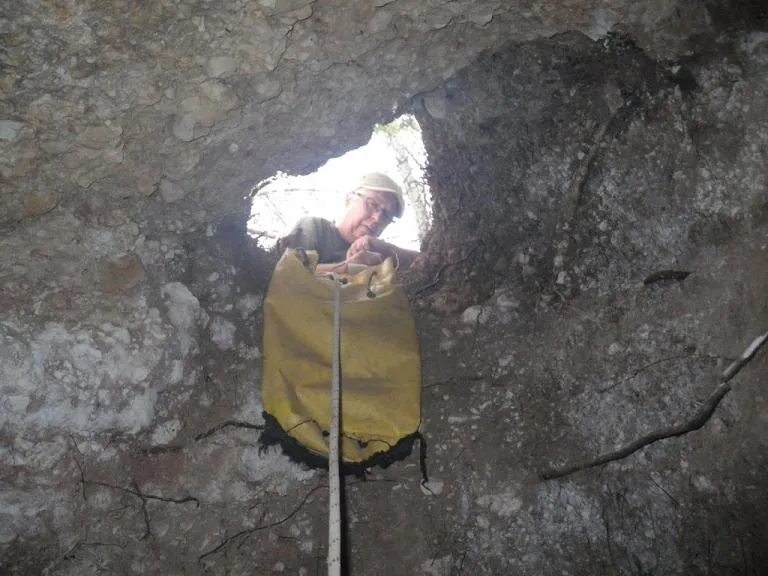
Entrance no. 2 is quite wide, it is 4.8×3.3 metres, it is the traditional access of the Cova del Calvari and has an old rope tied to a tree to facilitate the descent.
Entrance no. 3 is 0.8 m to the S of the previous one and is 1×1.5 metres. It has a pit 8.5 metres deep that drops into the S gallery of entrance 2.
Through this entrance we descend carefully down a steep slope about 5 m; if we go towards the S, the cavity descends, we advance 18 metres. We come across some rocks; on the right, lower down, it continues 4 metres more. If we climb the blocks (r+2.20), we continue 4 metres more until we find a step. We pass it by a passage on the right between the blocks, and carefully descend 5.5 metres and a small step of -0.8 metres. The gallery continues heading S and with a width of one metre, the height varies around 11 metres; it is a joint covered with wall formations. We advance 14 metres and the gallery forms a small meander where we observe a curious stalagmite. In this stretch, at the lowest point we reach 23 metres of vertical range.
Two and a half metres further on the corridor forks: on the right we find an ascending gallery that ends at 7 metres of passage. On the left the joint becomes narrower until at 4 metres it becomes impenetrable.
If from the base of the entrance ramp we go heading North, we climb some blocks, and within a few metres we reach the head of a pit where we place a spit; it is a P-1.40, which deposits us on a block; here we see the continuation and install another spit to descend a P-6.30. Descending this pit we observe the window of junction with the zone that comes from entrance number 1 that we described before.
At the base of the pit, we access laterally and by means of a ramp a gallery about 1.5 metres wide. This gallery, heading S, ends at 2.5 metres. On the other hand, heading N we find a P-2.50. Having descended this we find ourselves in a small chamber; on our right and heading SE a narrow descending gallery allows us to advance a few metres and reach the maximum depth of the cave: -28 metres.
Further to the right, heading NE, we climb to a sloping chamber with very unstable and quite dangerous blocks; this chamber about 5 metres long by 2.5 wide is on a higher level and no continuation is detected.
If we continue heading N, we descend an r-1.30 to continue along a gallery about 10 metres. At its end there are two small pits (P-2) of which only one is passable. This gallery brings the cavity to an end.
Speleothems
The gallery heading S, one metre wide and of variable height around 11 metres, is a joint covered with wall formations. In a small meander a curious stalagmite is observed.
Progression
Access through entrance no. 1 (avenc del Calvari): entrance 1.5×1 m that leads to a small P-2. At the base of the small pit, a gallery continues down about 6 metres on a steep slope to a blocked narrow passage. Upwards, a pile of blocks and a narrow passage on the right leads to a small chamber with no continuation. Returning to the base of the small pit, an r+0.70 is climbed above a block; at 3 metres, a fissure between blocks communicates with a lower zone. Four and a half metres further on, a passage 0.6×0.7 metres leads 2 metres lower to a corridor 0.5 metres wide and 1 metre high; to the left it turns at 5 metres and ends 2 metres further on; to the right, at 2.5 metres there is a pit of -6 metres. At -1.9 there is an ascending ramp. At the base of the pit, a joint 1.4 metres wide heading N ends at 3 metres; heading S, at 4 metres, a strong air current comes from a raised passage. A block is climbed (r+1.30) and 1 metre later, through a window, one connects to a pit that joins entrances 1 and 2. Twenty metres towards the S is entrance number 2.
Entrance no. 2, 4.8×3.3 metres, is the traditional access and has an old rope tied to a tree to facilitate the descent. Entrance no. 3, 0.8 m to the S of the previous one and 1×1.5 metres, has a pit 8.5 metres deep that drops into the S gallery of entrance 2.
Through entrance 3 one descends down a steep slope about 5 m; towards the S one advances 18 metres to some rocks; on the right, lower down, it continues 4 metres more. The blocks are climbed (r+2.20) and one continues 4 metres more to a step, which is passed by a passage on the right between the blocks; one descends 5.5 metres and a small step of -0.8 metres. The gallery continues heading S; one advances 14 metres to a small meander. Two and a half metres further on the corridor forks: on the right an ascending gallery ends at 7 metres; on the left the joint narrows and at 4 metres becomes impenetrable.
From the base of the entrance ramp, heading North, some blocks are climbed and within a few metres one reaches the head of a pit where a spit is placed: P-1.40, which deposits one on a block; here another spit is installed to descend a P-6.30. At the base of the pit one accesses laterally by a ramp a gallery about 1.5 metres wide; heading S it ends at 2.5 metres; heading N there is a P-2.50. Having descended this, on the right and heading SE, a narrow descending gallery allows one to advance a few metres to the maximum depth of the cave: -28 metres. Further to the right, heading NE, one climbs to a sloping chamber with very unstable and quite dangerous blocks, about 5 metres long by 2.5 wide, on a higher level, with no continuation detected. Continuing heading N one descends an r-1.30 and continues along a gallery about 10 metres; at its end there are two small pits (P-2) of which only one is passable.
History
In Vilada, this whole series of cavities of the Canal Closa is called “Els Forats”, with no further names.
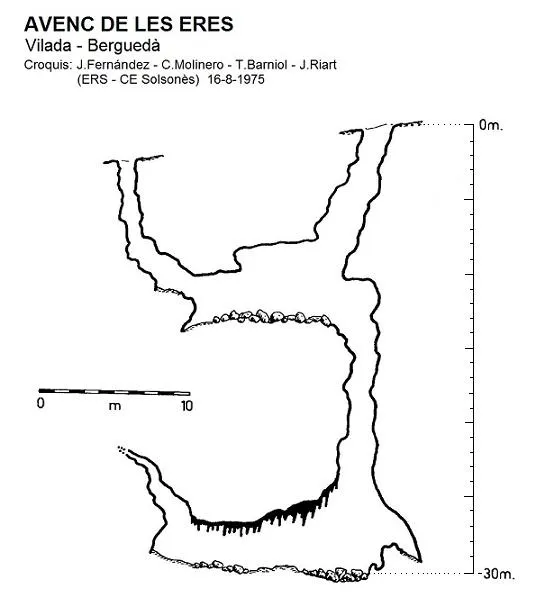
The first news we have of an exploration is that of members of the ERS – Centre Excursionista del Solsonès in 1975, contributing a sketch that is published in the Catàleg Espeleològic de Catalunya (1980) volume 5, without specifying any further data.
We know that around 2001 members of the SIRE – UEC el Prat carry out a sweep of the area and manage to locate some of the cavities.
Finally, in 2013, F. Cardona (ECG), J. Cuenca and X. Samarra (GEB) carry out a survey of the area and are able to locate the Cova i avenc del Calvari and another hole.
In September and October 2013 members of the GE Badalona return to the area and carry out the cataloguing work of the Cova del Calvari (la Cova) and of two modest and unpublished nearby cavities.
User Comments (0)
No comments yet.
Be the first to share your experience!
Registered Explorations (0)
No explorations registered yet.
Register your visit to this cave!
Bibliography
- Borràs, J; Miñarro, JM.; Talavera, F.(1980).-”l'Urgell, el Solsonès, la Segarra i el Berguedà”. Catàleg Espeleològic de Catalunya (vol.5):113-114. Ed. Políglota. Barcelona.
- Totes les dades, topografia i fotografies han estat extretes del web del Grup d'Espeleologia de Badalona: geb.cat (Apunt del 18-11-2013: Forats de la Canal Closa)
Nearby caves
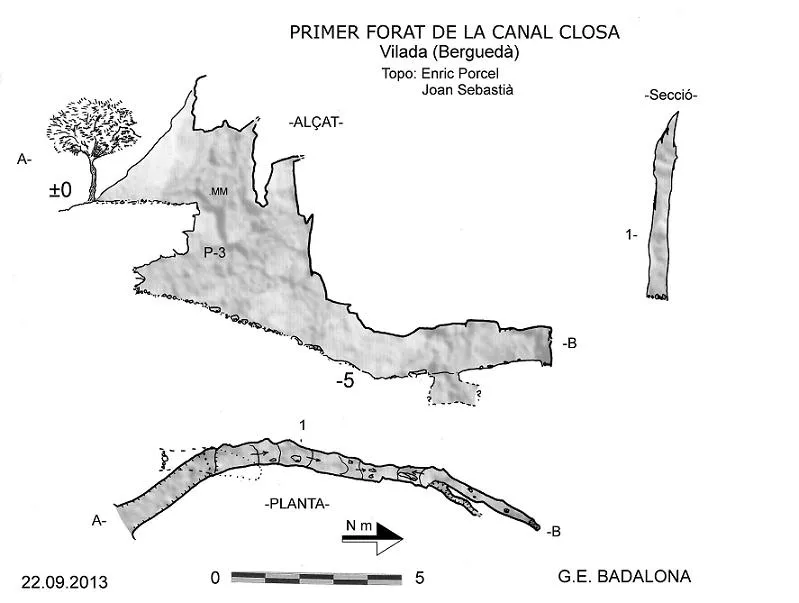


Source: Espeleoindex (espeleoindex.com), modified. CC BY-NC 4.0, https://creativecommons.org/licenses/by-nc/4.0/