
Cova del Pollancre
A 40-metre-long cave in the Terradets gorge, in Camarasa, explored in March 2012 by the GEB and the CE de Castellar del Vallès.
EspeleoWorld
Cova del Pollancre
A 40-metre-long cave in the Terradets gorge, in Camarasa, explored in March 2012 by the GEB and the CE de Castellar del Vallès.
Camarasa · Noguera
Length: 40 m · Depth: 11 m
Updated record
https://espeleoworld.com/en/c/cova-del-pollancre
Information can change. Always verify coordinates, access, weather, and cave conditions before setting out.
A 40-metre-long cave in the Terradets gorge, in Camarasa, explored in March 2012 by the GEB and the CE de Castellar del Vallès.
Topographic
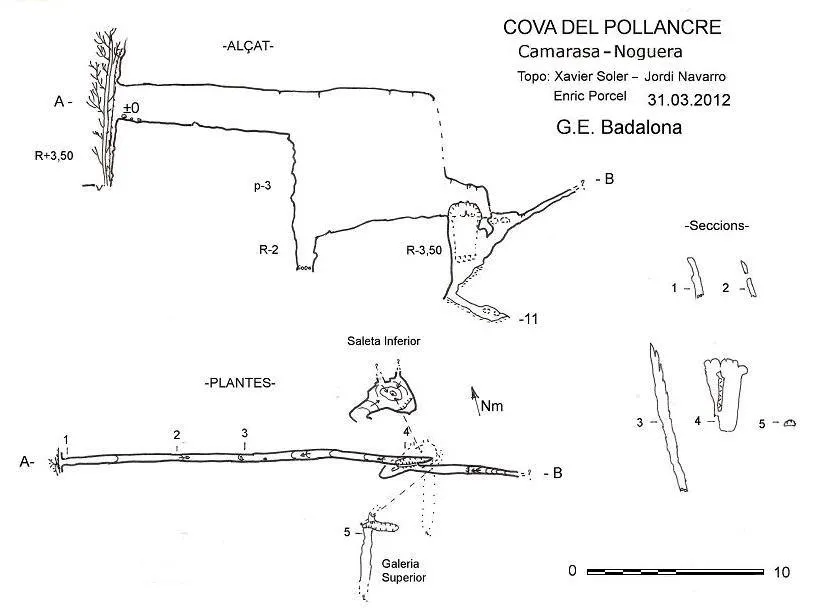
Espeleoindex · CC BY-NC 4.0, https://creativecommons.org/licenses/by-nc/4.0/ · Image © its author.
Photos
Espeleoindex · CC BY-NC 4.0, https://creativecommons.org/licenses/by-nc/4.0/ · Image © its author.
Description
Morphology
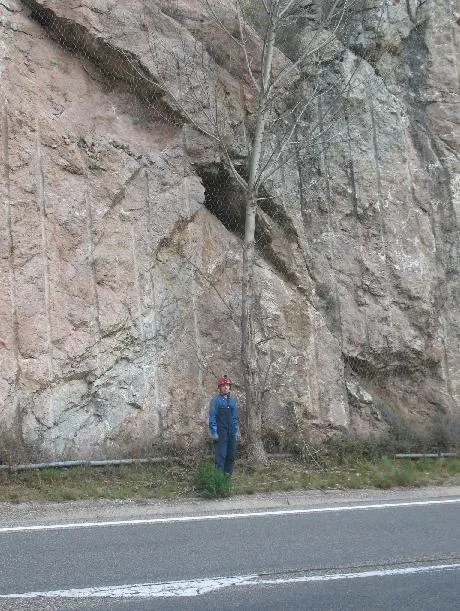
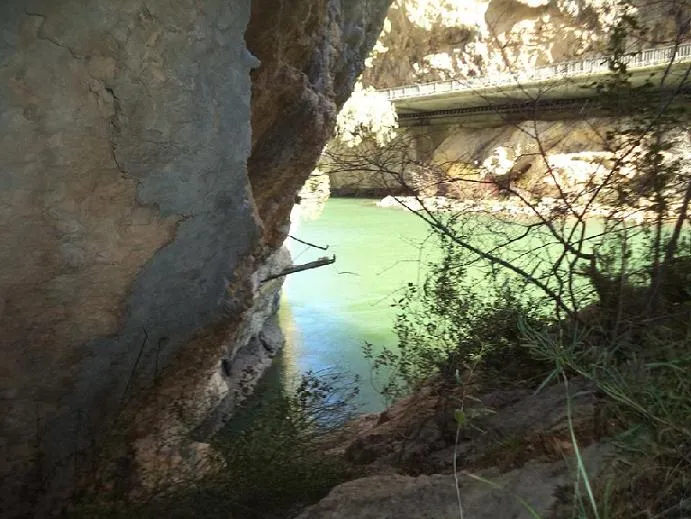
A cavity with a difficult access, since we have to climb up the tree the 3.5 m that separate us from the cave, which hangs on the wall. From the tree, the wire containment mesh of the road must be crossed.
Then we find a fissure 0.30 metres wide by 2 metres high. Once inside, we will advance 10.5 m to reach a P-3 easily downclimbed, with a narrow continuation of an r-2.
On the walls a multitude of aragonite flowers can be seen deposited on a patina of clay that in turn covers the limestone. The joint at this point is 8 metres high and 0.40 metres wide. From here and to our right we will climb 8 metres and through a window full of formations we access a P-3.5 which is no more than another joint parallel to the previous one, but wider (1 metre). At the base of this pit, if we go to the right we will descend 2 metres where we will find a muddy crawl that leads to a lower small chamber of about 4×3 metres. This small chamber acts as a receiver of the waters coming from the entrance crawl and from two other smaller ones that we find on the left. Everything is covered with mud and the centre of the small chamber acts as a swallow hole. Despite the evident water activity no possibilities of continuation can be seen.
Turning back, if we go to the left, we will climb 4 metres up a very steep flowstone 0.60 metres wide by 1 metre high that leads us to an upper small chamber. Continuing straight on we find a crawl of about 3 metres that quickly becomes impenetrable. If we move 1.8 metres towards the NW we will see two crawls hanging at ceiling level, through which it was not possible to pass due to their meagre dimensions. The left one is full of formations and the measurement gives 3.50 metres of the visible part.
Speleothems
On the walls a multitude of aragonite flowers can be seen deposited on a patina of clay that in turn covers the limestone. The window is full of formations and the left crawl is also full of formations.
Hydrology
The lower small chamber acts as a receiver of the waters coming from the entrance crawl and from two other smaller ones that we find on the left. The centre of the small chamber acts as a swallow hole. Despite the evident water activity no possibilities of continuation can be seen.
Progression
Access: climb up the tree the 3.5 m that separate us from the cave, cross the wire containment mesh of the road. Inside, advance 10.5 m to a P-3 easily downclimbed, with a narrow continuation of an r-2. To the right, climb 8 metres and through a window full of formations access a P-3.5. At the base of this pit, to the right descend 2 metres to a muddy crawl that leads to a lower small chamber of about 4×3 metres. Turning back, to the left, climb 4 metres up a very steep flowstone 0.60 metres wide by 1 metre high to an upper small chamber. Continuing straight on, a crawl of about 3 metres becomes impenetrable. Moving 1.8 metres towards the NW, two crawls hanging at ceiling level could not be passed due to their meagre dimensions.
History
A cavity opened as a result of the widening of the C-13 in the 90s and which, despite being beside the road, has gone unnoticed due to its difficult access. It is a totally unpublished cave, explored by members of the GEB and of the CE de Castellar del Vallès in March 2012.
User Comments (0)
No comments yet.
Be the first to share your experience!
Registered Explorations (0)
No explorations registered yet.
Register your visit to this cave!
Bibliography
- Totes les dades han estat extretes del web del Grup d'Espeleologia de Badalona (www.geb.cat).
Nearby caves


Source: Espeleoindex (espeleoindex.com), modified. CC BY-NC 4.0, https://creativecommons.org/licenses/by-nc/4.0/