
Cova de Rialb
Cova de Rialb, in Queralbs, with a passage of 501 metres and a vertical range of 38 metres (+12/-26), known since time immemorial and studied by speleologists since 1910.
EspeleoWorld
Cova de Rialb
Cova de Rialb, in Queralbs, with a passage of 501 metres and a vertical range of 38 metres (+12/-26), known since time immemorial and studied by speleologists since 1910.
Queralbs · Ripollès
Length: 501 m · Depth: 38 m
Updated record
https://espeleoworld.com/en/c/cova-de-rialb
Information can change. Always verify coordinates, access, weather, and cave conditions before setting out.
Cova de Rialb, in Queralbs, with a passage of 501 metres and a vertical range of 38 metres (+12/-26), known since time immemorial and studied by speleologists since 1910.
Topographic
Espeleoindex · CC BY-NC 4.0, https://creativecommons.org/licenses/by-nc/4.0/ · Image © its author.
Photos
Espeleoindex · CC BY-NC 4.0, https://creativecommons.org/licenses/by-nc/4.0/ · Image © its author.
Description
Morphology
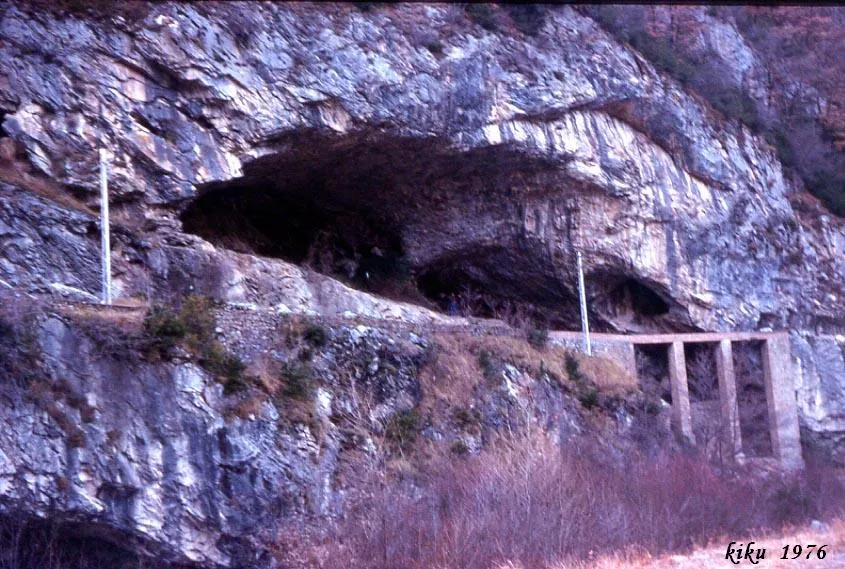
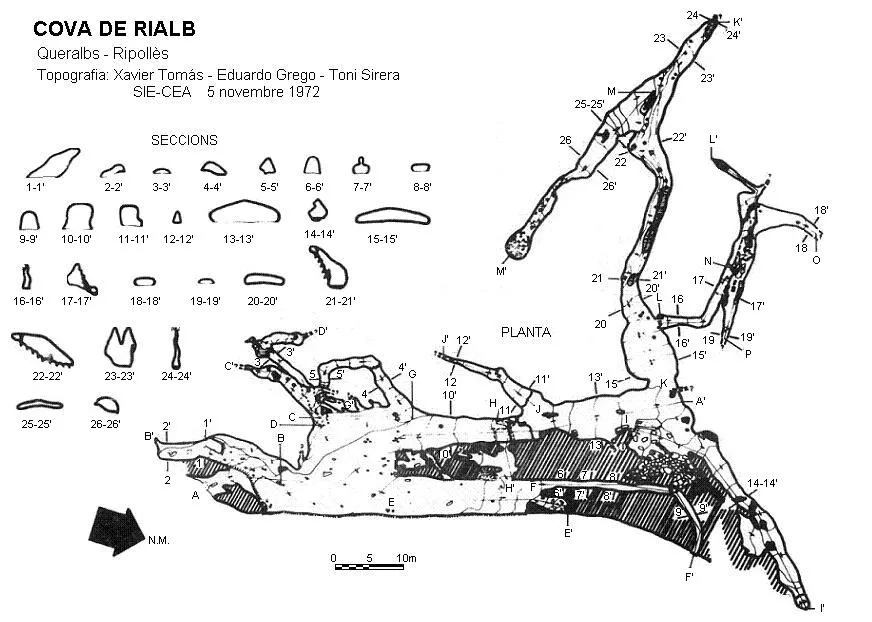
The entrance, of rounded section, leads to a large chamber with an oval vault, open to the outside on its NE side, being cut by the Núria cremallera railway line. From the NW side closest to the line, a narrow flat gallery about 30 metres long emerges, which comes out again to the outside through a small hole. On the opposite side, to the left of the entrance mouth, there is an ascending passage that ends after a few metres. In the SW part of the chamber there is a series of passages, in one of which we find the point of maximum vertical range of the cavity, +12 metres.
At the back of the entrance chamber begins what we could call the Main Gallery, about 45 metres long, from which various branches of very different configuration run towards the interior of the mountain, their lengths ranging between 15 and 30 metres. Also towards the outside there is a group of small passages that connect at different points the first half of the gallery with the northern part of the entrance vestibule.
After the aforementioned stretch in the Main Gallery, this reaches a terminal chamber totally occupied by debris, being cut perpendicularly by a new gallery that on the left ascends until reaching a flooded zone; once this is passed and almost at the end of the gallery we find a new stretch of cave of NW-SE direction, also ascending and with a steep slope, about 30 metres long. From the central part of this long gallery of NE-SW direction begins a new perpendicular passage of NW direction, which turns after a few metres, connecting by different vertical drops with a lower floor practically superimposed along the whole length of its course. Their developments are 38 and 30 metres respectively. Situated again in the terminal chamber of the Main Gallery, to the right of it, the gallery descends on a slight slope until reaching at its lowest point the -26 metres of depth. The total vertical range of the cavity is 38 metres (+12/-26).
Hydrology
The new gallery that ascends on the left reaches a flooded zone.
History
Cavity known since time immemorial by the people of the region. The oldest written notice we know of is that provided by Artur Bofill in an extensive excursion account about Núria, the valley of Ribes and the Alt Llobregat, the fruit of some excursions carried out in the years 1883-1884 and published in 1888 in the Butlletí de l'Associació d'Excursions Catalanes (Tom X) (predecessor entity of the CEC), in which he makes a brief note: “se troban las covas de Rial, bastant grans, ab hermosas estalactitas, y apenas deterioradas, puig son pochs los qui las visitan” (sic). This same text is reproduced by Puig y Larraz (1896) and by Font i Sagué (1897) in their respective catalogues.
But it is not until 14 August 1910 that Faura i Sans, accompanied by Albert Santamaria and Gaspar Sala (CEC), make a first reconnaissance and a brief descriptive article is published. In the photos it can be seen that below the cave passed the wagon line of the Queralbs mines and where years later the Núria cremallera would pass. This visit aroused the curiosity of the brothers Eusebi and Emili Turc, members of the Agrupació de Sports y Excursions de Ribes, who accompanied by Gaspar Sala carried out during the year 1911 a first and detailed survey of the cave. This work served as the basis for a new article signed by Faura i Sans at the end of the same 1911. The survey by the Turc brothers is preserved in the map library of the Centre Excursionista de Catalunya.
Subsequently the cave was the object of different naturalists and especially of biospeleologists (Maheu, Zariquiey, Español). Little by little it became one of the classic cavities of Catalan speleologists. During 1972 it was the main objective of a campaign in the area by members of the SIE – CEA, in which the most accurate survey we know of was made.
As an anecdotal note, in 1973 the cave served for a 2500-hour endurance test by Emili Reyes, building a brick partition that closed the entrance of the main gallery. On 1 July 1984, on the initiative of the Escola Catalana d'Espeleologia and the Federació Catalana d'Espeleologia, a clean-up day was organised in the cavity and among other rubbish 71 sacks of rubble were extracted from the aforementioned partition.
Bio
Coleoptera: Perriniella faurai.
User Comments (0)
No comments yet.
Be the first to share your experience!
Registered Explorations (0)
No explorations registered yet.
Register your visit to this cave!
Bibliography
- Borràs, J.; Miñarro, JM.; Talavera, F.(1980).-”el Ripollès, la Garrotxa i l'Alt Empordà”. Catàleg Espeleològic de Catalunya. (vol. 4):1-296. Ed. Políglota. Barcelona.
- Faura i Sans, M.(1911).-”Excursió a les coves de Rialp”. Butlletí CEC (199):230-233. Centre Excursionista de Catalunya. Barcelona.
- Faura i Sans, M.(1911).-”Les coves de Rialp”. Butlletí CEC (203):236-240. Centre Excursionista de Catalunya. Barcelona.
- Sirera i Navia, Antoni; Tomás i Corretgé, Xavier.(1973).-”La cova de Rialb y cavidades cercanas en el valle del Freser”. Comunicacions III Simpòsium Espeleologia. pp.154-178. Agrupació Cientifico-Excursionista de Mataró.
- Fotografies extretes del Blog “www.Espeleobloc.blogspot.com.es” post del dia 14 de febrer de 2011.
- Mapes antics. Centre Excursionista de Catalunya. mdc.cbuc.cat/cdm/singleitem/collection/mapesCEC/id/276
Nearby caves


Source: Espeleoindex (espeleoindex.com), modified. CC BY-NC 4.0, https://creativecommons.org/licenses/by-nc/4.0/