
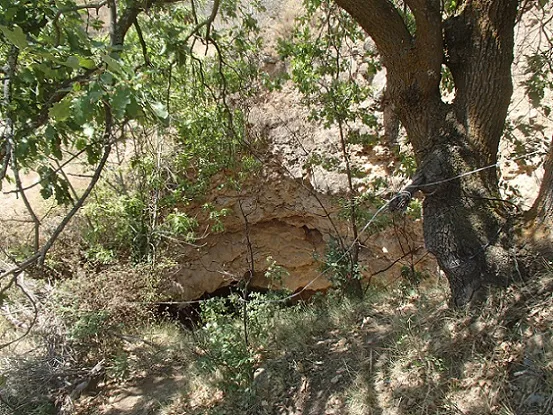
Cova de Muxí
Cavitat descendent inèdita molt a la vora de Sort (Pallars Sobirà)
EspeleoWorld
Cova de Muxí
Cavitat descendent inèdita molt a la vora de Sort (Pallars Sobirà)
Sort · Pallars Sobirà
Length: 50 m · Depth: 21 m
Updated record
https://espeleoworld.com/en/c/cova-de-muxi
Information can change. Always verify coordinates, access, weather, and cave conditions before setting out.
An unpublished descending cavity very close to Sort (Pallars Sobirà), with a large circular mouth, a boulder ramp and galleries in karstified Devonian limestones.
Topographic
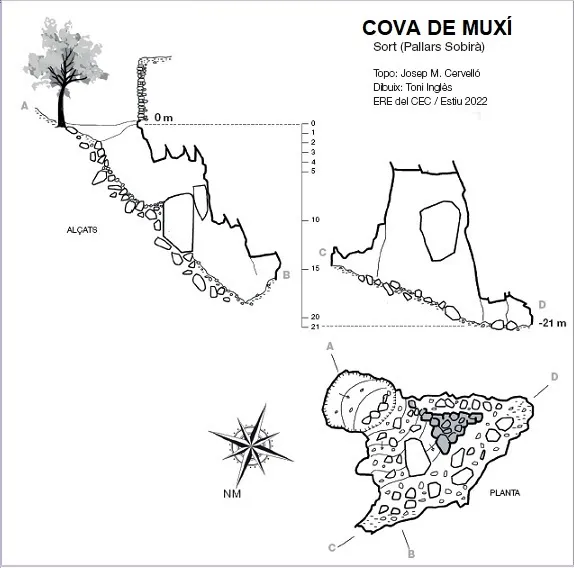

Espeleoindex · CC BY-NC 4.0, https://creativecommons.org/licenses/by-nc/4.0/ · Image © its author.
Photos

Espeleoindex · CC BY-NC 4.0, https://creativecommons.org/licenses/by-nc/4.0/ · Image © its author.
Description
Morphology
At the foot of a high dry-stone wall a large circular mouth opens beside an oak. A boulder ramp leads us to a point where a large block divides the ramp in two. The dimensions of the conduits are large and become narrower at the final part.
Speleothems
At the lowest point of the cavity is the only place where there is speleothem formation, in an environment dominated by the clastic process derived from the collapse that caused the surface mouth and the access ramp.
Progression
On the right, after a step, we reach a lower gallery with a descending tendency that leads us to the lowest point of the cavity. An ascending gallery between blocks and the wall of the conduit leads us to the point furthest from the entrance.
Other details
As for its formation, the deepest gallery is a conduit formed by dissolution of the Devonian limestones that was intercepted by a superficial clastic collapse (perhaps a collapse doline) that caused the boulder ramp.
History
Despite being referenced on the ICGC map and having been known in the area since long ago, it had remained unpublished in the speleological bibliography.
The first mention we have is by Lluís Marià Vidal, perhaps from the last decade of the 19th century, found in a handwritten paper incorporated into one of his field notebooks kept at the Museu Geològic del Seminari de Barcelona. Vidal calls it cova de l'Escaleta due to toponymic confusion, since that area, stepped by large dry-stone walls, is known as the Escalella.
On the ICGC map it appears as Cova de Moixí, but Mr. Rosendo Manrique, from Sort, indicates to us that the correct name should be Cova de Muxí, referring to Dr. Agustí Muxí Monroset, name of the owner of the site and former doctor of Sort, where there is a street in the town named after him.
The survey was carried out in the summer of 2022 by Josep Maria Cervelló.
User Comments (0)
No comments yet.
Be the first to share your experience!
Registered Explorations (0)
No explorations registered yet.
Register your visit to this cave!
Bibliography
- Totes les dades, topografia i fotografies han estat facilitades per Josep Maria Cervelló (ERE del CEC)
Nearby caves
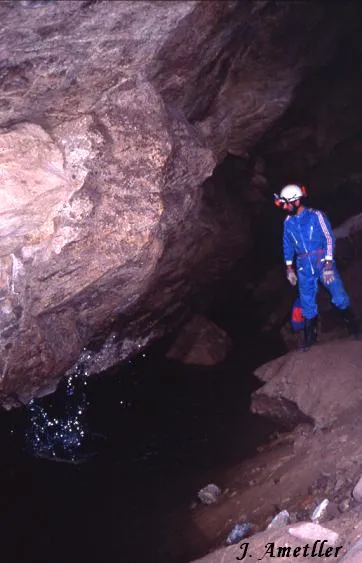
Cova Savarneda
3.2 km · S
Soriguera (Pallars Sobirà)
2 topo.12 photos
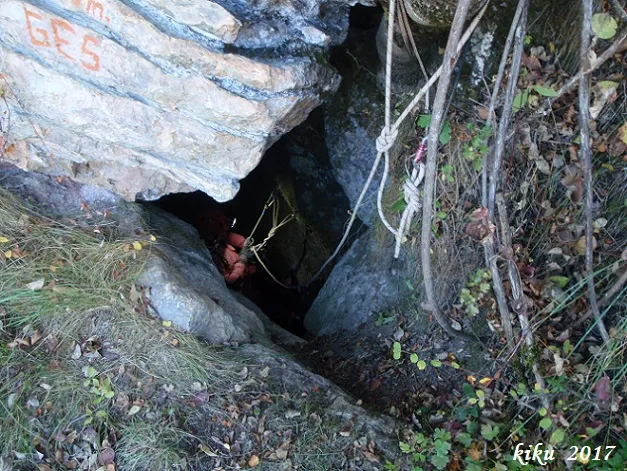
Avenc del Tinc-ca-tinc
3.5 km · NW
Sort (Pallars Sobirà)
2 topo.17 photos
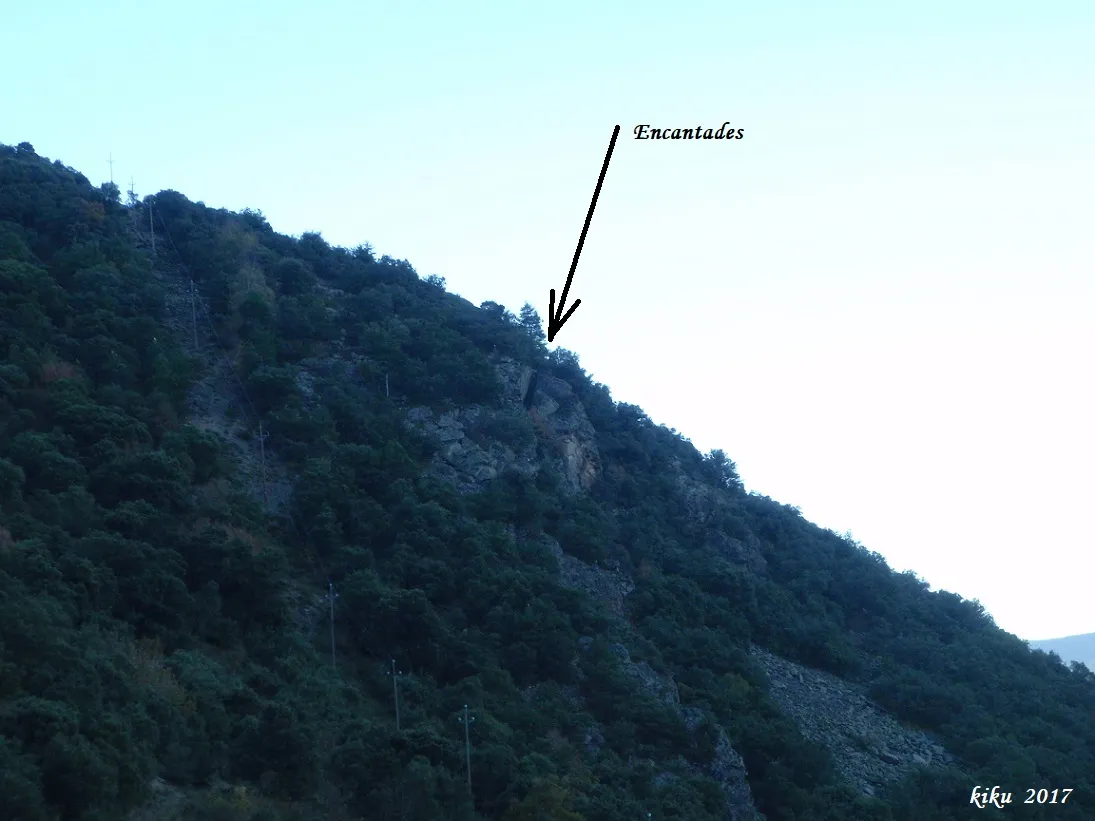
Forat de les Encantades
4.5 km · N
Sort (Pallars Sobirà)
1 topo.5 photos
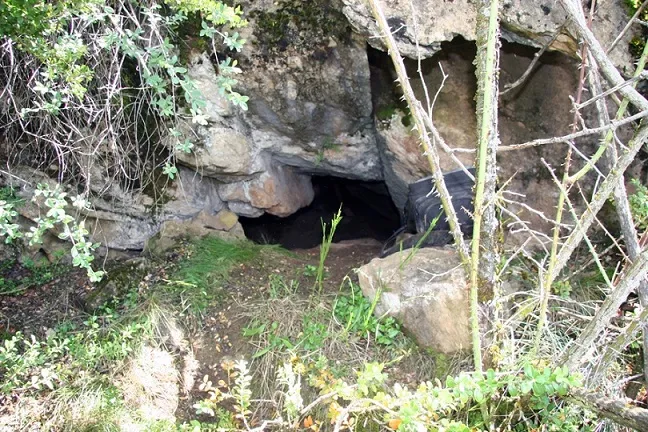
Cova de l'Home Mort
6.4 km · SE
Soriguera (Pallars Sobirà)
1 topo.6 photos
Source: Espeleoindex (espeleoindex.com), modified. CC BY-NC 4.0, https://creativecommons.org/licenses/by-nc/4.0/