
Cova de l'Orri
A 157-metre-long cave in Sales de Llierca, with a large chamber 9 metres high and 8 metres wide, explored in 1933.
EspeleoWorld
Cova de l'Orri
A 157-metre-long cave in Sales de Llierca, with a large chamber 9 metres high and 8 metres wide, explored in 1933.
Sales de Llierca · Garrotxa
Length: 157 m · Depth: 6 m
Updated record
https://espeleoworld.com/en/c/cova-de-l-orri
Information can change. Always verify coordinates, access, weather, and cave conditions before setting out.
A 157-metre-long cave in Sales de Llierca, with a large chamber 9 metres high and 8 metres wide, explored in 1933.
Topographic
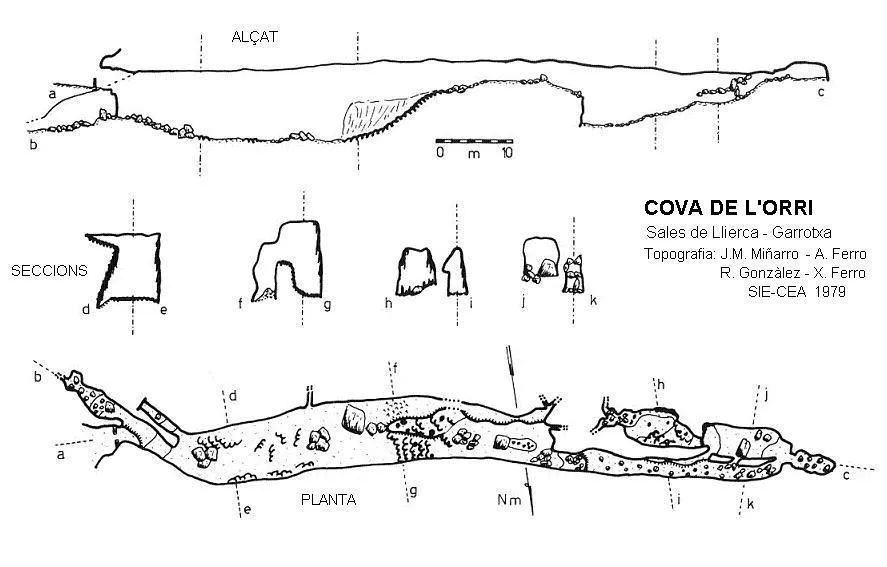
Espeleoindex · CC BY-NC 4.0, https://creativecommons.org/licenses/by-nc/4.0/ · Image © its author.
Photos
Espeleoindex · CC BY-NC 4.0, https://creativecommons.org/licenses/by-nc/4.0/ · Image © its author.
Description
Morphology
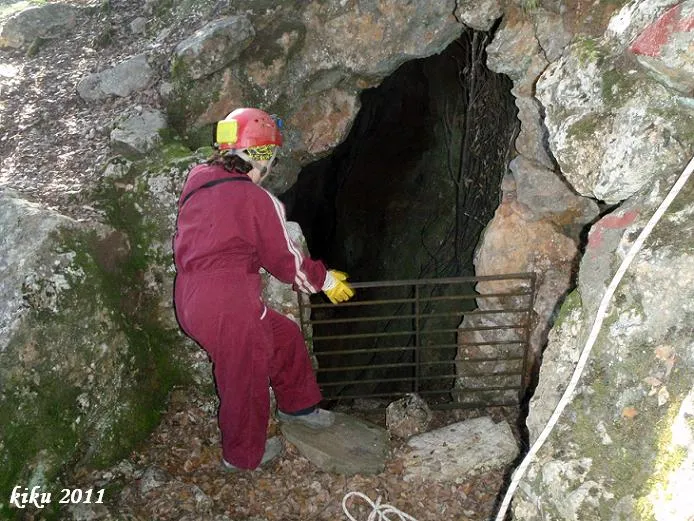
The entrance, where we find a small grille so that animals do not fall in, leads to a small landing from which a 3-metre drop must be descended (it is recommended to bring a safety rope). Once down, towards the SE there is a slightly descending gallery among blocks that ends after a few metres. Returning to the foot of the entrance and heading NW, one quickly enters the largest chamber of the cave, which is a gallery about 9 metres high, with a very flat ceiling; during its 25 metres of length, it maintains an almost uniform width of about 8 metres. At the final part of this gallery and on its left there is a large fallen block and next there is a boulder pile completely covered by concretion which, without reaching the ceiling, divides the gallery into two parts; on the left the floor continues flat and gives the impression of the old thalweg of a small river, being impassable a few metres further on. On the right the floor begins to rise among stepped flowstone and gours, until almost reaching the ceiling of the cavity and penetrating into a small chamber with a low ceiling; its end bifurcates again, but after a few metres the passages meet again and by a short gallery, on a ramp, full of stones, one reaches a drop of about 4 metres that can be overcome laterally between the blocks. Here begins a narrow gallery about 6 or 7 metres high which takes a slight ascent to penetrate into an area full of blocks that rises more rapidly until it leads out into a new chamber of chaotic appearance and descending towards the ESE, that is to say towards the exterior; through different openings it communicates with the previous gallery. Also at its lower end a series of small passages of short length originate and remain filled with blocks and sediments.
History
Around 1933 news reached the Club Muntanyenc Barcelonès that some caves had been discovered in the Sadernes area. Having made contact with the rectors of Sadernes and of Sales de Llierca, these provided them with all the data collected during their visits, which awakened their interest in exploring them. Due to the great excitement generated among the members of the Club, they had to hire a coach to transport the large group of members (about 25) to Tortellà, who proceeded to explore and study the cave on 15 October 1933. N. Llopis Lladó published in 1934 a documented work in the Club's bulletin, which would form part of the compilation that in 1935 would give rise to the second volume of Sota Terra.
Bio
12-XI-2016 J.Serrano-M. Roca Col. Leiolidae Lepthodirirni Parvospeonomus delarouzeei
User Comments (0)
No comments yet.
Be the first to share your experience!
Registered Explorations (0)
No explorations registered yet.
Register your visit to this cave!
Bibliography
- Borràs,J.;Miñarro,JM.;Talavera,F.(1980).-”El Ripollès, la Garrotxa, i l'alt Empordà”. Catàleg Espeleològic de Catalunya (Vol.4):204-205.Ed Políglota.Barcelona.
- Llopis, N. (1935).- “Coves de l'Orri” Sota Terra (II): 23-28. Club Muntanyenc Barcelonès.
Nearby caves


Source: Espeleoindex (espeleoindex.com), modified. CC BY-NC 4.0, https://creativecommons.org/licenses/by-nc/4.0/