
Cova Cambra
Emblematic cavity of the Port, el (Tortosa) about 300 m long, right in the middle of the Mola de Catí.
EspeleoWorld
Cova Cambra
Emblematic cavity of the Port, el (Tortosa) about 300 m long, right in the middle of the Mola de Catí.
Tortosa · Baix Ebre
Length: 300 m · Depth: 57 m
Updated record
https://espeleoworld.com/en/c/cova-cambra
Information can change. Always verify coordinates, access, weather, and cave conditions before setting out.
Emblematic cavity of the Port, el (Tortosa) about 300 m long, right in the middle of the Mola de Catí.
Topographic
Espeleoindex · CC BY-NC 4.0, https://creativecommons.org/licenses/by-nc/4.0/ · Image © its author.
Photos
Espeleoindex · CC BY-NC 4.0, https://creativecommons.org/licenses/by-nc/4.0/ · Image © its author.
Description
Morphology
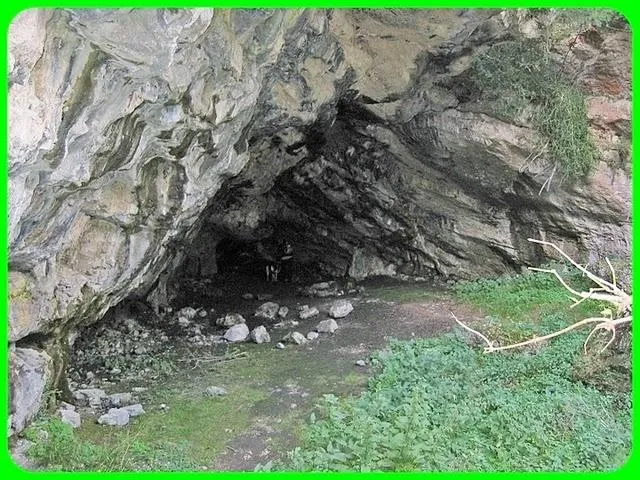
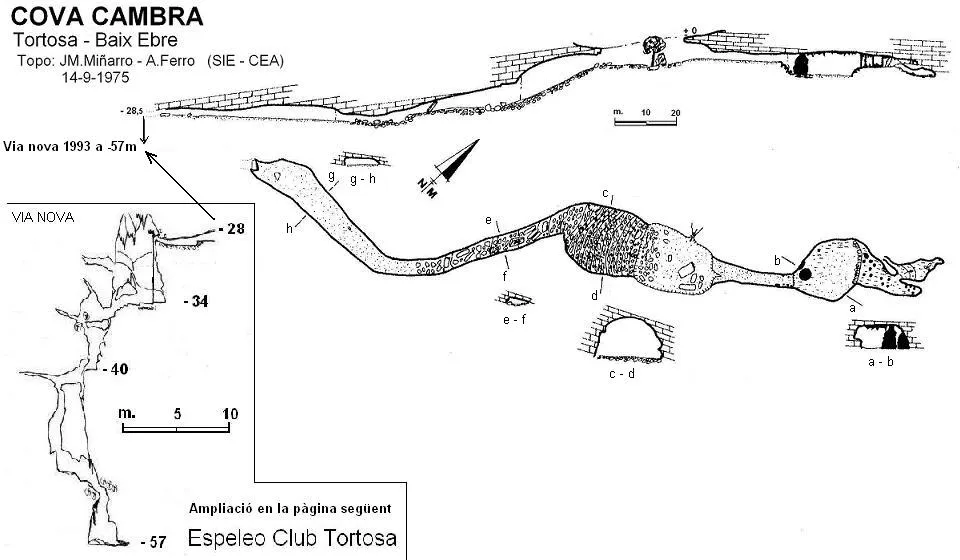
A large collapse entrance (25 x 18 m) gives access to the galleries of this interesting cavity. A descending ledge places us at the bottom of the depression, covered by large blocks and exuberant vegetation. Two options are presented to us to continue the exploration: towards the NE and towards the SW. Following the first, in a sloping portico is found the start of a low gallery with a ceiling, of rounded section, and which at 22 metres of passage suddenly opens out into a chamber of notable dimensions (20 x 18 x 7 m). At the other end of this hall, climbing up some flowstone, there is a wide landing, packed with stalactites and columns, all the while reducing the height of the ceiling. A small hole communicates with a descending gallery of short passage and crammed with sediments, representing the point of maximum penetration for this sector.
Returning again to the entrance mouth, we will follow in the opposite direction to the previous gallery, to go into a conduit of large dimensions and with a strong slope full of blocks and walls totally bare of stalactitic ornamentation. In the final stretch the inclination stabilises and the gallery gradually loses height and width, to shortly afterwards have its passage become quite rough because of the blocks. In the last stretch the floor is practically flat and covered by sediments that plug the conduit.
Speleothems
By a slippery step one reaches this hall, where a large column almost touching the entrance wall stands out, the floor is covered by some “gours” and stalagmitic formations, all of them presenting a characteristic black colour.
Progression
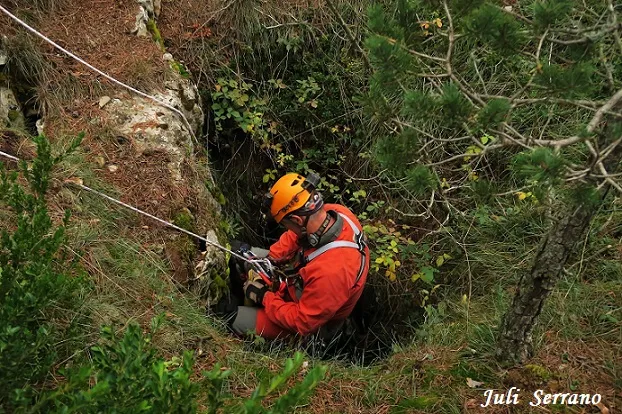
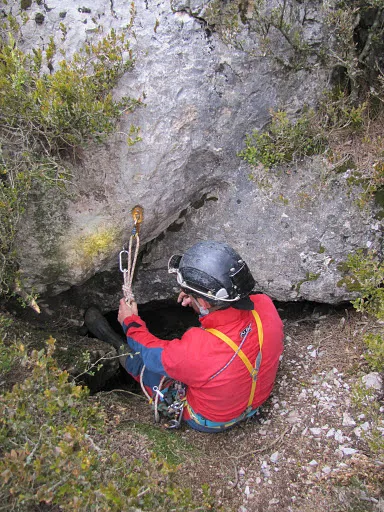
An important clearing of these sediments at the final end allowed access to a series of pits and steps joined at some points by narrow crawls that had to be cleared and that reach the point of maximum depth of the cave at the level – 57.
History
Known since time immemorial. Cited in the old catalogues (Madoz, Prado, Mallada, Puig y Larraz; Font, Faura, Ferraté). There is a record of a visit made before 1849 by an illustrious man of Tortosa, Josep Maria Paulí (editor of the chapter on Tortosa in Pascual Madoz's Diccionario geográfico). Mallada introduces a so-called Cova Petita, referring to the inclined gallery and later, Faura mentions the avenc de la Mola de Catí, which according to what Ferraté reveals to us years later, is none other than this same sector of inclined gallery. Jeannel and Racovitza collect Breuil's visits to the Port area, who among other cavities visits cova Cambra on 23 May 1914, making a quite precise sketch.
It should be noted that all these authors do not agree on the municipality in which the cavity is found and because of this some duplicate the citation, recording two coves Cambra in different municipalities. It seems that the Mola de Catí belonged to the municipality of Alfara de Carles, but was ceded to the town council of Tortosa so as not to have to pay the tax of five cents that the people of Tortosa demanded from every person who crossed the pontoon bridge built over the Ebre, burnt in 1892 while they were painting it. Since then this magnificent corner of the Port has been an isolated enclave of the municipality of Tortosa.
Anyone who wishes to go deeper into the history of cova Cambra can consult the magnificent Historia de Tortosa (1934) (vol.2) by Enric Bayerri.
During August 1934, members of the Centre Excursionista de Catalunya carry out a broad search in the Port massif and among others visit cova Cambra and make a more accurate topographic survey than Breuil's and continue to distinguish cova Cambra from the cova Petita.
For many years cova Cambra has been the most visited cavity of the Port, both by excursionists and by speleologists.
In 1993, during an initiation course of the Espeleo Club Tortosa and sheltered inside the cavity during a heavy downpour, they hear an important roar of water at the point of maximum depth. They return and, after 24 hours of clearing with a pneumatic hammer, they manage to reach a series of pits, at the bottom of which a new level of maximum depth is reached.
User Comments (0)
No comments yet.
Be the first to share your experience!
Registered Explorations (0)
No explorations registered yet.
Register your visit to this cave!
Bibliography
- Andrés, O. (1966).- “Cova Cambra – Ports de Beceit” Geo y Bio Karst (9): 287-288. Barcelona.
- EC Tortosa (1994).- “Espeleo notícies” Cul de sac (1): 4 pp. Espeleo Club Tortosa.
- Jeannel, R. et Racovitza, E.G. (1918).- “Enumération des grottes visitées, 1913-1917, (6ª série). Biospeologica (39)
- Porta, L. (1935).- “Excursions espeleològiques pels Ports de Tortosa” Butll. Del Centre Excursionista de Catalunya (482): 276-281; (483): 315-323. CEC – Barcelona.
- SIE (1978).- “Contribució al coneixement espeleològic dels Ports del Caro (Baix Ebre) (IV): La Mola de Catí i el Mont Caro”. EspeleoSie (21): 27-70. SIE-CE Àliga. Barcelona.
- Fotografies facilitades per l'Espeleo Club de Tortosa.
Nearby caves


Source: Espeleoindex (espeleoindex.com), modified. CC BY-NC 4.0, https://creativecommons.org/licenses/by-nc/4.0/