
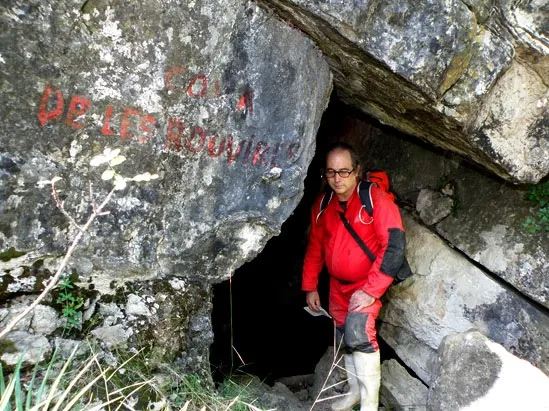
Complex de les Rovires Nº1-3
A group of crevices 17 metres deep and 141 metres long in Pallejà, with access from the font de les Rovires or from Fontpineda.
EspeleoWorld
Complex de les Rovires Nº1-3
A group of crevices 17 metres deep and 141 metres long in Pallejà, with access from the font de les Rovires or from Fontpineda.
Pallejà · Baix Llobregat
Length: 141 m · Depth: 17 m
Updated record
https://espeleoworld.com/en/c/complex-de-les-rovires-n-1-3
Information can change. Always verify coordinates, access, weather, and cave conditions before setting out.
A group of crevices 17 metres deep and 141 metres long in Pallejà, with access from the font de les Rovires or from Fontpineda.
Topographic
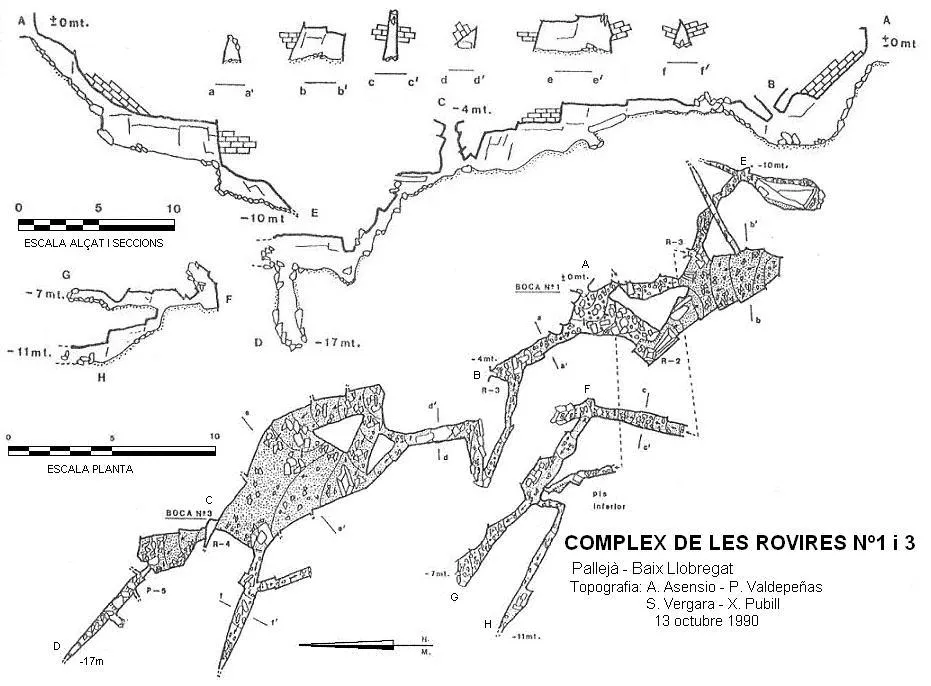
Espeleoindex · CC BY-NC 4.0, https://creativecommons.org/licenses/by-nc/4.0/ · Image © its author.
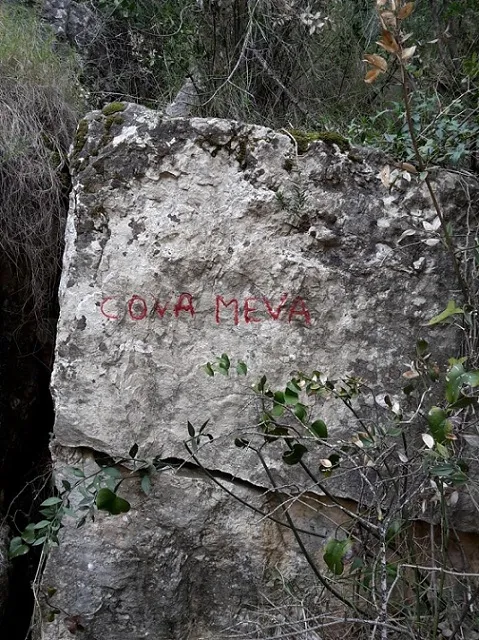
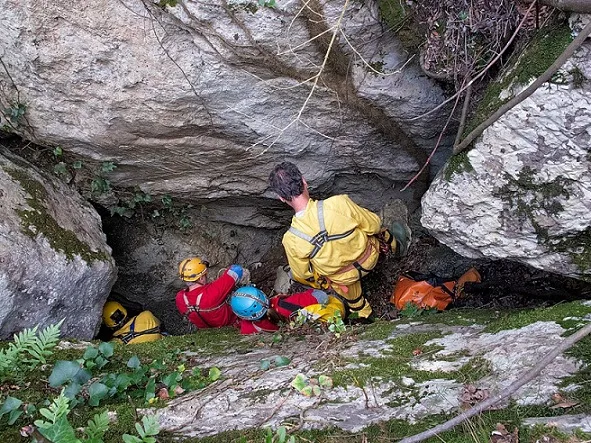
Photos
Espeleoindex · CC BY-NC 4.0, https://creativecommons.org/licenses/by-nc/4.0/ · Image © its author.
Description
Morphology
Through a portico of square section one enters a long hall with a strong downward slope; halfway down the slope and on the right we find the connecting gallery with l'escletxa no. 3. Continuing again along the hall, at the end of it some blocks form a 2 metre rise, connecting perpendicularly with a gallery of high ceiling and comfortable 5 metre route, at the end of which it places us in a hall of 5X3 metres from which three continuations emerge; the most evident and comfortable is a straight gallery of 5 metres of route where at the final part a climb of some metres introduces us into a chaos of blocks with no apparent continuation. In the lower part of this gallery, a simple crawlway places us in a hall of greater volume from which two branches of 6 and 8 metres respectively emerge and of uncomfortable access. In the upper part of this latter hall we find a window with an inclined passage that leads us to the ample hall mentioned earlier; in this hall we find a rise of -3 metres of difficult access that connects with a descending and narrow conduit, cut perpendicularly in its final part by a long small room of low ceiling occupied by an enormous block. It should be mentioned that some metres above the entrance of this latter rise we find an ascending gallery of narrow section and of 6 metres of route through which a strong current of air enters from the exterior. Continuing along the connecting gallery to l'escletxa no. 3, we find a comfortable gallery of high ceiling; in the upper part of this and between some blocks there exists a small entrance mouth (B) of difficult access. Below this access, the gallery continues and connects with another of narrower section, forming two narrow passages between blocks; after a sharp change of direction, the dimensions increase until reaching a hall of 7X5 metres; at one end of the hall a rise between blocks places us in a descending gallery that becomes impracticable after 7 metres.
L'escletxa no. 3 has an entrance pit of 4 metres of depth, of irregular section and quite narrow, connecting at one end and after climbing a small partition with the hall of 7X5 metres. The meagre base of the entrance pit forms a quite hidden elbow through which one accesses a short ramp which connects with a small hall of 2X2 metres, of low ceiling and blocks in precarious equilibrium; through a window in the wall one accesses a pit of -5 metres, followed by a rise of -3 metres with numerous blocks embedded in the walls but which allows us to access -17 metres, the point of maximum depth of the cavity.
History
Discovered and explored in 1935 by a hiking group of the archaeology section of the Unió Excursionista de Catalunya, led by Josep Maria Benet. At that time they located 5 urn-shaped vessels covered with slate discs and inside them bone remains and ashes, as well as elements of shells pierced to make a necklace. These remains and others of pottery were expanded and studied by Josep Colomines who subsequently published (1948) a detailed study. The cavity was named Cova de Can Montmany.
In November 1948, a group of members (Llopis, Thomas, Montoriol, Termes and Vicens) of the recently created GES of the Club Muntanyenc Barcelonès visited a series of cavities in Pallejà which they generically called Forats de la Presa d'Aigua, but they give no further detail. From the GES activity sheet we know more things, since the name of each of the visited cavities and their development are detailed, namely: Forat Petit (-6 m); Forat Pla (10 m); Forat del Caos (-14 m); Avenc Estret (-10 m) and Avenc del Diable (-25 m). Nothing more is known, but we suspect that one of them, (perhaps the Forat del Caos) is the one that until then was known as Cova de Can Montmany and possibly they have nothing to do with those we now know as Forats de la Presa d'Aigua.
For years there is no more news, although occasionally notes of activities of some speleological groups appear that mention the Forats de la Presa d'Aigua.
In 1974 two members of the Penya Excursionista Guimerà (Barcelona) publish in the social bulletin the record of a so-called Cova de Pallejà, with a very careless location and drawing. Its existence could never be verified, but in 1984, in Gours-10, F. Rubinat already hints that it could be l'Escletxa no. 1 of les Rovires (Cova de Can Montmany) and now we are sure of it.
Also in 1974, Joan Pallarès, Xavier Bellés and other companions begin to catalogue the cavities of this sector of Pallejà and which years later would be published in Gours-10. It is then that the name Escletxes de les Rovires appears.
In 1989 Antonio Asensio and Pedro Valdepeñas begin to review all the known cavities, surveying them anew and documenting other unpublished ones.
In January 1990 Pedro Valdepeñas manages by means of a dig to connect les escletxes no. 1 and no. 3 of les Rovires. During the heavy rains that fell in the area in April 1991 large blocks collapsed in one of the galleries (section d-d'). Some movements also occurred in the main hall of the sector of l'escletxa no. 3 (section e-e').
User Comments (0)
No comments yet.
Be the first to share your experience!
Registered Explorations (0)
No explorations registered yet.
Register your visit to this cave!
Bibliography
- Asensio, A.; Valdepeñas, P. (1993).-”Las cavidades de la Mola de Montmany y alrededores”. Passamà (1):5-26. GIRES. Sant Esteve de Sesrovires.
- Colomines, Josep (1948).- “La cueva de Can Montmany, de Pallejà”. Ampurias (9-10): 237-242. Museu d'Arqueologia. Barcelona.
- Rubinat, Francesc; Pallarès-Personat, Joan.(1984).-”Catàleg Espeleològic del Massís de Garraf - Unitat Septentrional - Sector 14”. GOURS (10):61-73. GEFOMA. Barcelona.
- Rubinat Aumedes, Francesc.(2004).-Catàleg Espeleològic del massís de l'Ordal (monogràfic):1-117. SIE-CE Àliga. Barcelona.
- Fitxa actualitzada el març de 2018, coordenades i fotografies extretes del Blog (www.espeleobloc.com.es) apunt del dia 25-07-2011.
- fitxa actualitzada l'abril de 2020 on s'inclouen topografies antigues i s'actualitza la història.
Nearby caves
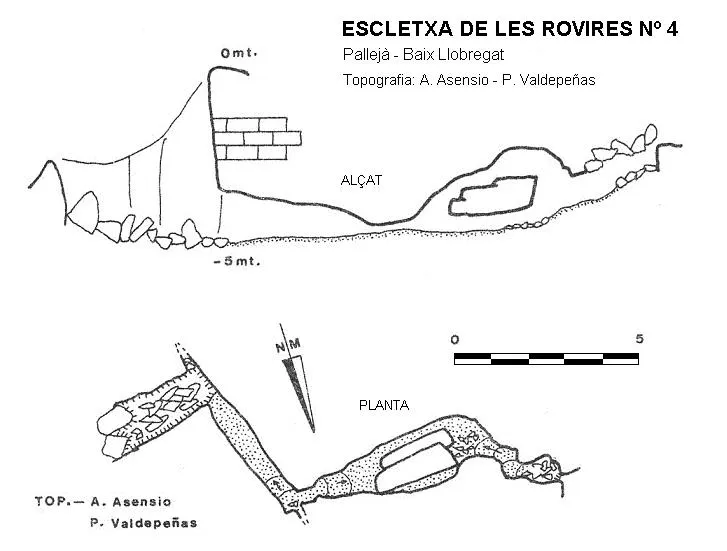
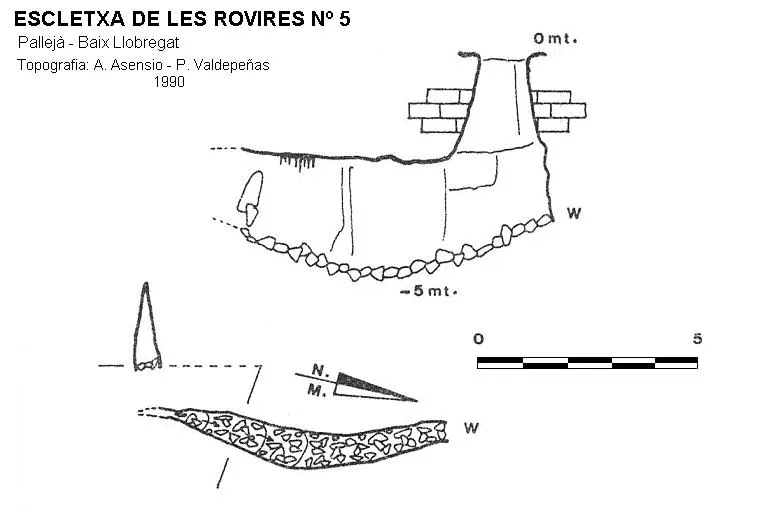


Source: Espeleoindex (espeleoindex.com), modified. CC BY-NC 4.0, https://creativecommons.org/licenses/by-nc/4.0/