
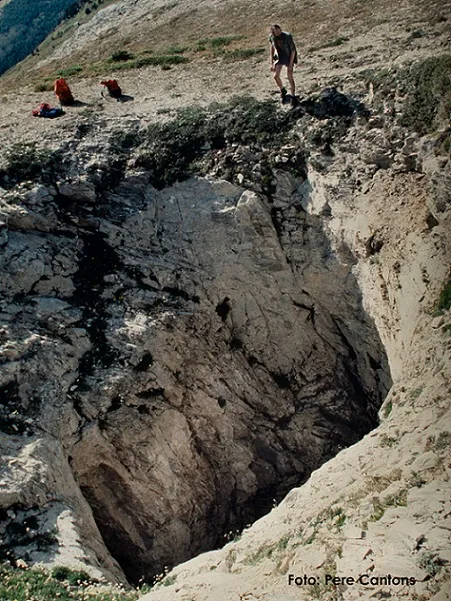
Cigalera de l'Obaga de Baleran
One of the main Catalan cavities due to its drop (-320 m), in the municipality of Alt Àneu. Located below the cigalera de Comaviera (EA.4), on the right slope of the barranc de Baleran.
EspeleoWorld
Cigalera de l'Obaga de Baleran
One of the main Catalan cavities due to its drop (-320 m), in the municipality of Alt Àneu. Located below the cigalera de Comaviera (EA.4), on the right slope of the barranc de Baleran.
Alt Àneu · Pallars Sobirà
Length: 900 m · Depth: 320 m
Updated record
https://espeleoworld.com/en/c/cigalera-de-l-obaga-de-baleran
Information can change. Always verify coordinates, access, weather, and cave conditions before setting out.
One of the main Catalan cavities due to its drop (-320 m), in the municipality of Alt Àneu. Located below the cigalera de Comaviera (EA.4), on the right slope of the barranc de Baleran.
Topographic
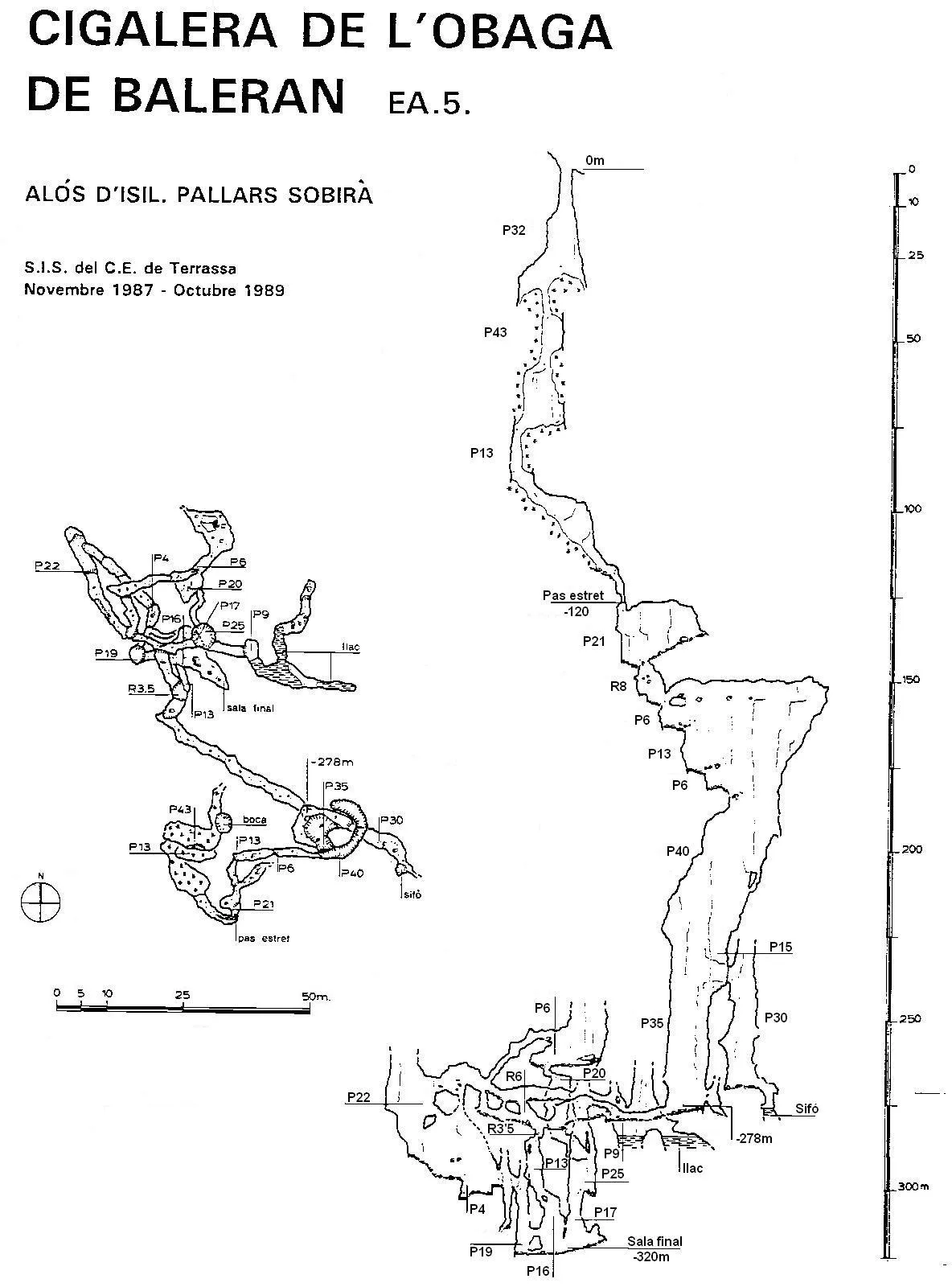
Espeleoindex · CC BY-NC 4.0, https://creativecommons.org/licenses/by-nc/4.0/ · Image © its author.
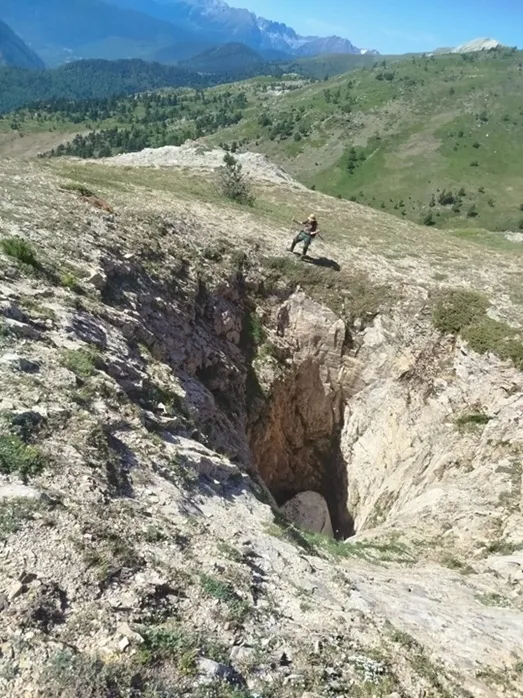
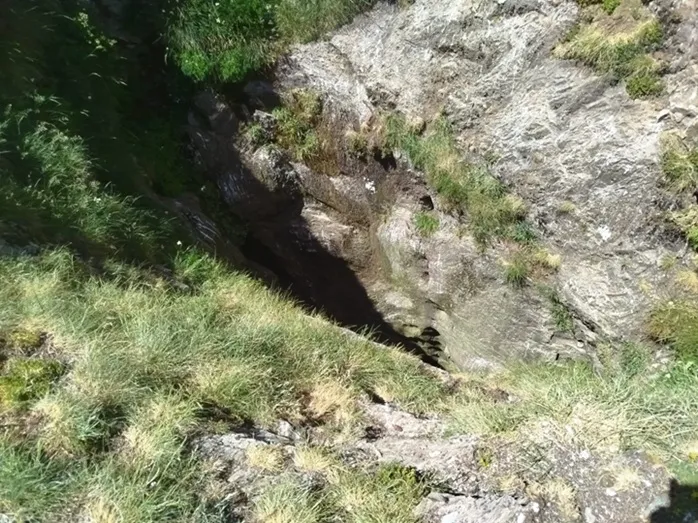
Photos
Espeleoindex · CC BY-NC 4.0, https://creativecommons.org/licenses/by-nc/4.0/ · Image © its author.
Description
Morphology
An entrance of 3x4 metres gives way to a pit largely occupied by a great snow and ice congesta. This characteristic makes the descent very irregular and its topography varies every year depending on the amount of ice. It is usually free in the first 15-25 metres; below this level one must follow the descent between the wall and the rimaia and take care, especially at the end of summer, because of the possibility of enormous blocks of ice falling.
With these highly variable characteristics, in the year when they can be passed, one reaches the level of –120 metres where an extremely narrow passage communicates with a new, fairly wide pit of 21 metres. Next, between blocks, a drop of 8 metres is descended and then another of 6. Three pits of 6, 13 and 6 metres follow successively (level –180) which lead to an important vertical of 97 metres that can be descended in three fractions. At its base (level –278), a gallery in a NW direction emerges which after 30 metres leads to a drop of 3.5 metres followed by two consecutive pits of 13 and 16 metres, reaching the final chamber (level –320).
Again at the upper part of the 3.5 metre drop, one can follow a muddy gallery that must be climbed up and reach a junction which, to the right, leads to a pit of 42 metres that communicates again with the final chamber. If instead of descending the pit one traverses along a handline, one reaches a new vertical, this one of 9 metres, and its bottom is occupied by water (El llac).
If from the aforementioned junction one follows to the left, one reaches a second junction; the right-hand gallery, ascending, leads to a chamber with a large block, after having descended a drop of 6 metres.
From the second junction, one finds a drop of 4 metres followed by a pit of 22 metres and at its bottom, a descending meander with drops leads to a new vertical, of 19 metres, which turns out to be the same 5 metre pit parallel to the final chamber.
Hydrology
The bottom of the 9 metre vertical is occupied by water (El llac).
Other details
Toponymy: According to the map consulted we can see that the area is named with different spellings: Baleran, Valeran, Balaran, without being able to determine which is the most correct.
History
This cavity and some of those around it had been known for a long time by the shepherds and hunters of the area. Speleologically it was located in the summer of 1977 by members of the SS Plantaurel and other French groups accompanying them on the campaign. We have news that some years earlier, a group from Girona had located it and perhaps even descended the first metres of the entrance pit.
On 9 August 1977 the SSP located the entrance. It was not until 14 July 1978 that J.P. Larrégola (TAMS) descended the first pit (of 18 metres that year) and saw a very steep snow ramp. The following day, two members of the SSP stopped at –60 for lack of material. The second week of August they returned and reached the narrow passage at –120, managed to pass it and reached –235. During these days they decided to rename the pit with the name of Jean-Paul Larrégola, who had died on 2 August in a mountain accident in the cirque de Troumouse. The last week of August they went up loaded with material and were able to reach the level of maximum depth (they fixed it at –322) and explore different galleries and pits of the final section. They also made the first survey. In these last days, Joan Pallisé of the SIS de Terrassa collaborated in the campaign.
The news reached Barcelona quickly and the following weekend a team from the SIE-CEA and the ERE-CEC went up to the area and located the entrance. The following week they returned with 400 metres of rope and reached the narrow passage at –120. At Alós d'Isil, a man from the village with a very closed pallarès way of speaking, commented that that hole is a cigalera that is found on the obaga de Baleran.
Without any established agreement, every weekend of September and until October they continued going up and to the SIE and the ERE were added members of the SIS de Terrassa (two of whom were the first to reach the bottom of the cavity on 15 October) and also of the SE Gelera, SEO Gràcia and SES Puigmal). After resurveying the pit, the ropes were left installed, but the first snows of November blocked the entrance pit and they trusted in returning the following summer.
In August 1979 the French and the SIS de Terrassa went up, but from –60 it was found blocked. Only some chimneys and lateral pits among the ice could be re-examined.
The French continued going up every year until 1984 or 85 and it was thought that the cavity remained blocked. The first weekend of October 1985 the people of the SIS verified that the ropes had been removed and they could descend again to the narrow passage. From 1 to 3 November the SIS resurveyed a good part of the cavity. It should be added that the 400 metres of rope of the SIE had been recovered by the French and despite the good will to return them, they never agreed on the date and form of collection.
During 1986, despite three attempts by the SIS, the first pit was blocked again. But the following year, from the end of August until mid-October, taking advantage that the passage was open, every weekend they went up and finished surveying and exploring some conduits that had not been looked at.
The tenacity of the people of the SIS has no limit and in October 1989 they entered again; the results were poor but some new small pit in the final sector and a meander at the head of the last pit (level –235) led them to a new vertical of 30 metres that ends in a small flooded pit.
User Comments (0)
No comments yet.
Be the first to share your experience!
Registered Explorations (0)
No explorations registered yet.
Register your visit to this cave!
Bibliography
- Aguirre, F.; Vives, M. (1988).- “Cigalera de l'Obaga de Baleran (1977-1987)”. SIS (11): 48-56 /Arxiu Centre Excursionista de Terrassa (53): 164-172; SIS-CET, Terrassa
- Cardona, F. (1989).-Grans cavitats de Catalunya. Vol. 1: La Serralada Pirinenca, 198 pp. EC Gràcia, Barcelona.
- Géraud, Ph. (1978).- “Reconnaissance spéléologique du massif de la Roca Blanca”. L'Echo des Ténèbres (2): 4-6, SS Plantaurel
- Géraud, Ph. (1978).- “Massif de la Roca Blanca. Province de Lérida – Espagne” L'Echo des Ténèbres (3): 6-9, SS Plantaurel
- Géraud, Ph. (1978).- “Le gouffre Jean-Paul Larrégola”. L'Echo des Ténèbres (3): 10-12, SS Plantaurel.
- Fotografies facilitades per Pere Cantons.
Nearby caves


Source: Espeleoindex (espeleoindex.com), modified. CC BY-NC 4.0, https://creativecommons.org/licenses/by-nc/4.0/