
Bufador Nº8 de Beví
A pit 52 metres deep and 400 metres long at Santa Maria de Besora, with 6 entrances and a complex route between galleries and shafts.
EspeleoWorld
Bufador Nº8 de Beví
A pit 52 metres deep and 400 metres long at Santa Maria de Besora, with 6 entrances and a complex route between galleries and shafts.
Santa Maria de Besora · Osona
Length: 400 m · Depth: 52 m
Updated record
https://espeleoworld.com/en/c/bufador-n-8-de-bevi
Information can change. Always verify coordinates, access, weather, and cave conditions before setting out.
A pit 52 metres deep and 400 metres long at Santa Maria de Besora, with 6 entrances and a complex route between galleries and shafts.
Topographic
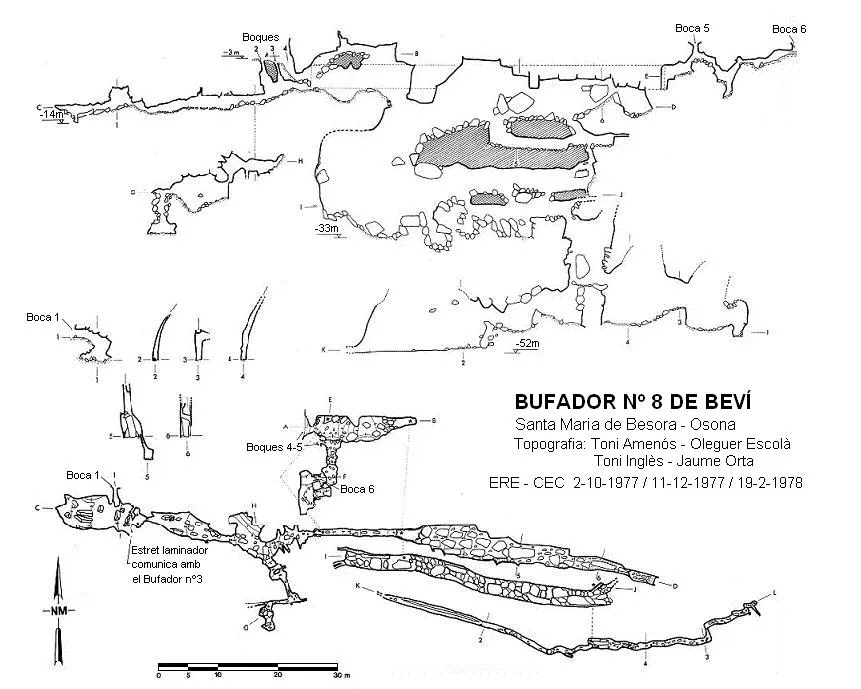
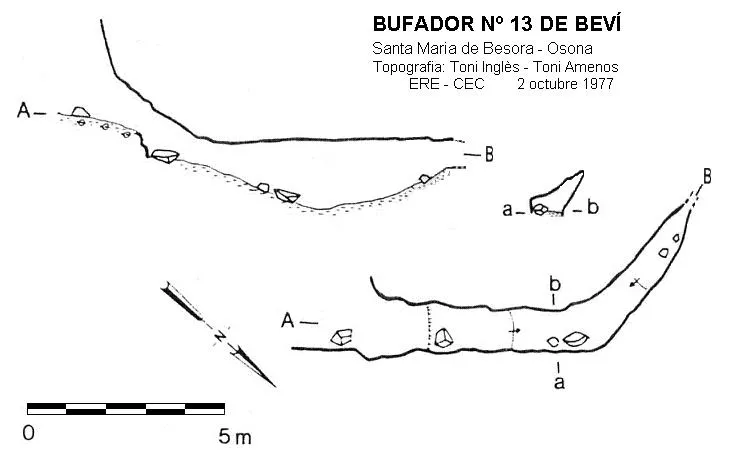
Espeleoindex · CC BY-NC 4.0, https://creativecommons.org/licenses/by-nc/4.0/ · Image © its author.
Photos
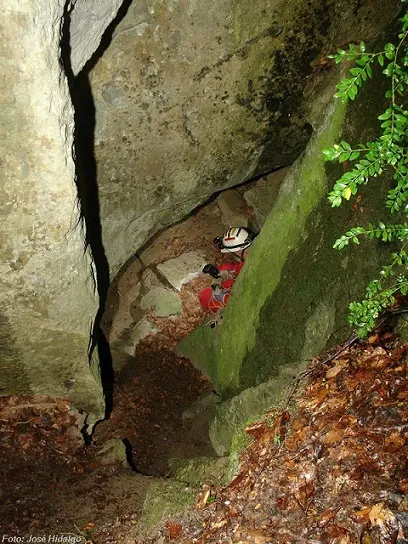
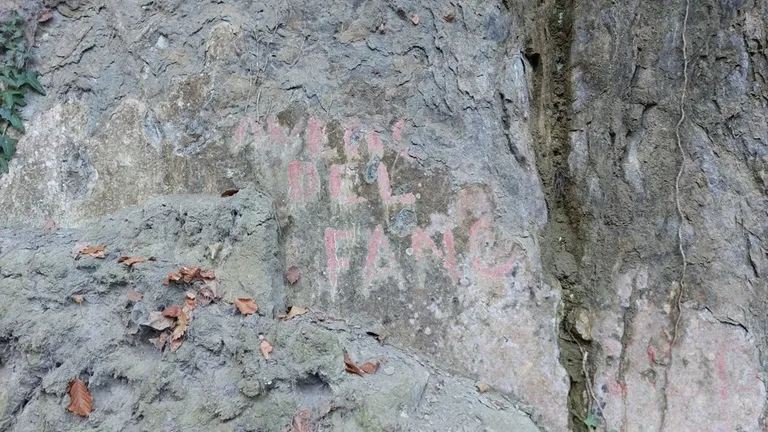
Espeleoindex · CC BY-NC 4.0, https://creativecommons.org/licenses/by-nc/4.0/ · Image © its author.
Description
Morphology
The cavity can be accessed through 6 entrances located in different places on the upper levels. The entrance, perhaps the most important, is number 4 and we make the description starting from this access. This entrance opens at the E end of the N lateral branch, and appears as a ramp that places us 3 metres lower in a vestibule from which three continuations emerge:
a) Above a step and to the right of the entrance, we find the base of entrance no. 5 and the start of a twenty-metre gallery that leads us to entrance no. 6.
b) Opposite the entrance, an ascending ramp leads us to a room full of blocks, at the end of which opens a 6-metre pit that connects at its base with the "Pou Gran".
c) To the left of the entrance, we descend a step of a metre and a half and find ourselves in a gallery oriented E-W, like most of the cavity. If we follow the gallery W, we pass a small, low-roofed passage and enter a sector of the cavity formed by three rooms joined to each other by narrow passages.
At the beginning of the first room and in the roof, we see two conduits that communicate with the outside through entrances no. 2 and no. 3. In this same room and on the left, a narrow gallery formed by two perpendicular joints leads us to a 7-metre pit opened between blocks. Immediately afterwards we cross the second room of 12x4 metres and enter the third room, where entrance no. 1 is located on the right and 2 metres from the floor. Also in this room and at the same height as the entrance, but on the left, there is a narrow squeeze that communicates with the el Bufador no. 3 de Beví.
Returning again to the entrance vestibule and following the aforementioned E-W gallery, but in the opposite direction, we reach the mouth of the "Pou Gran" of 23 metres. Halfway down the pit, a large block wedged between the two walls allows us, after making a small pendulum, to reach a hanging gallery 40 metres long with a width that oscillates between 1.60 and 5.70 metres. This gallery, totally occupied by blocks, communicates at two points with a lower passage parallel to it. Almost at the end of the 20 metres of this passage and through a 7-metre pit, we descend to a new gallery that develops between the levels -25 and -34 metres, which we can also access by finishing the descent of the "Pou Gran".
The two E-W ends of this new and important gallery 3 metres wide are separated by 45 metres of distance, not of route. In three places of the E half of the gallery, large holes that occupy the entire width make passage from one side to the other very difficult. All three holes communicate with another lower level, at the E end of which opens a 12-metre pit. At the bottom of this pit, two new verticals of 6 metres lead respectively to two galleries of opposite direction. The gallery that leads in direction E is 28 metres long and has two steps of 3 and 2 metres. While the gallery that continues in direction W is 44 metres long with two steps of 3 and 4 metres, developing below all the levels and galleries mentioned above. This latter gallery allows us to reach the lowest point of the cavity at -52 metres.
According to the latest information, it seems that due to the collapses, the cavity currently has only four accessible entrances and very probably its depth is limited to about -35 metres. The exploration is quite dangerous due to the instability of the materials that form it. (Data from 2012).
History
The first mentions of visits to some of the cavities located inside this great fissure correspond to Dr. Francesc Español, carried out in 1934 for biospeleological purposes.
In 1965 the Grup Espeleològic Terra i Mar (GETIM) of Sabadell explored the avenc dels Tigres; the avenc del TIM, the avenc Besora and the avenc del Vent.
Later the ERE of the CEC between the years 1977 and 1980 carried out a meticulous inventory of the cavities located in this fissure that would be published in the magazine Espeleòleg no. 34-35.
During 1979 the Centre Espeleològic Cervelló carried out the exploration of various cavities of this fissure, with the aim that they be published in the Catàleg Espeleològic de Catalunya (Borràs-Miñarro-Talavera), this led to giving a new denomination to some cavities.
The EspeleoÍndex team has considered it more appropriate to use the denomination of the cavities made by the members of the ERE-CEC, since it is a more complete joint work. This same line regarding the denomination has been used by Jordi de Valles in the Catàleg Espeleològic de Catalunya (4).
It must be borne in mind that between this cavity and the el Bufador no. 3 de Beví there is a narrow squeeze that communicates them, although we do not know if physical passage between the two is possible. If the passage were possible, the sum of both cavities would give a route of more than five hundred metres.
User Comments (0)
No comments yet.
Be the first to share your experience!
Registered Explorations (0)
No explorations registered yet.
Register your visit to this cave!
Bibliography
- Borràs,J; Miñarro,J.M; Talavera,F.(1980).-”el ripollès la garrotxa i l'alt empordà”. Catàleg Espeleològic de Catalunya (vol4):1-296. Ed. Políglota. Barcelona.
- Escolà Boada,Oleguer; Inglès Alcon, Antoni; Martinez Rius, Albert.(1983).-”Bufadors de Babí”. Espèleòleg (34-35):223-243. ERE-CE Catalunya.
- GE Terra i Mar.(1968).-”Grup d'espeleologia Terra i Mar -Sabadell-” Espeleòleg (7):239-241. ERE.CE Catalunya.
- Valles, Jordi de.(2010).-”Alt Empordà, Baix Empordà, Gironès, Osona, Pla de l'Estany, Selva”. Catàleg Espeleològic de Catalunya (4):1-397. EC Gràcia – FCE.
- Fotografies extretes del blog: espeleobloc.blogspot Apunt del 4-9-2013
Nearby caves
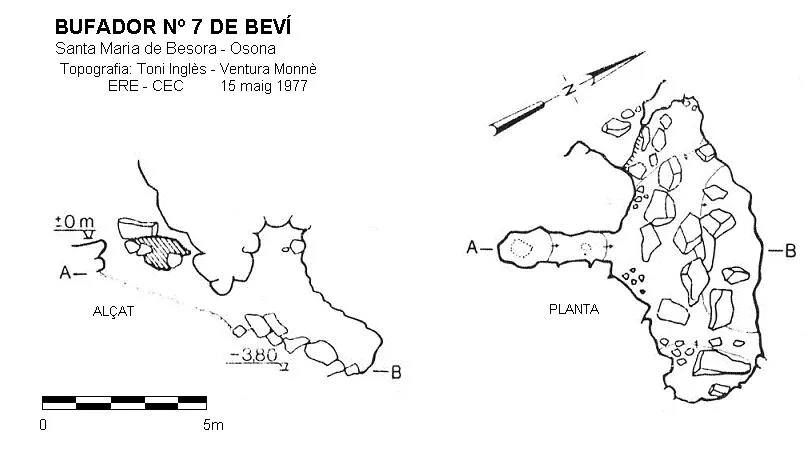
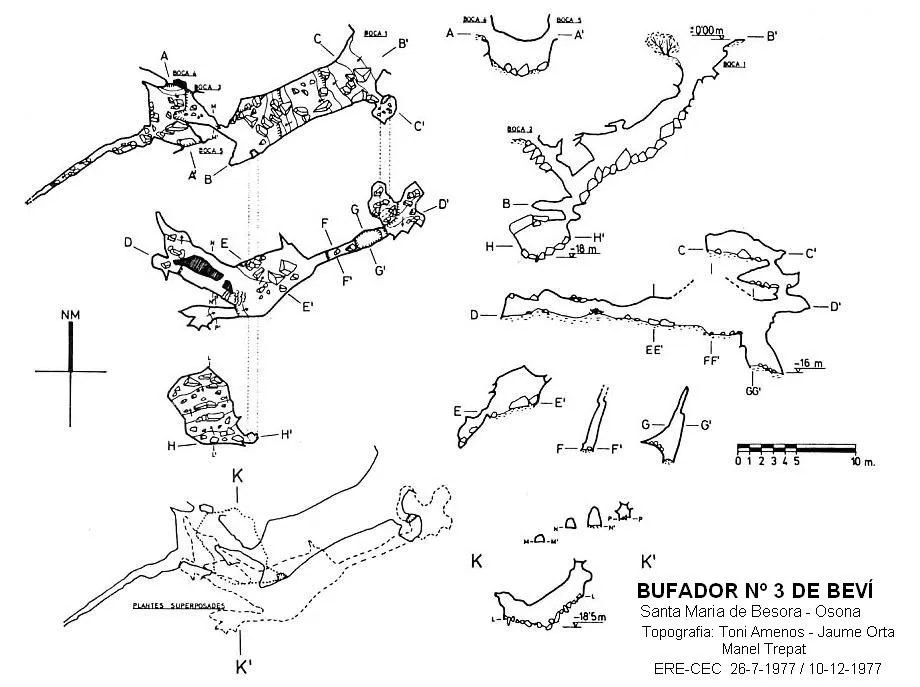


Source: Espeleoindex (espeleoindex.com), modified. CC BY-NC 4.0, https://creativecommons.org/licenses/by-nc/4.0/