
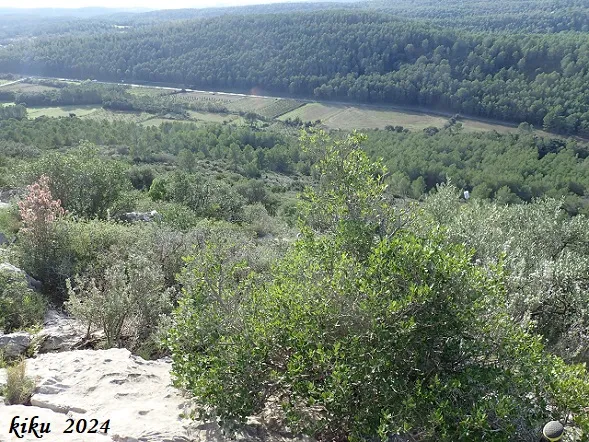
Bora Major
Coneguda cova d'uns 45 m. de recorregut a Terrades (Alt Empordà)
EspeleoWorld
Bora Major
Coneguda cova d'uns 45 m. de recorregut a Terrades (Alt Empordà)
Terrades · Alt Empordà
Length: 45 m · Depth: 18 m
Updated record
https://espeleoworld.com/en/c/bora-major
Information can change. Always verify coordinates, access, weather, and cave conditions before setting out.
A cave of about 45 m of passage in Terrades (Alt Empordà), also known as Bora Major.
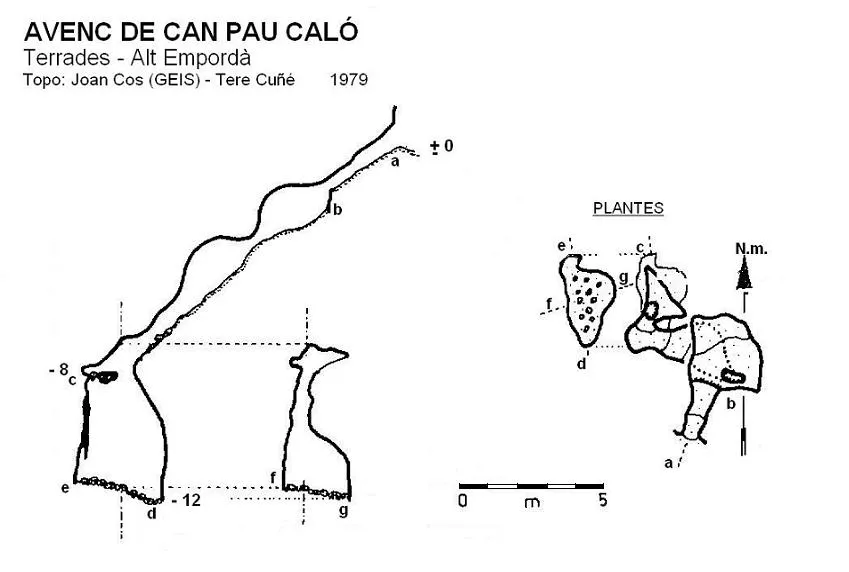
Topographic
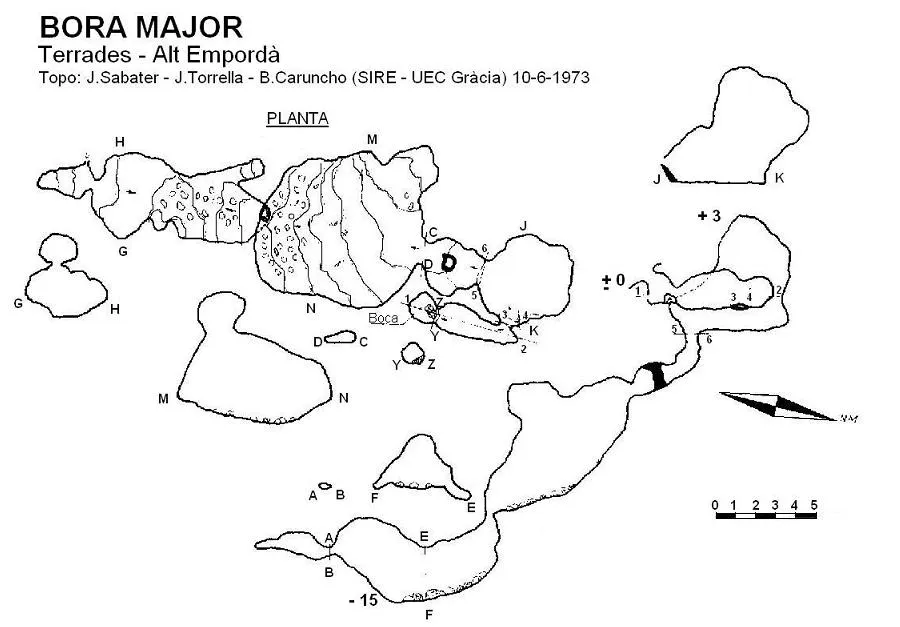
Espeleoindex · CC BY-NC 4.0, https://creativecommons.org/licenses/by-nc/4.0/ · Image © its author.
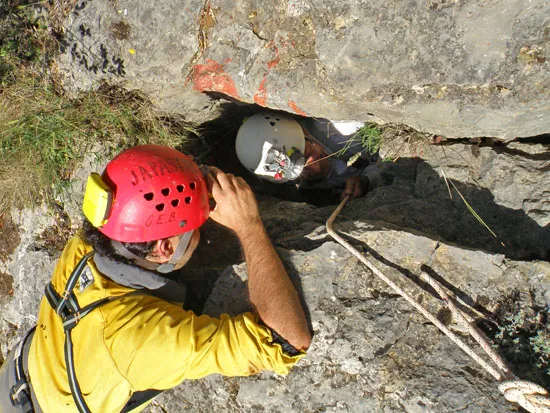
Photos
Espeleoindex · CC BY-NC 4.0, https://creativecommons.org/licenses/by-nc/4.0/ · Image © its author.
Description
Morphology
Once past the small mouth and a short passage, a narrow gap leads to a first chamber; at one of its ends a sloping conduit opens that communicates with the largest chamber of the cavity. At the lower end of this chamber and via a short vertical drop, we reach a small chamber that is the end point of the cave.
Speleothems
At one of the ends of the first chamber a sloping conduit opens with a column in the very middle.
Progression
Once past the small mouth and a short passage, a narrow gap leads to a first chamber; at one of its ends a sloping conduit opens with a column in the very middle, which communicates with the largest chamber of the cavity. At the lower end of this chamber and via a short vertical drop, we reach a small chamber that is the end point of the cave.
History
Since the Diccionario geográfico by Pascual Madoz (1850), two cavities in the Terrades area are mentioned, also recorded by C. del Prado, Puig y Larraz, Font i Sagué and Faura i Sans: the Cova de Santa Magdalena and the Cova dels Encantats. We have never had specific data about them, although perhaps one of the two could be the Bora Major.
The first news we have of the cavity is from Dr. Ricardo Zariquiey (father), who in August 1917, accompanied by Messrs. Guimjoan and Rosés, made a first recognised visit in search of subterranean fauna. In September 1923 it was visited again by his son, Ricardo Zariquiey Álvarez, accompanied by Mr. Bofill and with the same purposes. It should be said that they all call it by the incorrect form Vora Major. Over the years there have been many visits made by different biospeleologists and also by many curious people.
Complete data on the cavity were not available until January 1972, when it was explored by Empordà speleologists (S. Delclós et al.), who made a first survey and called it Cova de la Moneda Falsa, which seems to be how it is known in Sant Llorenç de la Muga, where they were given the information.
During the spring of 1973, the biospeleologist Àngel Lagar, together with colleagues from SIRE – UEC Gràcia, carried out a series of explorations in the area and explored and surveyed the Bora Major, thus recovering the name that Dr. Zariquiey had given it.
Bio
Coleoptera
Leioididae.
- Parvospeonomus delarouzeii
Curculionidae
- Otiorhychus (Lixorrhyncus zariquiei (Clermont, 1949)
User Comments (0)
No comments yet.
Be the first to share your experience!
Registered Explorations (0)
No explorations registered yet.
Register your visit to this cave!
Bibliography
- Borràs, J.; Miñarro,JM.; Talavera,F. (1980).-Catàleg espeleològic de Catalunya. Vol. 4: el Ripollès, la Garrotxa i l'Alt Empordà. 296 pp. Ed.Políglota. Barcelona.
- Delclós, S. (1972).- “Cuevas y simas del Alt Empordà”. Comunicaciones del II Simposium Metodologia Espeleológica– Topografía. SIE – CEA i Escola Catalana d'Espeleologia. Barcelona.
- Escolà, O.; Bellés, X. (1984).- “Distribució geogràfica dels Speonomus del subgènere Parvospeonomus (Col. Catopidae Bathysciinae) al vessant meridional dels Pirineus. Actes de la III Sessió conjunta d'entomologia: 19-28. ICHN – SCL. Mataró
- Español, F. (1946).-”La Zariquieya troglodytes Jeann.” Graellsia 4 (4): 89-97
- Español, F. (1956).- “Los Bathysciinae catalanes (col. Catopidae)”. Actes du II Congrés International d'Etudes Pyrénéens, T.3 (2):109-123. Luchon – Pau, 1954.
- Lagar, A.; Salvadó, M.; Sabater, J.; Torrella, J. (1973).- “Cavidades de Terrades (Alt Empordà, Girona)”. Senderos (176): 19-25. Unió Excursionista de Catalunya. Barcelona.
- Dades Biospeleològiques facilitades per Floren Fadrique.
- Actualització de dades, coordenades i fotografies facilitades per Juli Serrano (SIE-CEA) i Francesc Rubinat (ERE-CEC), novembre de 2024.
Nearby caves
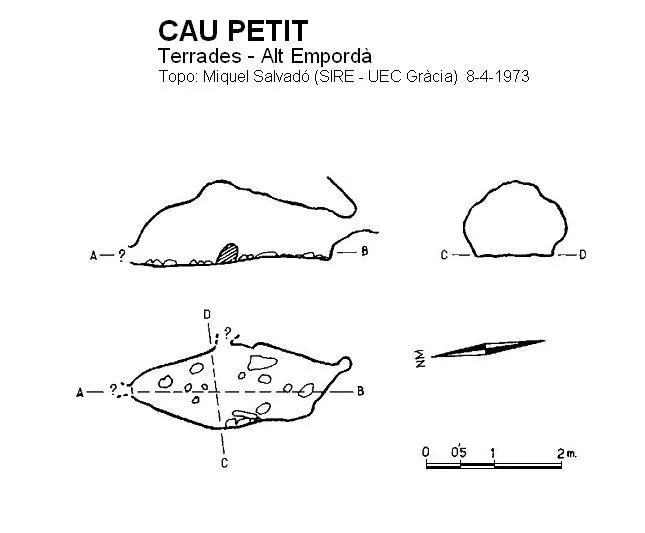
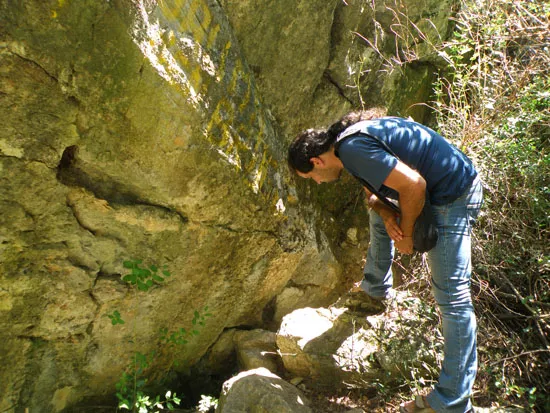


Source: Espeleoindex (espeleoindex.com), modified. CC BY-NC 4.0, https://creativecommons.org/licenses/by-nc/4.0/