
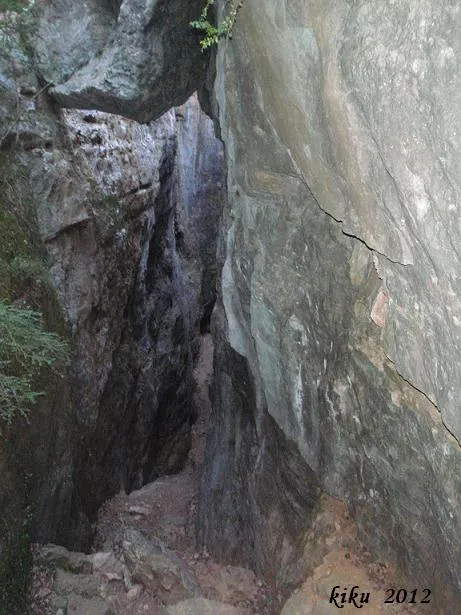
Avencs i Coves de la Febró
An important system of cracks with a route of 1810 metres at la Febró, with three main cracks, galleries, caves and pits, and a long history of explorations.
EspeleoWorld
Avencs i Coves de la Febró
An important system of cracks with a route of 1810 metres at la Febró, with three main cracks, galleries, caves and pits, and a long history of explorations.
Febró, La · Baix Camp
Length: 1810 m · Depth: 73 m
Updated record
https://espeleoworld.com/en/c/avencs-i-coves-de-la-febro
Information can change. Always verify coordinates, access, weather, and cave conditions before setting out.
An important system of cracks with a route of 1810 metres at la Febró, with three main cracks, galleries, caves and pits, and a long history of explorations.
Topographic
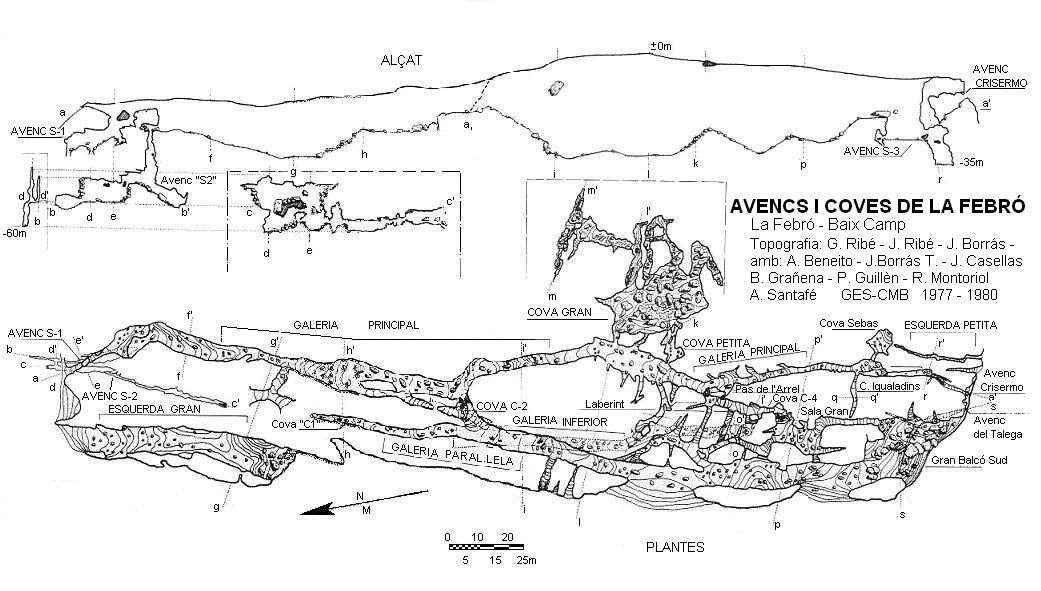

Espeleoindex · CC BY-NC 4.0, https://creativecommons.org/licenses/by-nc/4.0/ · Image © its author.
Photos

Espeleoindex · CC BY-NC 4.0, https://creativecommons.org/licenses/by-nc/4.0/ · Image © its author.
Description
Morphology
The cavity is formed fundamentally by cracks that run parallel to the cliff that generated them. We can distinguish three main cracks, in addition to other secondary ones perpendicular or oblique to the first: L'Esquerda Gran is the closest to the cliff, it is the widest but also the shortest, and it runs isolated from the others. The Galeria Paral·lela is located in the middle, between l'Esquerda Gran and the Galeria Principal, it is rigorously rectilinear, continuing through the Gran Balcó Sud, the latter presenting communications with the third crack and a whole set of links with an intermediate zone of perpendicular or oblique fractures, open at different levels, called the Laberint. The Galeria Principal is the furthest from the cliff, almost 300 metres long, narrow and deep, with communications with the Laberint, la Cova Gran, la Cova Petita and other caves of lesser interest, as well as three pits. We also find a “Via Ferrata” that allows us to climb back up to the exterior.
Galeria Principal: It is an N-S megaclast with a route of 292 metres subaerial; a few metres from its start at the N end, there is the entrance of the pit S-1, of -14 metres and 25 metres of route; a few metres further on there is a vertical rise, below which opens the pit S-2, of -33 metres (a shaft of -19) and 121 metres of route. The Galeria Principal continues for a space of 65 metres until becoming ascending along a stretch of approximately the same length, at the end of which there is an ascending passage in the eastern wall that allows us to exit to the exterior. Continuing along the gallery, we descend steeply until reaching -34 metres from the exterior, the point where the Cova Gran opens; this is formed by a quadrangular room of 16x30 metres, from which different galleries emerge, one of them linking with a new small cave followed by a vertical crack whose bottom is at -73 metres of depth. The speleometry of the Cova Gran is 254 metres of route and -39 metres of drop. Next to the entrance of the Cova Gran, the Cova Petita opens, of more modest dimensions. On the opposite wall opens the Cova C-3, to which we will refer later. Following the main crack, we will ascend and leave on the right the Pas de l'Arrel, which communicates with the Laberint. The Galeria Principal becomes a narrow corridor of 58 metres until reaching the place where the Cova Sebas and the Cova dels Igualadins open. The crack ends further on after a couple of pits of -7 and -8 metres.
El Laberint: It is a set of interwoven galleries which we will access through the Pas de l'Arrel; once past this, we find ourselves in a gallery of 25 metres that ends at the Sala Gran and from which three branches emerge on the right that communicate with a new network of corridors that lead out to the Galeria Paral·lela. Before the Sala Gran, we find the entrance of the Cova C-4, totally subterranean (Galeria Inferior), with a route of 192 metres and occupied by blocks among which some small pits open; in the central zone, a strong ramp hanging 6 metres above the floor is the communication with the Cova C-3.
La Galeria Paral·lela: It has a subaerial route of 176 metres, beginning at the Gran Balcó Sud; it also presents two balconies over the cliff and 6 communications with the Laberint. Further N it presents a wide gallery of communication with the Galeria Principal.
Other details
Numerous formations were extracted from the cave, which were sent to many places, but especially to Reus, to the mas d'en Macià Vila, in order to adorn the gardens and cascades.
History
According to J. Ferraté (1918), he cites that at the beginning of the 19th century it served as a refuge for the smuggler and conspirator Josep Ferrer i Grau, alias l'Agnès de Vilaplana, who hid there while fleeing from the armed force. He also tells us that in 1843 it served as a refuge for general Prim during the course of the Carlist wars. Although in 1843 there was no Carlist war, the uprising of Joan Prim and Llorenç Milans del Bosch against Espartero did take place in Reus.
Between the days 30 October to 2 November 1887 Antoni Palau explores them and in December of the same year he publishes the review in the bulletin “l'Excursionista”. In 1896 it is cited by Puig y Larraz in the book 'Cavernas y Simas de España' based on the data of Antoni Palau. In 1897 Font i Sagué reproduces the same text of Puig y Larraz in the 'Catàlech Espeleològich de Catalunya'. In 1918 J. Ferraté in the book 'Espeleologia de les comarques tarragonines', deals extensively with the cavity with partial topographic surveys. More recently the cavity is frequented by speleologists, generally from Tarragona and Reus. In 1973-74, the ERE of the Centre Excursionista de Catalunya carries out a topography of the main cracks, this topography remaining unpublished, since it was not published. In 1980 the GES of the Club Muntanyenc Barcelonès carries out a systematic prospection of the cracks, carrying out a topographic survey of all the cracks, publishing it in Sota Terra no. 1. Currently these cracks are very frequented by hikers of all kinds, as well as by climbers, who have opened various climbing routes, as well as a “via ferrata”.
User Comments (0)
No comments yet.
Be the first to share your experience!
Registered Explorations (0)
No explorations registered yet.
Register your visit to this cave!
Bibliography
- Borrás, J.; Miñarro, J.M.; Talavera, F.(1984).-”El Baix Camp, el Priorat i la Ribera d'Ebre” Catàleg Espeleològic de Catalunya (Vol 7):1-283. Ed políglota. Barcelona.
- Cardona i Oliván, Ferran.(1990).-”El sistema mediterrani i la depressió central”. Grans Cavitats de Catalunya (Segon Volum):1-484. EC Gràcia. Barcelona.
- Cardona i Oliván, Ferran.(1993).-”Les Correjades (la vall d'en Bas – Garrotxa. Annex: Grans esquerdaments d'interès espeleològic a Catalunya””. Exploracions (16):51-65. EC Gràcia. Barcelona.
- Ferraté, J.(1918).- Espeleologia a les Comarques Tarragonines.134 pp. Reus.
- Font i Sagué, N.(1897).-”Catalech Espeleologich de Catalunya (continuació)” Butlletí del Centre Excursionista de Catalunya (32):249-253. CE Catalunya.Barcelona.
- Palau, Antoni.(1887).-”Excursions. Serras de Prades” l'Excursionista (110):97-104. Associació Catalanista d'Excursions Científicas. Barcelona.
- Puig y Larraz, Gabriel.(1896).- Cavernas y Simas de España. 1-440. Madrid.
- Ribé, G; Borràs, J.(1980).-”Avencs i Coves de la Febró (complex)”. Sota Terra (1):39-53. GES-CM Barcelonès. Barcelona.
- Fotos sense autor extretes del blog “Espeleobloc” post del dia 18-12-2009.
Nearby caves
Avenc del Giem
0.5 km · N
Febró, La (Baix Camp)
1 topo.7 photos
Avencots dels Motllats de la Pona
0.6 km · W
Febró, La (Baix Camp)
1 topo.6 photos
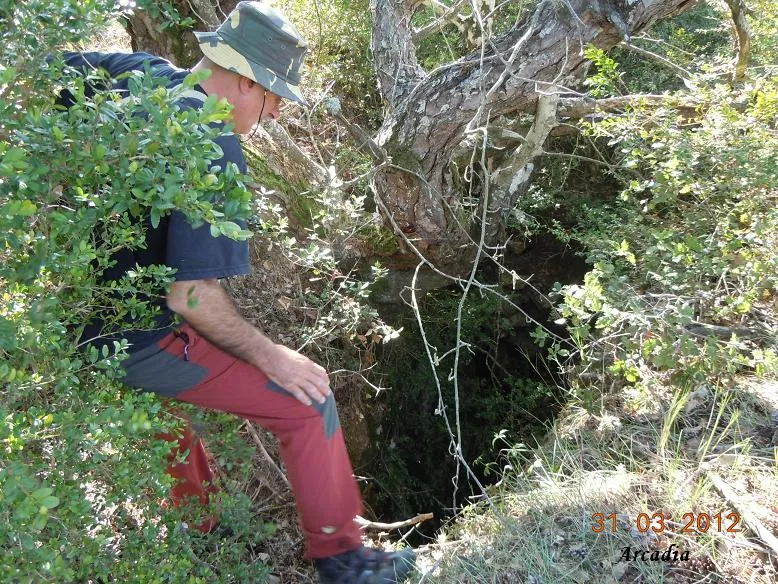
Avenc de la Roca del Migdia Nº1
1.0 km · W
Febró, La (Baix Camp)
1 topo.3 photos
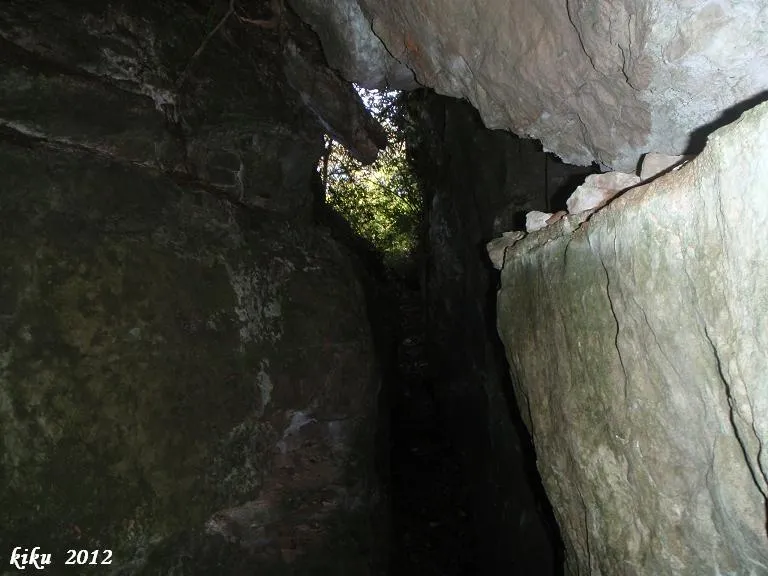
Avenc de la Roca del Migdia Nº2
1.0 km · W
Febró, La (Baix Camp)
1 topo.1 photos
Source: Espeleoindex (espeleoindex.com), modified. CC BY-NC 4.0, https://creativecommons.org/licenses/by-nc/4.0/