
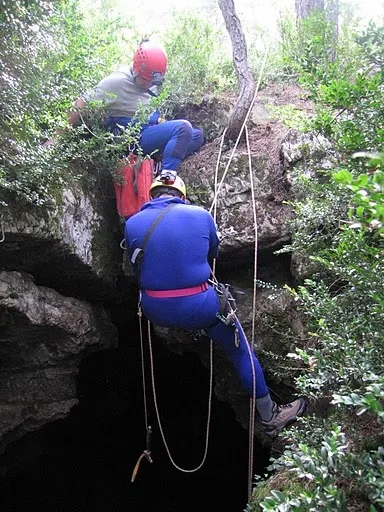
Avenc del Salany
A 26 m deep pit at the Mola de Catí (el Port, Tortosa), with a 19 m shaft, a collapse chamber and meandering galleries with concretions.
EspeleoWorld
Avenc del Salany
A 26 m deep pit at the Mola de Catí (el Port, Tortosa), with a 19 m shaft, a collapse chamber and meandering galleries with concretions.
Tortosa · Baix Ebre
Length: 132 m · Depth: 26 m
Updated record
https://espeleoworld.com/en/c/avenc-del-salany
Information can change. Always verify coordinates, access, weather, and cave conditions before setting out.
A 26 m deep pit at the Mola de Catí (el Port, Tortosa), with a 19 m shaft, a collapse chamber and meandering galleries with concretions.
Topographic
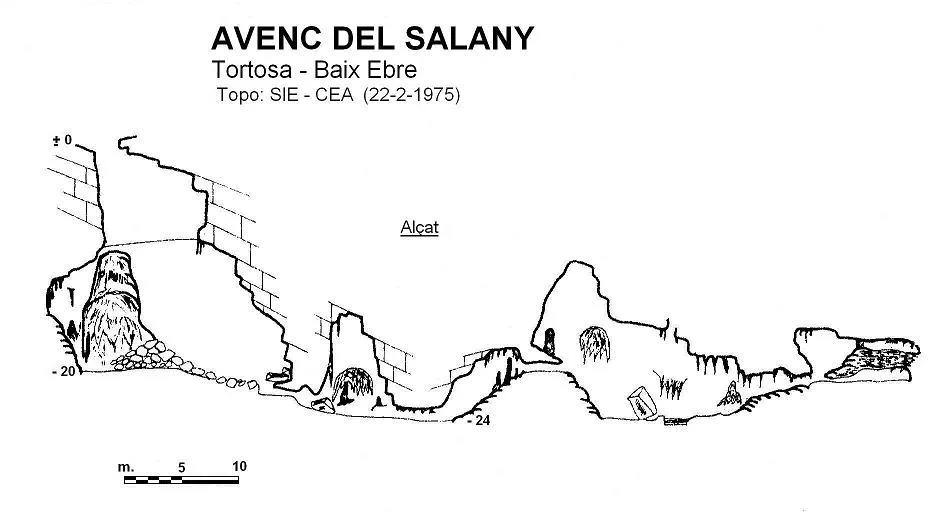
Espeleoindex · CC BY-NC 4.0, https://creativecommons.org/licenses/by-nc/4.0/ · Image © its author.
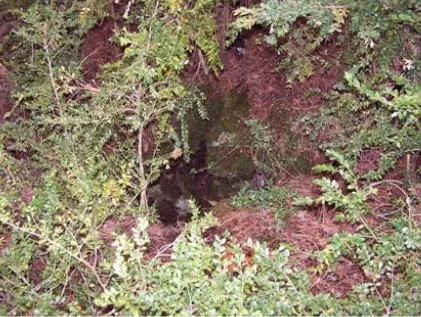
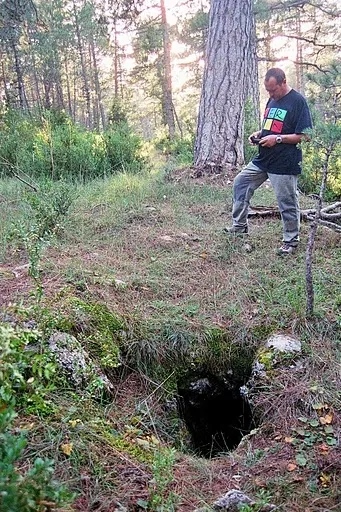
Photos
Espeleoindex · CC BY-NC 4.0, https://creativecommons.org/licenses/by-nc/4.0/ · Image © its author.
Description
Morphology
The entrance shaft begins with a subcircular opening 2 metres in diameter, forming a perforation in the ceiling of the underlying chamber. The drop is 19 metres deep, subdivided halfway along its course by a ledge formed by a thick stalagmitic formation. At the base of the shaft a debris cone develops, generally of clastic products from the opening to the outside, since we are faced with a collapse chamber of about 20 x 15 metres and about 10 to 17 in height and of great didactic beauty. The discontinuity solutions marked by the stratification with an inclination of 15 to 20º are clearly visible, and along it appear the stalactitic coatings that cover the western wall of the chamber.
The axis of this chamber, oriented SW – NE, as is general throughout the cavity, would have its theoretical prolongations at both ends. At the northern one, the thick flowstone that subdivides the shaft prevents inspection of the hypothetical continuation at this point. On the opposite side (SW), only a small descending opening among the clastic products gives access through a narrow passage to a new stretch of this interesting phenomenon. This continuation is a clear fragment of meandering gallery, a passage of minimum dimensions 1.5 X 1.8 metres but with wider sections that have terraces partially covered by stalagmitic concretion.
At the other end of the narrows we emerge into a gallery 20 x 5 metres and a height of between 8 and 14 metres, the point of maximum height coinciding with a chimney to which the actions of infiltration and clastification are joined, producing a mixed morphology between the classic collapse domes and those of dissolution.
The continuation is via a new ascending stretch in a staircase of gours and microgours, bringing us to the terminal chamber, about 6 x 4 metres and 2.5 in height, filled with flowstone, beneath which some small passages develop; a column with a broad lithogenic base is worth noting.
Speleothems
In this lithogenic plug stalactites and stalagmites develop in great number, some specimens of the latter standing out for their slenderness, thin and of great height (data 1975).
This last stalagmitic plug which undoubtedly covers the blocks fallen from the vaults and forms a balcony that dominates the relatively wide gallery.
Hydrology
At certain times of the year a small stream of water flows which at level – 24 is dammed, recovering again after another stalagmitic plug. The passage is made 4 metres higher (level – 20), through a narrows.
After the step it produces one reaches the level of maximum depth (- 26). Here some water pools of variable depth form (about 40 cm. the maximum) and largely surrounded by magnificent gours.
Progression
The passage is made 4 metres higher (level – 20), through a narrows. After the step it produces one reaches the level of maximum depth (- 26). The continuation is via a new ascending stretch in a staircase of gours and microgours, bringing us to the terminal chamber.
Other details
Interesting and beautiful 26 m. deep pit at the Mola de Catí (el Port, Tortosa).
History
This cavity was discovered and explored by members of the ERE – CEC during the trip of the days 30-4 and 1-5-1970. (Information provided by Pere Cantons).
Like the rest of the cavities discovered and explored by the ERE at that time, it remained unpublished until a few years later, during the campaigns of the SIE – CEA it was relocated and surveyed.
User Comments (0)
No comments yet.
Be the first to share your experience!
Registered Explorations (0)
No explorations registered yet.
Register your visit to this cave!
Bibliography
SIE (1978).- “Contribució al coneixement espeleològic dels Ports del Caro (Baix Ebre) (IV): La Mola de Catí i el Mont Caro”. EspeleoSie (21): 27-70. SIE-CE Àliga. Barcelona.
Coordenades i fotografies de l'Espeleo Club Tortosa
Nearby caves


Source: Espeleoindex (espeleoindex.com), modified. CC BY-NC 4.0, https://creativecommons.org/licenses/by-nc/4.0/