
Abisso Pozzo della Neve
Abisso Pozzo della Neve is a cave in the north-eastern Matese, in the municipality of Campochiaro (Molise). It has a vertical drop of 1045 m and a development of about 8000 m; more recent estimates indicate over 9 km.
EspeleoWorld
Abisso Pozzo della Neve
Abisso Pozzo della Neve is a cave in the north-eastern Matese, in the municipality of Campochiaro (Molise). It has a vertical drop of 1045 m and a development of about 8000 m; more recent estimates indicate over 9 km.
Campochiaro
Length: 8000 m · Depth: 1048 m
Updated record
https://espeleoworld.com/en/c/abisso-pozzo-della-neve-campochiaro
Information can change. Always verify coordinates, access, weather, and cave conditions before setting out.
Abisso Pozzo della Neve is a cave in the north-eastern Matese, in the municipality of Campochiaro (Molise). It has a vertical drop of 1045 m and a development of about 8000 m; more recent estimates indicate over 9 km.
Topographic

© T. Bernabei · none-stated · Tullio Bernabei, via Scintilena atlas · https://www.scintilena.com/speleoit/atlas/molise/poz_neve.html
Photos

© Gruppo Speleologico del Matese (site gsmatese.it contact, per the page) · none-stated · Gruppo Speleologico del Matese, via Italian Botanical Heritage (luoghi.italianbotanicalheritage.com) · https://luoghi.italianbotanicalheritage.com/en/?p=34164
Description
Morphology
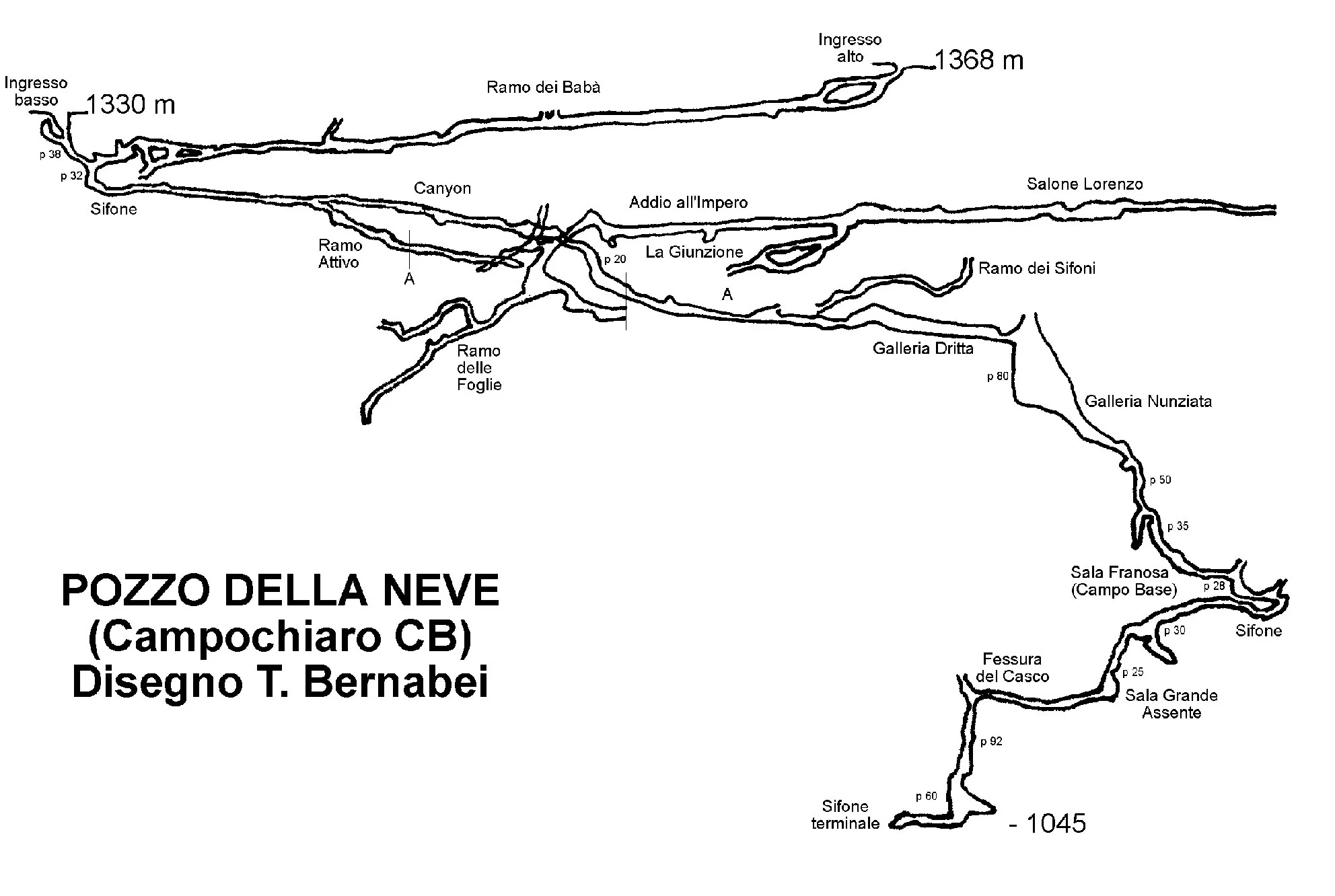
The cave system is formed by pits, meanders, flooded sections, large chambers and narrow passages. The survey shows, among others, the Ramo Attivo, the Ramo delle Foglie, the Ramo dei Sifoni, the Galleria Dritta and the Galleria Nunziata. There are also the Ramo Addio all'Impero, the Salone Lorenzo, the Sala Grande Assente and the Fessura del Casco. The Sala Franosa is used as an internal base camp. Three verticals measure about 80, 92 and 60 m. At the bottom there is a terminal sump.
The Schiffer pit exceeds 170 m in height, including the 25 m gained in a climb in 2010.
In the upper branches, about 1 mile long, the rock is white limestone with rudist fossils. Here there is also a long white meander.
Speleothems
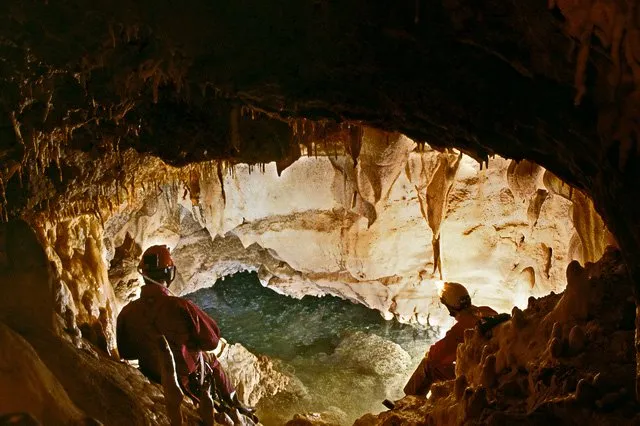
Photographs of the cave show draperies, flowstone and stalactites.
Hydrology
Among the water inputs of the cave are the inflows of the Schiffer pit; in summer, however, no active stream flows.
Around -110 m there is a sump. At the end of summer it allows passage, but the autumn rains close it again.
A fluorescein test was carried out in the stream of the Ramo dei Baba, to verify the connection with the nearby Cul di Bove. The dye was not detected, so the connection is not demonstrated.
Progression
Between 1962 and 1974 the Ramo Attivo, the main branch as far as the 80 m pit and the Galleria Nunziata were explored, with a sump at -731 m as the bottom. In 1981 the diver Matteo Diana (GS CAI Roma) passed a sump at about -693 m and explored to -780 m. In 1982 the way around that sump was discovered; with the internal camp at -560 m, the limit reached was -855 m, at the Fessura del Casco. Another source indicates -895 m.
The bottom, at -1045 m, was reached on 23 October 1988. The final squeeze was forced by two Roman cavers, part of a group of four that had passed the sump by diving. In 1987 and 1988 camps of several groups were held, with the CSR and Polish cavers from Dabrowa Gornicza, dedicated to the final squeeze.
Around 1990 the Ramo Addio all'Impero, parallel to the main branch, was found with climbs in the Ramo delle Foglie. Between 1999 and 2004 work was done on the Schiffer pit and on the Ramo dell'Eclissi. Then followed the Ramo dell'Invidia, the Ramo Ramo and the Ramo dei Single, the latter in 2011.
Between 2008 and 2010 three large summer camps increased the development. In 2009 a permanent internal camp was set up at the Sala Franosa, at -700 m. In 2010 the Ramo dell'Invidia, almost 600 m long, stopped at a semi-sump, about 300 m above the Fessura del Casco.
Other details
The vertical drop given in the atlas sheet is -1045 m (-1007 m downwards and +38 m upwards). Grottocenter reports 1048 m of depth and 8000 m of development. Other estimates of development are over 9 km (2015) and about 13 km (2014), but without a cited survey.
The authors of a 2011 study believe that the depth is probably overestimated. The survey updated from 2004 and some temperature measurements from 1994 indicate an error perhaps greater than 60 m.
The nearby Cul di Bove probably belongs to the same system. Joining the two caves is a goal of the explorers, but so far no connection has been demonstrated.
History
The first explorations date back to a Roman caving camp, held from 14 to 24 August 1955. Over time various Matese groups have worked in the cave: the Gruppo Speleologico del Matese (1985), the Speleologi Molisani (1995, born from a split) and the Speleomatese collective (2008).
The atlas survey bears the names of ASR, Speleo Club Roma, Circolo Speleologico Romano, Speleologi Romani and GS CAI Roma. In 2009 the summer camp brought together ten groups, from Matese, Rome, Naples, Puglia and other areas, for a total of 135 people in two weeks.
User Comments (0)
No comments yet.
Be the first to share your experience!
Registered Explorations (0)
No explorations registered yet.
Register your visit to this cave!
Nearby caves
Contains information from © OpenStreetMap contributors, www.openstreetmap.org, made available under the Open Database License (ODbL 1.0, https://opendatacommons.org/licenses/odbl/1-0/), modified. · https://www.openstreetmap.org/node/1827646845 · data as of 2026 · Text written by Espeleoworld from public sources. Please ask us before reusing it. · Text by Scintilena / Speleo.it (POZZO DELLA NEVE - Molise (Atlante delle grotte, scheda Mo Cb 10)), Circolo Speleologico Romano (Monti del Matese (Circolo Speleologico Romano)), MeteoWeb (Matese, l'enorme patrimonio speleologico presente nelle sue montagne calcaree (MeteoWeb, Jan 2014)), Dominella Trunfio (Pozzo della Neve: nel Matese uno scrigno luminoso nascosto a 100 metri di profondita (greenMe, 21 Dec 2015)), Natalino Russo, Manuela Merlo, Luigi Russo, Valerio Olivetti, Federica Antonucci (Dopo il lungo inverno. La riscoperta di Pozzo della Neve (Speleologia n. 64, giugno 2011, pp. 26-35)), Italian Botanical Heritage ("Well of the Snow" Abyss (Luoghi - Italian Botanical Heritage)), Grottocenter (Grottocenter entrance 168628 - Neve (Pozzo della)) · adapted by Espeleoworld (normalized, translated); the adaptation is licensed Our own text, written from public sources. Please ask us before reusing it. · The derived data is available on request under the ODbL: [email protected]