
Forat de Riu Algars
A 2000-metre-long cave in Alfara de Carles (el Port), with a height difference of 43.50 metres and a meandering layout. The surveyed route is 1,190 metres.
EspeleoWorld
Forat de Riu Algars
A 2000-metre-long cave in Alfara de Carles (el Port), with a height difference of 43.50 metres and a meandering layout. The surveyed route is 1,190 metres.
Alfara de Carles · Baix Ebre
Sviluppo: 2000 m · Profondità: 43 m
Scheda aggiornata
https://espeleoworld.com/it/c/forat-de-riu-algars
Le informazioni possono cambiare. Verifica sempre coordinate, accesso, meteo e condizioni della cavità prima di partire.
A 2000-metre-long cave in Alfara de Carles (el Port), with a height difference of 43.50 metres and a meandering layout. The surveyed route is 1,190 metres.
Topografia
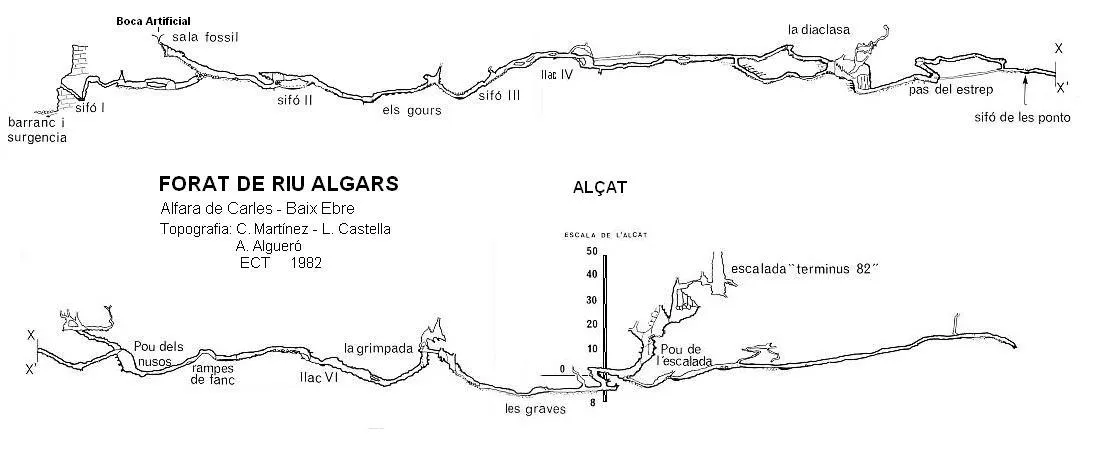
Espeleoindex · CC BY-NC 4.0, https://creativecommons.org/licenses/by-nc/4.0/ · Immagine © del suo autore.
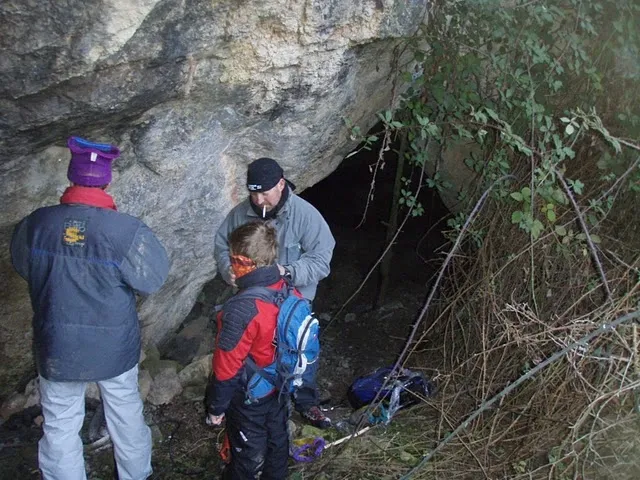
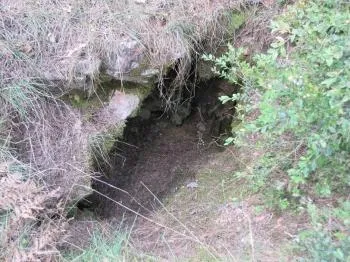
Foto
Espeleoindex · CC BY-NC 4.0, https://creativecommons.org/licenses/by-nc/4.0/ · Immagine © del suo autore.
Descrizione
Morfologia
The cavity consists of a main gallery that in plan presents a meandering layout, with rather modest cross-sections. From the main gallery branch off different secondary galleries, some of which climb significant height differences where climbing is required. The height difference of the main gallery does not vary much with respect to the level of the mouth, with gentle ups and downs and the occasional step. The height difference is 43.50 metres (+35.50/-8).
Concrezioni
The formations are scarce and very localised. It is interesting to observe an important mud coating, which covers the walls of numerous sectors of the cave.
Idrologia
The cave itself is an emissive cavity that acts during heavy rainfall. Its morphology gives evidence of a forced-conduit functioning; only the higher sectors remain sheltered from the rise in water level. Sumps form in the lower sectors. The first of these, located just after entering, can be avoided by entering through the artificial mouth. The second sump is bypassed by an upper dry gallery. The third sump is the most serious, since a long dive is required to empty it (the water drains through a small sink located 30 metres before reaching the sump). Later there are still three more sumps, although these are temporary in character, as is the one at les Graves.
Progressione
The explored route approaches 2,000 metres, while the surveyed part represents only 1,190 metres. Several sectors of the cave are pending exploration.
Storia
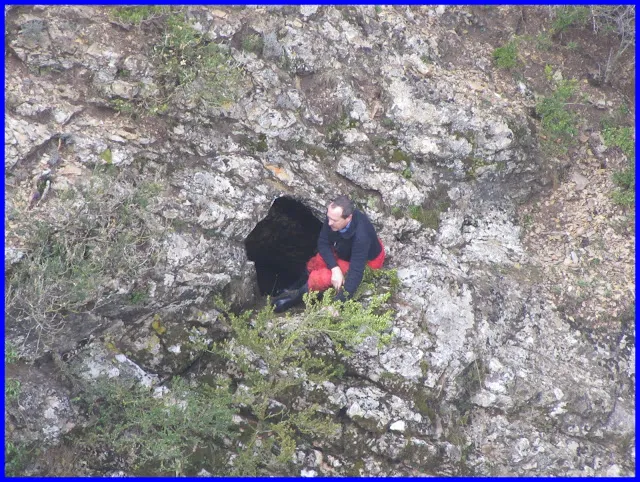
In 1980, some members of the ECT (Espeleo Club de Tortosa) carried out a prospection through the ravines that form the headwaters of the Algars river, to the NW of the Mola de Catí. They located a small mouth hanging on a cliff, on the right side of a small ravine; they entered through it and observed that, shortly after, a pool of water prevented any continuation. They gave it no further importance.
A year later, in the summer of 1981, they returned and verified that the water level had varied and that this small pool looked very much like a sumped conduit.
So they wanted to empty it. First they used, without success, a manual pump; later they achieved their objective by emptying it by gravity using a rubber tube.
Once this first sump was passed, the exploration stopped before a second sump; this is emptied by means of a manual pump, work that proved useless, since simultaneously a narrow upper level was discovered that allows it to be bypassed.
A third sump, the most important, again halted progress. First incursions were made with diving equipment in order to learn its dimensions and the possibilities of emptying it. This was achieved using an electric pump for 24 hours; the electric current was obtained thanks to a generator located outside. Once this difficulty was overcome, the cavity was explored on consecutive dates, although the level of some further sump had to be reduced.
In January 1982, this cavity was the scene of an accident that, fortunately, had no serious consequences. Five cavers from the ECT were carrying out an exploration; at that time they still did not know the hydrological behaviour of the cave, unaware that it could become active. Stopped before a flooded gallery that on other occasions was not flooded, they decide to turn back and observe with dread that the first sump, which they themselves had emptied in order to enter, is again sumped and filling at a forced pace; at that moment there was heavy rain outside. Four of the cavers were still able to pass the sump, diving on free breath and in the dark, but the fifth did not feel up to it. Shortly afterwards, an important flow of water was coming out of the cave mouth while their companion en Francesc Geballí was still inside.
A spectacular rescue operation was then mobilised, where the presence of firefighters with powerful pumps was not lacking, but little could be done while the cavity emitted a large volume of water. Once the flow had diminished and by means of pumps, it was possible to penetrate, finding the companion in the upper part of the Fòssil chamber which, being a high point, was not affected by the flood; he was scraping the ceiling, removing the rails in order to feed himself, in case this lasted many days; at this point he remained more than 50 hours waiting for rescue.
The same year but a few months later, the ECT opened an artificial mouth that connects with the cavity at the highest point of the Fòssil chamber, which was verified to be very close to the surface. They also placed survival supplies at different points of the cave in case a similar accident occurred (these have not been renewed since, they are probably in poor condition). A telephone cable was also installed along the cavity, with several communication points.
In September 1982 they organised the campaign “Algars 82”, where the existing survey was made up to the present day, where 1,190 metres of route are represented. In this survey several secondary ways are missing to be represented, with the total route estimated at 2,000 metres.
Commenti degli utenti (0)
Nessun commento ancora.
Sii il primo a condividere la tua esperienza!
Esplorazioni registrate (0)
Nessuna esplorazione registrata.
Registra la tua visita a questa grotta!
Bibliografia
- Cardona, F. (1990).- Grans cavitats de Catalunya, vol 2. 484 pp. EC Gràcia, Barcelona.
- Dades, topografies i fotos facilitades per l'ECT (Espeleo Club de Tortosa).
Grotte vicine
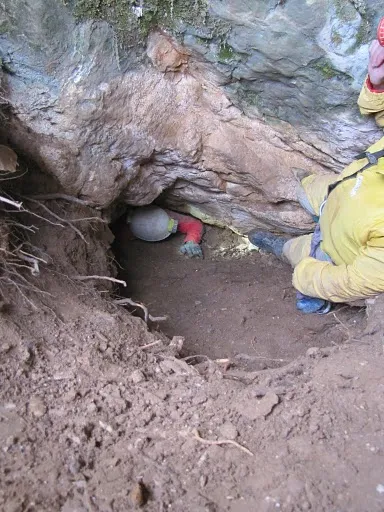
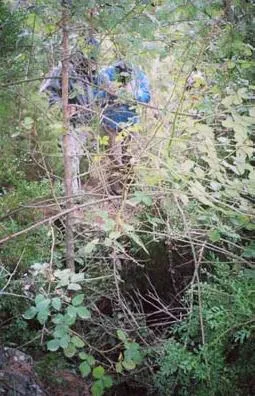


Fonte: Espeleoindex (espeleoindex.com), modificato. CC BY-NC 4.0, https://creativecommons.org/licenses/by-nc/4.0/