
Cova Marigot
A 546 m long cave in Benifallet (Baix Ebre), on the left bank of the barranc d'en Jordi. Currently closed; permission can be requested from the Ajuntament that manages the Cova Meravelles.
EspeleoWorld
Cova Marigot
A 546 m long cave in Benifallet (Baix Ebre), on the left bank of the barranc d'en Jordi. Currently closed; permission can be requested from the Ajuntament that manages the Cova Meravelles.
Benifallet · Baix Ebre
Sviluppo: 546 m · Profondità: 23 m
Scheda aggiornata
https://espeleoworld.com/it/c/cova-marigot
Le informazioni possono cambiare. Verifica sempre coordinate, accesso, meteo e condizioni della cavità prima di partire.
A 546 m long cave in Benifallet (Baix Ebre), on the left bank of the barranc d'en Jordi. Currently closed; permission can be requested from the Ajuntament that manages the Cova Meravelles.
Topografia
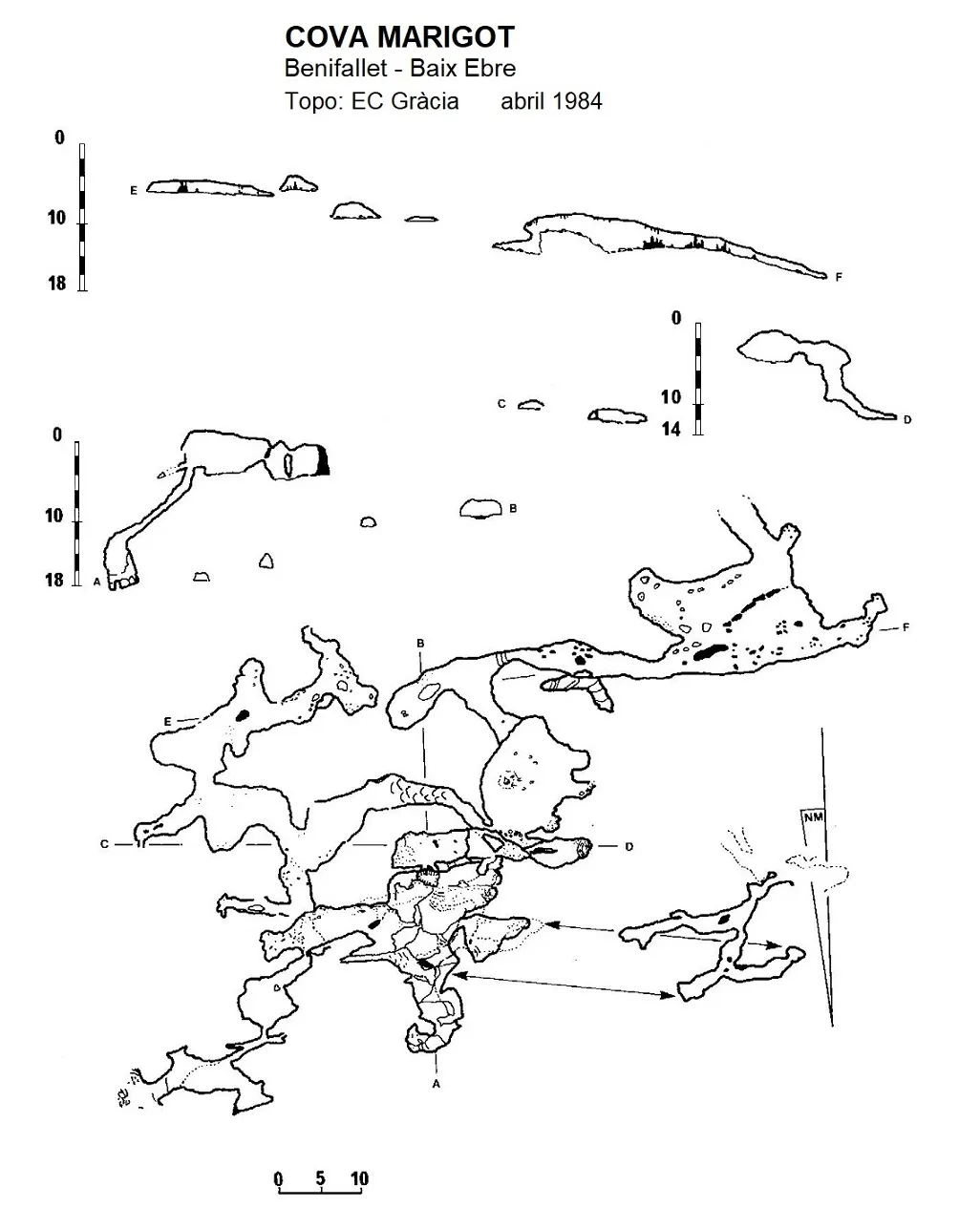
Espeleoindex · CC BY-NC 4.0, https://creativecommons.org/licenses/by-nc/4.0/ · Immagine © del suo autore.
Foto
Espeleoindex · CC BY-NC 4.0, https://creativecommons.org/licenses/by-nc/4.0/ · Immagine © del suo autore.
Descrizione
Morfologia
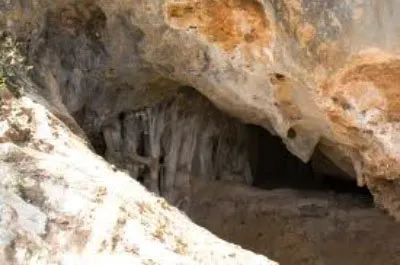
A mouth 2 metres wide and 1.5 metres high gives access to a gallery occupied by very compact sediments. From its W end, a narrow gallery begins which after a few metres becomes a crawlway that leads into a room with a low ceiling. This room extends along the W side, ending in another crawlway. We pass into a new room, this one of larger dimensions and occupied, at its base, almost entirely by concretion. From the W end two routes begin; one, the main one, leads to the lower level, and the other, secondary, formed by different galleries interposed between each other, which begin in the same room that is reached through a narrow crawlway.
Once in the room, and after overcoming a short step and at the foot of another, there is a narrow passage that communicates with the descending gallery with a sandy floor 4 metres long and which ends in a 4-metre step, the bottom of which is at elevation -18.6 relative to the entrance.
To continue along the main gallery one follows a crawlway next to the previous one a metre above the floor. At the end there is a 2-metre step. To the left of its opening a window opens that leads us to a heavily concretion-covered room parallel to the main gallery. Descending the step, a gallery takes us to a room; on the left, after overcoming another step, we reach the previous concretion-covered room, and on the right, there is a 4-metre drop. This leads to a gallery running E-W. At the E end, the gallery is at first of low height and then gradually reaches an average height of 1.6 metres, although in the final stretch it decreases again, in addition to there being a large amount of mud and abundant formations.
Returning to the aforementioned drop, in front, a barrier of formations separates the gallery from one of about 14 x 11 metres, where at one of its ends a crawlway emerges that leads into a gallery running E-W and, which in the final stretch, a large room divided into two parts by columns is the end of the cavity. At one of the ends the ceiling descends to 20 centimetres from the floor, which makes continuation impracticable but it can be seen to remain closed.
Concrezioni
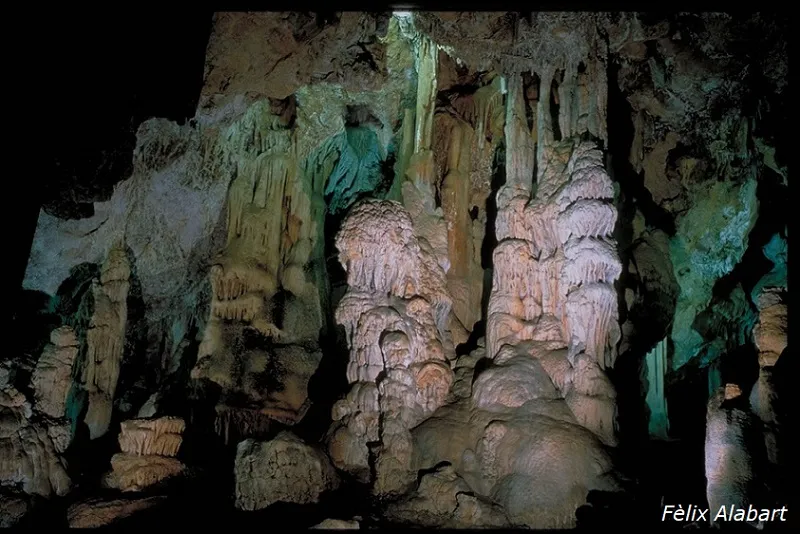
The room of larger dimensions is occupied, at its base, almost entirely by concretion. There is a heavily concretion-covered room parallel to the main gallery. In the final stretch of the gallery running E-W there is a large amount of mud and abundant formations. A barrier of formations separates the gallery from one of about 14 x 11 metres. A large room divided into two parts by columns is the end of the cavity.
Progressione
A mouth 2 metres wide and 1.5 metres high gives access to a gallery occupied by very compact sediments. From its W end, a narrow gallery begins which after a few metres becomes a crawlway that leads into a room with a low ceiling. This room extends along the W side, ending in another crawlway. We pass into a new room. From the W end two routes begin; one, the main one, leads to the lower level, and the other, secondary, formed by different galleries interposed between each other, which begin in the same room that is reached through a narrow crawlway. Once in the room, and after overcoming a short step and at the foot of another, there is a narrow passage that communicates with the descending gallery with a sandy floor 4 metres long and which ends in a 4-metre step, the bottom of which is at elevation -18.6 relative to the entrance. To continue along the main gallery one follows a crawlway next to the previous one a metre above the floor. At the end there is a 2-metre step. To the left of its opening a window opens that leads us to a heavily concretion-covered room parallel to the main gallery. Descending the step, a gallery takes us to a room; on the left, after overcoming another step, we reach the previous concretion-covered room, and on the right, there is a 4-metre drop. This leads to a gallery running E-W. Returning to the aforementioned drop, in front, a barrier of formations separates the gallery from one of about 14 x 11 metres, where at one of its ends a crawlway emerges that leads into a gallery running E-W and, which in the final stretch, a large room divided into two parts by columns is the end of the cavity.
Altri dettagli
Interesting cave 546 m long in Benifallet (Baix Ebre).
Storia
Since remote times a cave of l'Aumidiella was known by the people of Benifallet. Faura, in his Recull (1909) mentions: La Aumediella i Avenc prop de la Aumediella (sic), without providing any further data.
Bayerri (1934) explains how at the end of the 19th century a resident of Benifallet, Juan Vizcarro Salaet, on returning from a visit to the Cova de l'Aumidiella casually found another cave, until then unknown, which surpassed the previous one in beauty. The same Bayerri proposes that the more recently discovered one be named Aumidiella la major and the one known for a long time become the Aumidiella la menor. This one, however, does not seem to be the one we know as Aumidiella petita.
Around 1934 or 1935, N. Llopis Lladó (CMB) visits the caves of les Aumidielles and makes the survey of one that does seem to be the one later called Aumidiella petita, but... he calls it Cova de la Cotxidiella petita !. If one observes it, it is a gallery about 10 metres long and at the end it remains totally filled by sediments.
We have news that in August 1962 members of the GES – CMB visit the Coves de l'Aumidiella, but no concrete record of the explorations remains.
At Easter 1966, members of the GIE of the Club Excursionista de Gràcia decide to go and investigate what these caves they have heard about are. During those days they visit the one they call Aumidiella gran, Aumidiella petita and Cova del Dos, although they greatly magnify the results and go so far as to say: ... las cuevas del Dos y de la Aumidiella Gran contienen salas de gigantescas dimensiones, alzándose como unas de las cuevas más grandes de Cataluña (sic).
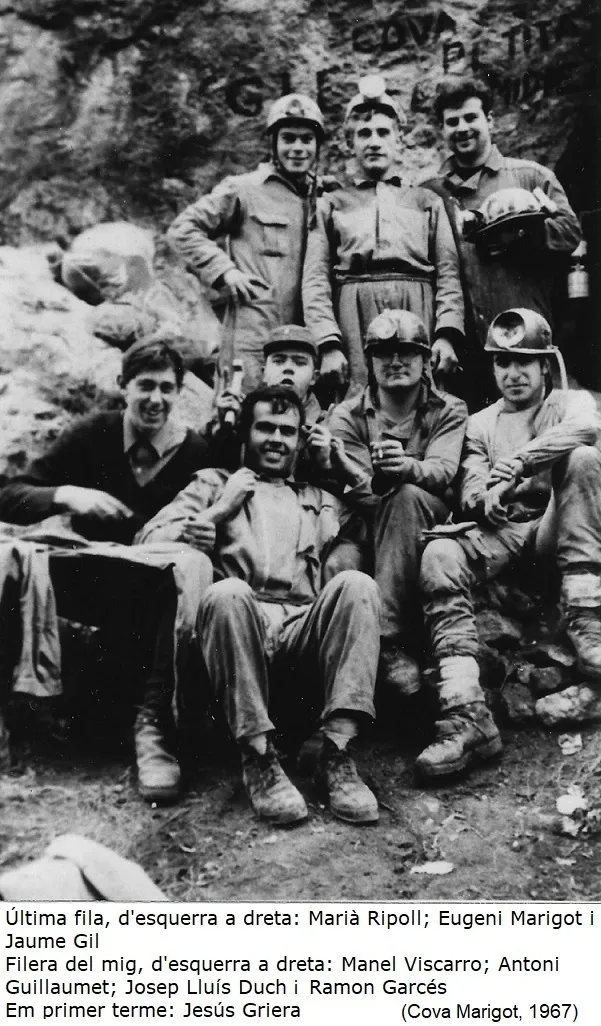
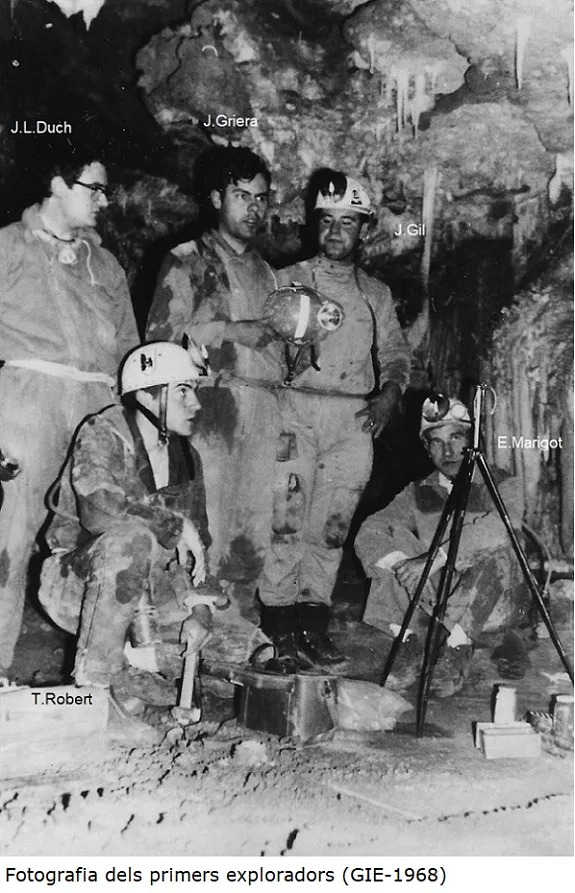
The following year, 1967, also at Easter, they return with more people and greater expectations. One group explores a whole series of pits, most of modest dimensions and of which we have not been able to find any kind of data. The other group decides to empty the sediments at the end of the gallery of the Cova de l'Aumidiella petita and after hours of work they manage to access the beautiful and complicated galleries of the one that from then on they decide to baptise as Cova Marigot, in recognition of the one who at that time took part in the campaigns and was the president of the group, Eugeni Marigot. The exploration and survey work involved many more visits throughout that same year.
Years later, in 1984, members of the Espeleo Club de Gràcia survey the cave again, rectifying the depth of 52 metres calculated by the GIE to 22.42 metres. The length increases by a few metres with respect to the first survey.
Commenti degli utenti (0)
Nessun commento ancora.
Sii il primo a condividere la tua esperienza!
Esplorazioni registrate (0)
Nessuna esplorazione registrata.
Registra la tua visita a questa grotta!
Bibliografia
- Bayerri, Enrique (1934).- Historia de Tortosa y su comarca. Vol.II: 702 pp. Capítulo Nono: Espeleología de la Comarca de Tortosa (pàg. 363-416). Imprenta Moderna de Algueró i Baiges. Tortosa.
- Cardona i Olivan, Ferran (1990).-”El Sistema Mediterrani i la Depressió Central”. Grans Cavitats de Catalunya (Segon Volum):1-484. Espeleo Club de Gràcia /Federació Catalana d'Espeleologia. Barcelona.
- Espeleo Club de Gràcia (1984).-”Contribució al Catàleg Espeleològic del Baix Ebre (Tarragona)”. Exploracions (8):47-57. EC Gràcia. Barcelona.
- Faura, Marià. (1909).- “Recull Espeleològic de Catalunya”. Sota Terra (I): 1-26. Club Muntanyenc. Barcelona
- GIE (1968).- “Cova E. Marigot – Benifallet”. Espeleòleg (6): 187-190. ERE Centre Excursionista de Catalunya. Barcelona.
- GIE (1969).- “Sierra de Cardó (Resumen de las actividades realizadas hasta el 31 de diciembre de 1968). Butlletí del Club Excursionista de Gràcia (319): 2-5. Barcelona.
- Morales, Ramon (1964).- “Las cuevas y simas de Benifallet”. Geo y Bio Karst (3): 25-26. Editat per Jmª Armengou. Barcelona.
- Fotografia de grup (1967) de l'Arxiu Eugeni Marigot. Identificació dels components facilitada per Toni Robert.
- Fotos interiors procedents de l'arxiu Félix Alabart.
Grotte vicine
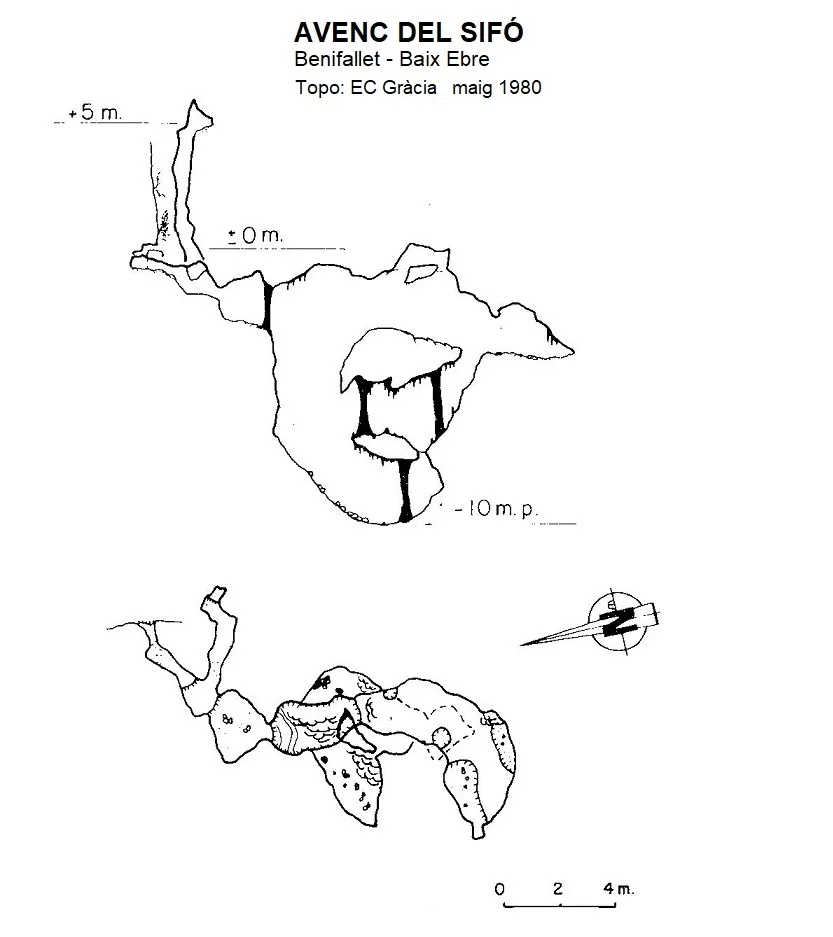


Fonte: Espeleoindex (espeleoindex.com), modificato. CC BY-NC 4.0, https://creativecommons.org/licenses/by-nc/4.0/