
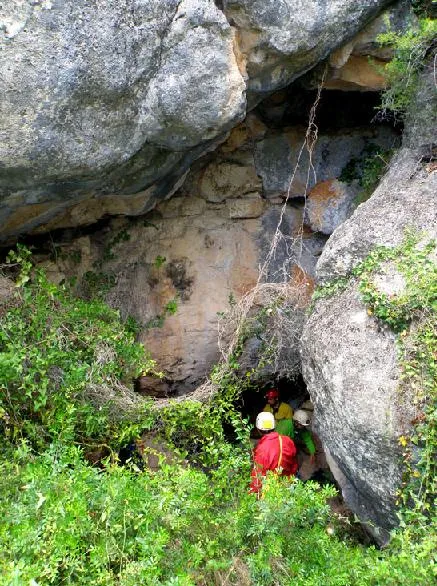
Cova Fonda
A very well-known cave with 286 metres of passage in Salomó (Tarragonès), known as Cova Fonda.
EspeleoWorld
Cova Fonda
A very well-known cave with 286 metres of passage in Salomó (Tarragonès), known as Cova Fonda.
Salomó · Tarragonès
Sviluppo: 286 m · Profondità: 15 m
Scheda aggiornata
https://espeleoworld.com/it/c/cova-fonda
Le informazioni possono cambiare. Verifica sempre coordinate, accesso, meteo e condizioni della cavità prima di partire.
A very well-known cave with 286 metres of passage in Salomó (Tarragonès), known as Cova Fonda.
Topografia
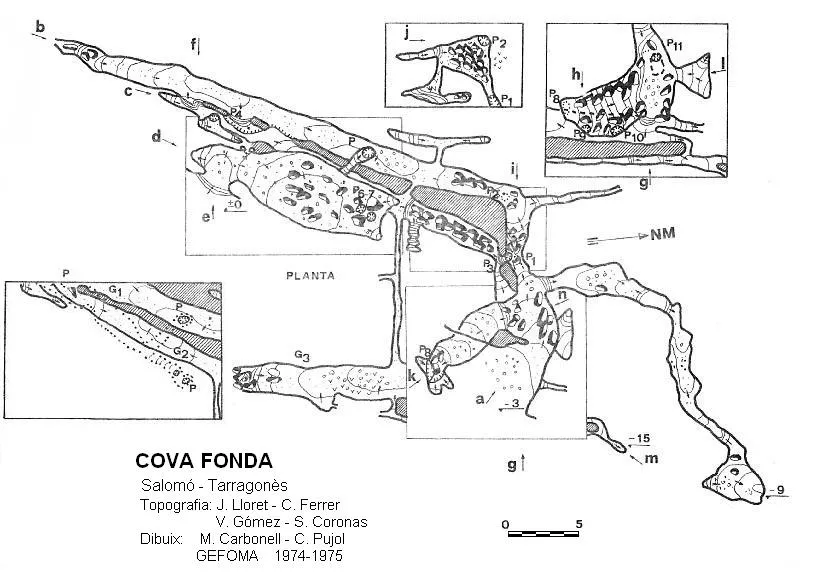
Espeleoindex · CC BY-NC 4.0, https://creativecommons.org/licenses/by-nc/4.0/ · Immagine © del suo autore.
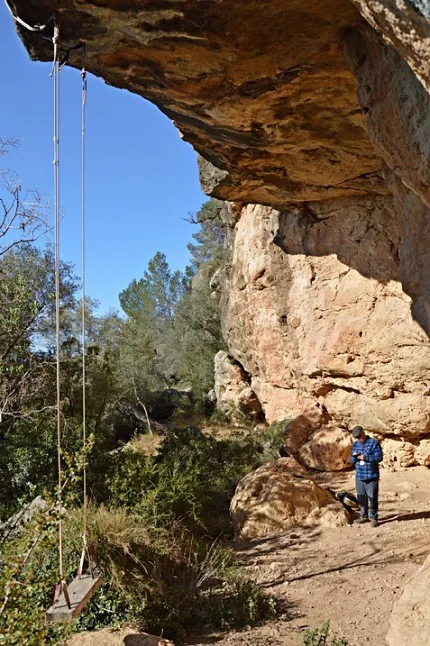
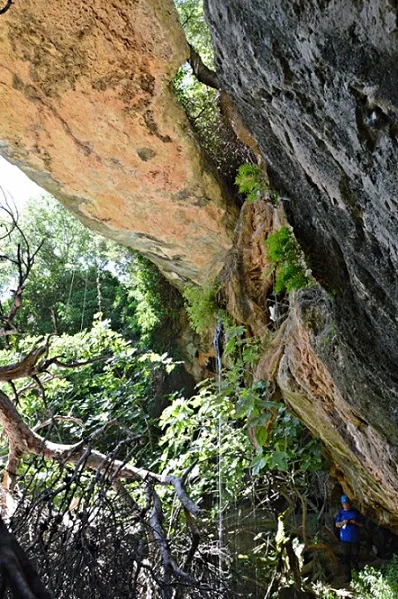
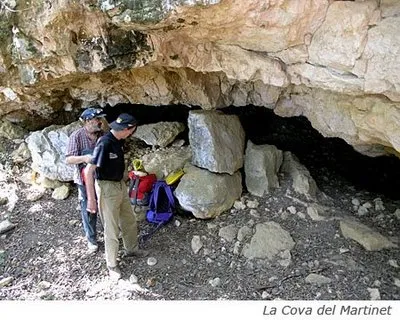
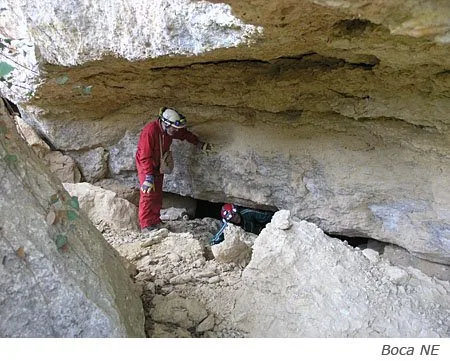
Foto
Espeleoindex · CC BY-NC 4.0, https://creativecommons.org/licenses/by-nc/4.0/ · Immagine © del suo autore.
Descrizione
Morfologia
Entering through the lower mouth, known for ever and where remains of a wall still exist, we find a descending gallery and after a few metres of passage it is possible to access three different galleries; on the left, through a narrow gallery and a series of steps one reaches a level located below the entrance gallery. Situated again at the previous point of the entrance gallery, on the right begins a gallery 27 metres long and of little height. Situated again at the point of the entrance gallery, the gallery continues descending steeply until finding a small pit of about 3 metres that leads again to the lower level already mentioned; going back up the main gallery and after a small chamber, one can reach the longest gallery of the cave, of about 37 metres, before the end of this and by means of a climb, one accesses some small passages that lead to a low-ceilinged chamber, at its southern end being found the upper mouth. There are more secondary galleries and others that connect the different levels of the cavity. (These can be consulted in the extensive description that Jordi Lloret makes of the cavity in the magazine Gours nº 3).
Storia
The first news known about the Cova Fonda is due to Pau Teixidor, doctor of Rodonyà and delegated member of the Centre Excursionista de Catalunya who, together with other companions, visited it on 24-5-1896 at the request of a young man who had informed him that there were many remains of bones. Already on that first visit they were able to assess the importance of the archaeological remains of the cavity, which continued with the work of Lluís Marià Vidal.
From that moment the cave is the object of many visits: Font i Sagué (1899), is accompanied by Pau Teixidor himself. Joan Ferraté with companions from Reus visit it on 15-8-1908 and make a sketch without scale or orientation of the plan (Ferraté, 1918). A few weeks later, on 8-9-1908, members of the first stage of the Club Muntanyenc (Faura, Serradell, Co de Triola and others) visit it and Faura makes a new plan, perhaps more complete than the previous one (F. Bertrand, 1912). The biospeleologists Jeannel and Racovitza visit it in October 1910 (Faura, 1911).
During an excursion organised on 25-4-1934 by the Institució Catalana d'Història Natural, in which members of the Club Muntanyenc Barcelonès also participate, the cave is visited and they make a complete work that was published the following year in Sota Terra II (Josep Closas, 1935).
Over the years it has been the object of numerous archaeological works and remains ranging from the Neolithic to the Middle Ages have been studied.
Toponymy: The original name of the cavity is Cova Fonda, which is how it appears published since the first explorations, although some added de Vilabella, believing that it was located in this municipality. It is not until the exploration of 1934 that they realise that the cave is really located in the municipality of Salomó and then they go on to call it Cova Fonda de Salomó (which is the most popularised name among speleologists). In the past it was also called Vergeracs (correctly it should be Vergerars) and it has even been called Godall.
Commenti degli utenti (0)
Nessun commento ancora.
Sii il primo a condividere la tua esperienza!
Esplorazioni registrate (0)
Nessuna esplorazione registrata.
Registra la tua visita a questa grotta!
Bibliografia
- Aymamí i Domingo, Gener.(1993).-”Notes sobre la bibliografia de la Cova Fonda de Salomó”. Miscel·lània Penedesenca 1992 (17):93-111. Institut d'Estudis Penedesencs.
- Bertrand i Cavaller, F.(1912).-”Cova Fonda de Vilabella”. Butlletí del CMB (8-10):78-82. Club Muntanyenc Barcelonès. Barcelona.
- Borràs, J.; Miñarro, J.M.; Talavera, F.(1978).-”l'Alt Camp, la Conca de Barberà, el Baix Penedès i el Tarragonès” Catàleg Espeleològic de Catalunya (Vol.2):1-246. Ed. Políglota. Barcelona.
- Closas, J.(1935).-”La Cova Fonda de Salomó”. Sota Terra (II):65-82. Club Muntanyenc Barcelonès.
- Faura i Sans, Mn.(1911).-”Excursiones espeleológicas realizadas durante el año 1910 en la región catalana”. Memorias de la Real Sociedad Española de Historia Natural (VI):425-591.
- Lloret Prieto, Jordi.(1976).-”Reseña de un par de visitas espeleológicas a la Cova Fonda de Salomó (Tarragona). Gours (3):17-32. GEFOMA-SEFM. Barcelona.
- Teixidor, Pau.(1896).-”La Cova Fonda (Vilabella)”. Butlletí del CEC (21):131. Centre Excursionista de Catalunya. Barcelona.
- Fotografies extretes del blog “Espeleobloc”, post del dia 4-7-2011.
Grotte vicine


Fonte: Espeleoindex (espeleoindex.com), modificato. CC BY-NC 4.0, https://creativecommons.org/licenses/by-nc/4.0/