
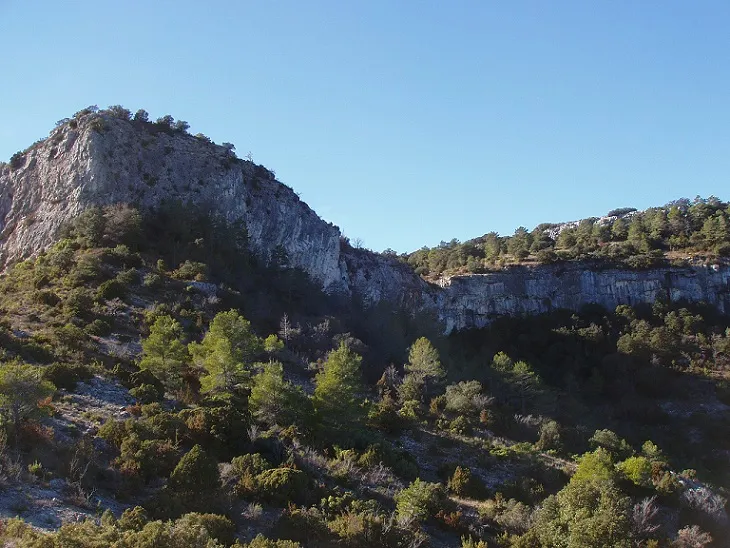
Cova dels Galls Carboners
Important burial cavity at els Motllats (Mont-ral), known as Cova del Grèvol, with remains from the Middle Bronze Age and cave fauna.
EspeleoWorld
Cova dels Galls Carboners
Important burial cavity at els Motllats (Mont-ral), known as Cova del Grèvol, with remains from the Middle Bronze Age and cave fauna.
Mont-ral · Alt Camp
Sviluppo: 60 m · Profondità: 11 m
Scheda aggiornata
https://espeleoworld.com/it/c/cova-dels-galls-carboners
Le informazioni possono cambiare. Verifica sempre coordinate, accesso, meteo e condizioni della cavità prima di partire.
Important burial cavity at els Motllats (Mont-ral), known as Cova del Grèvol, with remains from the Middle Bronze Age and cave fauna.
Topografia
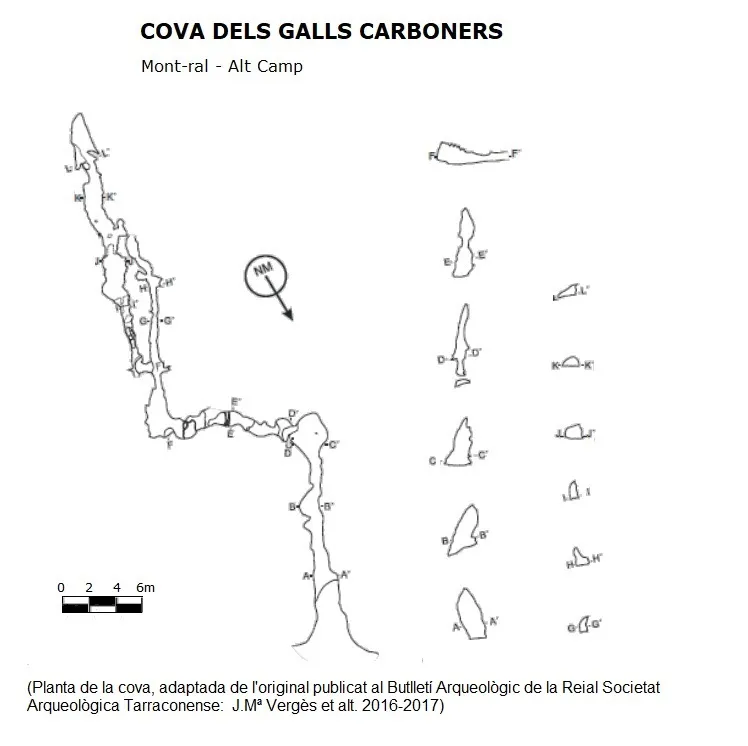
Espeleoindex · CC BY-NC 4.0, https://creativecommons.org/licenses/by-nc/4.0/ · Immagine © del suo autore.
Foto
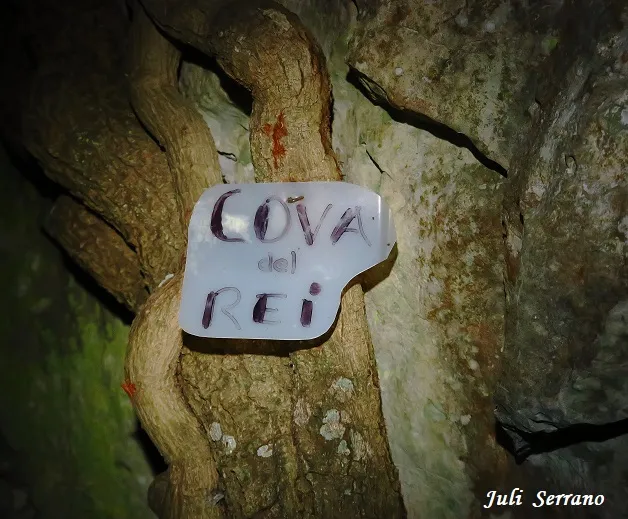
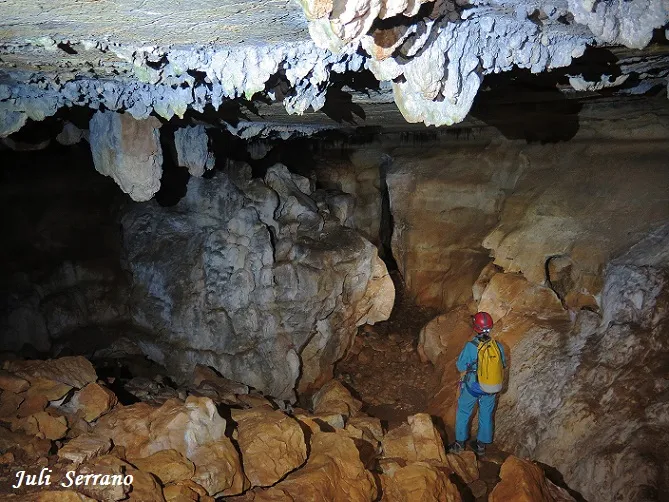
Espeleoindex · CC BY-NC 4.0, https://creativecommons.org/licenses/by-nc/4.0/ · Immagine © del suo autore.
Descrizione
Morfologia
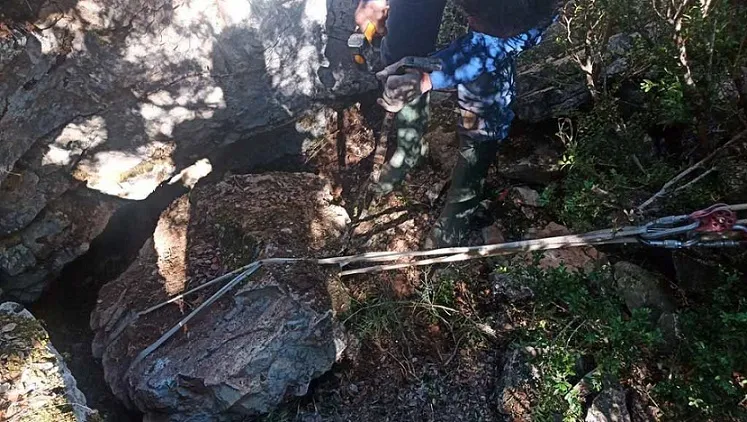
The mouth of the cavity hangs 5.3 m from the foot of the cliff and one must access it via a wall that is quite smooth at its base. A rope (in very poor condition) tied to a holly tree allows us to overcome this difficulty, positioning ourselves at a semi-elliptical mouth 3.5 m [wide], finding a small step of 0.6 m that was excavated in its lower part. Up above we find a straight gallery 11 m in a S direction; on the left wall of its interior we can observe the test pits and levels of one of the archaeological interventions. A few metres further on the gallery makes a pronounced 90 degree turn and begins to ascend with a couple more steps until positioning ourselves at a point where there are several stepped gours that, depending on the time of year and the rainfall, we found full of water. This is the section with the highest gallery. We must climb a height difference of 3.15 m to position ourselves up in a small chamber, with whitish clays and where the gallery again makes a pronounced 90º turn to the right, although we need to overcome a low passage by crawling until positioning ourselves on the other side, where we will quickly find ourselves with two parallel galleries; the lower one is narrower and shorter and is very often flooded with a small watercourse that seeps outward; the one on the right is dry, with less formation, and to reach the end one will need to overcome a couple of squeezes. The floor of this final part is covered with red clay (elevation + 11 m).
Idrologia
Several stepped gours that, depending on the time of year and the rainfall, we found full of water. The lower gallery is narrower and shorter and is very often flooded with a small watercourse that seeps outward; the one on the right is dry.
Progressione
The mouth of the cavity hangs 5.3 m from the foot of the cliff and one must access it via a wall that is quite smooth at its base. A rope (in very poor condition) tied to a holly tree allows us to overcome this difficulty. We must climb a height difference of 3.15 m to position ourselves up in a small chamber. One must overcome a low passage by crawling until positioning oneself on the other side. To reach the end of the gallery on the right one will need to overcome a couple of squeezes.
Storia
The cavity appears to have been discovered by the former owners of the mas d'en Marc, which is below the TV-7041 road from Mont-ral to Capafonts, and they themselves excavated it, taking from it many human bones and other prehistoric material; it was also known to the AAEMI de Valls, who found more archaeological material, which appears to have been lost. The colleagues from Valls knew it as Cova del Grèvol (after the tree at its mouth). Many years later, the descendants of the owners of the mas got in contact with the IPHES de Tarragona, which proceeded to carry out an archaeological excavation there and to study the material. The group (GIEM, Montblanc) was unaware of the existence of this cavity and was informed of it during the course of the interview that we conducted with J.M.Capellades de Valls for the preparation of the book. A week later they had already located it (April 2012), making three trips to prepare its record sheet. From the archaeological point of view it has been considered a burial cave with funerary rites of the Middle Bronze Age. Among the finds, one of 20 individuals stands out, along with many necklace pieces made up of small white beads probably manufactured from fragments of shell. The cave had been excavated in the 70s of the last century by Ferran Companys, owner of the estate where it is located, with the recovery of human remains, very well preserved. His descendants ceded them to the Àrea de Prehistòria de la Rovira i Virgili, the information having been provided by the colleague Josep Maria Vergés, researcher at the IPHES (Institut Català de Paleoecologia Humana i Evolució Social), who was the director of the excavation and whose main objective was to document the archaeological context of the collective sepulchre based on the elements that were preserved “in situ”, making a complete description of it in the work published in the Butlletí Arqueològic de Tarragona no. 38-39 (2016-2017). The researchers indicate that most of the materials would come from the Middle Bronze Age, about 3,500 years B.P., and besides the human remains, samples of sediments have been able to be extracted for residue analyses, in addition to the fact that a level with palaeontological remains was located below the burial deposit.
Note biospeleologiche
Coleoptera
- Duvalius berthae (Jeannel, 1910) (Joan Pallisé; 2012-2013)
- Troglocharinus orcinus (Jeannel, 1910) (Joan Pallisé; 2012-2013)
Commenti degli utenti (0)
Nessun commento ancora.
Sii il primo a condividere la tua esperienza!
Esplorazioni registrate (0)
Nessuna esplorazione registrata.
Registra la tua visita a questa grotta!
Bibliografia
- Vergès, J.M. et. Alt (2016-2017).- “La cova dels Galls Carboners (Mont-ral, Alt Camp) una cavitat d'inhumació col·lectiva durant l'edat del Bronze”. Butlletí Arqueològic. Reial Societat Arqueològica Tarraconense. Època V, núm 38-39
- Tota la recopilació de dades ha estat extreta de la fitxa realitzada per l'amic Joan Pallisé (Montblanc/Terrassa).
Grotte vicine



Fonte: Espeleoindex (espeleoindex.com), modificato. CC BY-NC 4.0, https://creativecommons.org/licenses/by-nc/4.0/