
Cova de la Font Mentidora
Cave with 810 metres of passage in the Conca de Dalt (Boumort), with a vertical drop of 21 metres (+11/-10).
EspeleoWorld
Cova de la Font Mentidora
Cave with 810 metres of passage in the Conca de Dalt (Boumort), with a vertical drop of 21 metres (+11/-10).
Conca de Dalt · Pallars Jussà
Sviluppo: 810 m · Profondità: 21 m
Scheda aggiornata
https://espeleoworld.com/it/c/cova-de-la-font-mentidora
Le informazioni possono cambiare. Verifica sempre coordinate, accesso, meteo e condizioni della cavità prima di partire.
Cave with 810 metres of passage in the Conca de Dalt (Boumort), with a vertical drop of 21 metres (+11/-10).
Topografia
Espeleoindex · CC BY-NC 4.0, https://creativecommons.org/licenses/by-nc/4.0/ · Immagine © del suo autore.
Foto
Espeleoindex · CC BY-NC 4.0, https://creativecommons.org/licenses/by-nc/4.0/ · Immagine © del suo autore.
Descrizione
Morfologia
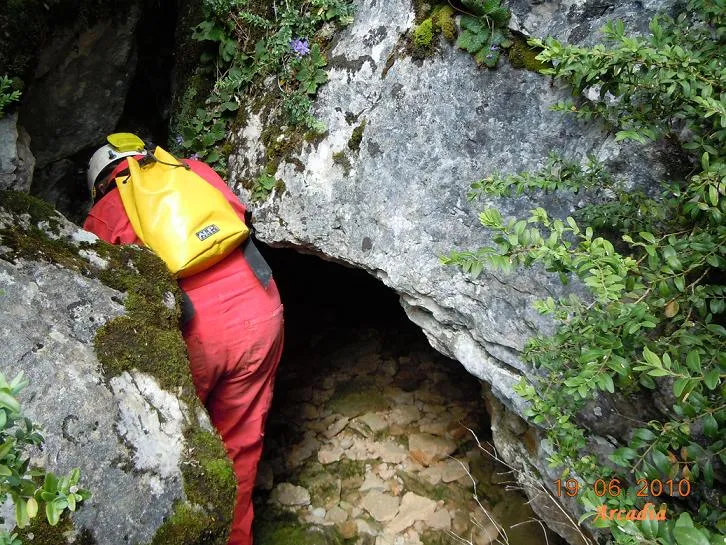
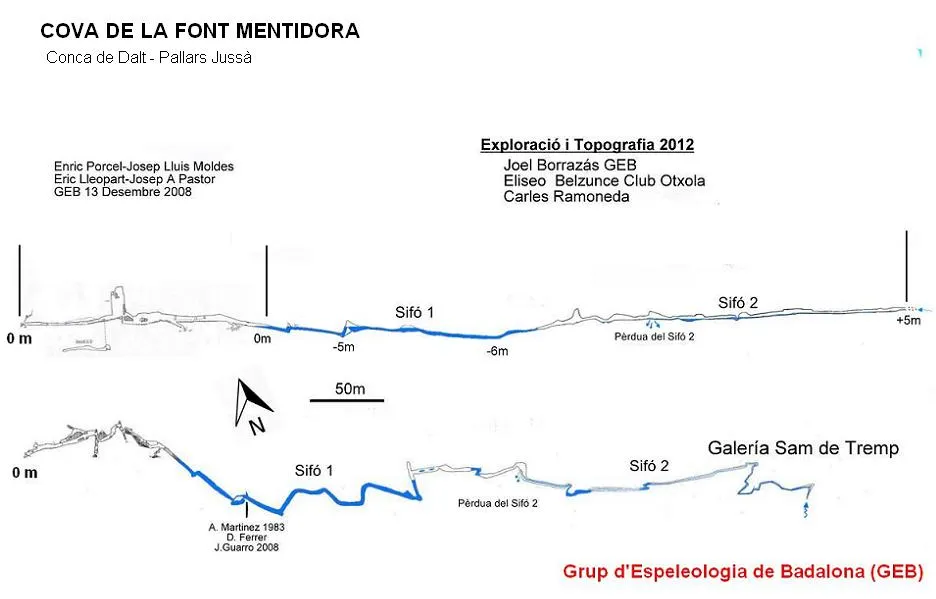
The 1x1.5 metre entrance gives way to a gallery running E-W, formed along a slightly ascending bedding plane; the section is almost uniform (1x3 m) up to 60 metres. A little before that, on the left, a gallery branches off which after 5 metres divides in two, only to become impassable a few metres further on. Continuing along the main gallery, this is cut perpendicularly by a joint, giving rise to a long, high chamber. The continuation is meandering for some metres until it becomes wider; from here we find a first “gour” that occupies a stretch of 8 metres, the sections ranging from 2 to 2.5 metres. About 12 metres further on we find a 6 metre pitch. The gallery continues until reaching the sump; a few metres before it, on the right, we find a narrow crawl that connects with a conduit occupied by the water that probably comes from the sump.
A few metres from the start of the sump there is an air bell with a crack in the ceiling without it seeming to offer any possibility of continuation; diving again, a cylindrical conduit about 2 metres in diameter appears, covered in mud, which gently descends to the point of maximum depth. At this point the guide line installed by Albert Martínez in 1983 enters a narrow crawl opened in the floor of the conduit, and begins to climb. However, before entering the crawl, an evident ascending chimney is observed, on the left, much wider.
Following this conduit, much wider and more evident than the crawl, one climbs up to reach a new air bell, also with walls covered in mud. At one of the ends the line of Albert can be seen, coming from the other side, tied to a rock projection. Thus this new conduit also leads to the air bell discovered by Albert in 1983.
After sump 2, the cave continues with a more abrupt morphology, it is like a kind of ravine through which a small river runs, ever narrower until reaching a point where it is not possible to advance further; from this point it can be seen that the cave has no passable continuation.
Idrologia
The water tank collects the water from a spring. At the 6 metre pitch a murmur of water can be heard. A narrow crawl connects with a conduit occupied by the water that probably comes from the sump. In the exploration carried out by Joel Borrazás and Carles Ramoneda on 8 August 2012, on reaching the end of the sump they de-rigged and discovered that the cave continued along a gallery on the right; this gallery cannot be seen from the water. It is a peculiar gallery, a kind of fissure through which a small stream runs as if it were a ravine, it is full of sharp edges and pointed stones that can easily cut the dry suit, a gallery that is laborious to advance through. After some metres they find a small stream that disappears into some cracks; it is probable that this is the loss that supplies water to the spring.
They continue exploring the cavity, it seems that they reach another sump, but in reality it is a lake that covers up to the armpits; they continue and the cave gradually climbs. At the bottom of the straight gallery they find the second sump, they inspect it with the lamps and it seems that it continues to the right, they take the opportunity to take images and return outside.
On 8 October 2012, the team formed by Joan Pericon, Jordi Pascual, Joel Borrazás and Eliseo Belzunce begin the dive in sump 2; after a few metres the sump ends. In part it is a disappointment, since they have spent quite a while hauling the material and it turns out that the sump could practically be passed by free diving.
Progressione
The first exploration of which there is a record corresponds to Francesc Español on 30 September 1952, accompanied by two of his students: Schütte and Impellitieri, carrying out a first survey that had remained unpublished until 60 years later.
As for the terminal sump, it had been partially explored by Diego Ferrer (GEB) in the early 80s, and later in 1983 Albert Martínez (ERE) managed to pass the sump, giving it a length of about 80 metres and a maximum depth of -7 metres, indicating possibilities of continuation on the other side.
In the dive carried out on 13 December 2008 a team formed by Hilari Moreno Jr., Albert Baucells, Mireia Bolta and Josep Guarro took part; on this occasion, the water level was probably a little lower than that of 1983, since the depth of the sump was noticeably less than that indicated and also its length.
More recently, on 9 March 2012, a cave-diving team from the GEB returns to the cavity; this time Joel Borrazás explores the continuation, going on to find a third air bell where the continuation of a dry gallery can be glimpsed.
On 8 August 2012 a team formed by Jordi Pascual, Joan Pericon, Carles Ramoneda and Joel Borrazás enter surveying the cavity; on reaching the end of the first sump they discover that the cave continues along a gallery on the right; it is probable that this is the loss that supplies water to the Font.
On 8 October 2012 a team formed by Joan Pericon, Jordi Pascual, Joel Borrazás and Eliseo Belzunce enter the cave, they pass the second sump and observe that it can almost be passed by free diving; shortly afterwards the cavity becomes impassable and it is not possible to advance further.
Storia
This cavity had from the beginning been called Cova de la Font Mentidora, although it was also known as Font mentidora de Perauba. Joan Senent and J.M. Victoria in the magazine Montaña nº 100 cite it as Font mentidora de Penyalta. Francesc Español in 1952 already cites that it is near the Mas de les Feixes. The name of els Freixes appears for the first time in an article in the magazine Cavernas nº 6 in 1965, probably the error was induced by the toponymy that appeared on the maps of the time. Currently both on the ICC maps and on the Mas itself, the name that appears on a very large sign is that of Les Feixes; therefore, attending to the official toponymy and to the original name of the cave, we believe that the correct thing would be to continue calling it Cova de la Font mentidora.
Note biospeleologiche
Troglocharinus (Speophilus) fonti schuttei: 6 female specimens and 6 male specimens, collected by Francesc Español with Erik Schütte Puig and Ignacio Fernández Impellitieri on 30 September 1952.
Commenti degli utenti (0)
Nessun commento ancora.
Sii il primo a condividere la tua esperienza!
Esplorazioni registrate (1)
Data dell'esplorazione: 29 ottobre 2025
Bibliografia
- Canela,R. y Victoria, J.M.(1965).-”La Font Mentidora dels Freixes”. Cavernas (6):201-204. GE Badalona.
- Escolà, Oleguer (2009).- “Una topografia inèdita de l'any 1952 de la Font Mentidora”. Blog: biosp.blogspot (apunt del 9-12-2009)
- Español,F.(1955).-”Nuevos datos sobre la entomofauna cavernícola de la provincia de Lérida”. Eos (31): 261-273
- Senent, J.; Victoria, JM.(1965).-“Datos para el conocimiento espeleológico del macizo del Boumort”. Montaña (100):269-281 Centre Excursionista de Catalunya. Barcelona.
- SIE-CEA.(1986).-XXV Aniversari SIE-CEA (1961-1986) pp6. Barcelona.
- Dades obtingudes de l'Espeleobloc dels dies 16 de desembre de 2008 i 8 de juny de 2010.
- Dades obtingudes de la web de Josep Guarro (http://www.freatic.com).
- Dades, fotografies busseig i topografia obtingudes de la web de Grup Espeleològic de Badalona (www.geb.cat).
Grotte vicine


Fonte: Espeleoindex (espeleoindex.com), modificato. CC BY-NC 4.0, https://creativecommons.org/licenses/by-nc/4.0/