
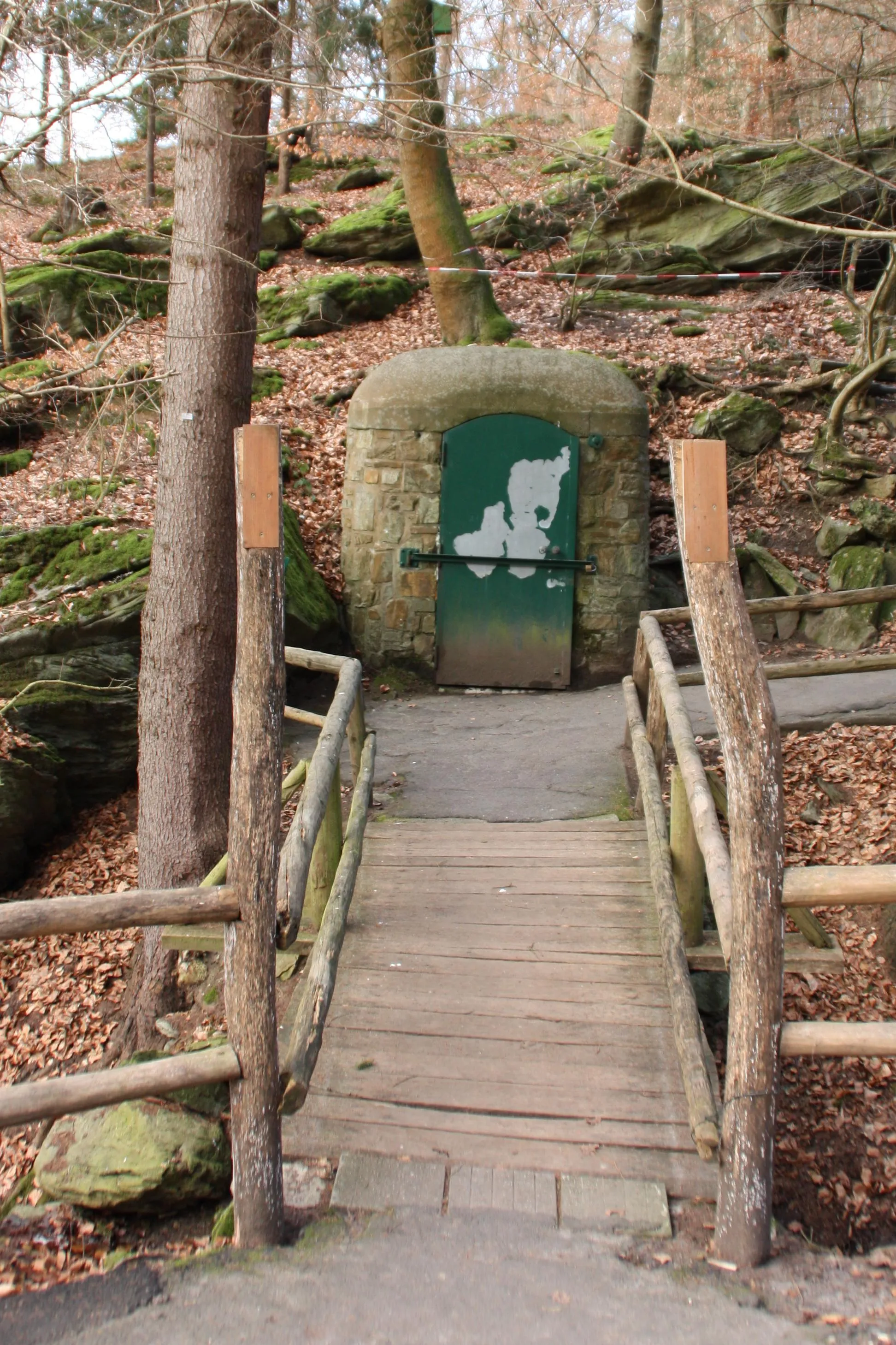
Leichtweißhöhle
The Leichtweißhöhle in Wiesbaden's Nerotal is originally a small natural cave, hardly more than a large rock overhang, a so-called abri.
EspeleoWorld
Leichtweißhöhle
The Leichtweißhöhle in Wiesbaden's Nerotal is originally a small natural cave, hardly more than a large rock overhang, a so-called abri.
Wiesbaden
Fiche actualisée
https://espeleoworld.com/fr/c/leichtweisshoehle-wiesbaden
Les informations peuvent changer. Vérifiez toujours les coordonnées, l'accès, la météo et l'état de la cavité avant de partir.
The Leichtweißhöhle in Wiesbaden's Nerotal is originally a small natural cave, hardly more than a large rock overhang, a so-called abri.
Photos
© Oliver Abels ( SBT ) · CC BY-SA 3.0, https://creativecommons.org/licenses/by-sa/3.0/ · Wikimedia Commons · https://commons.wikimedia.org/wiki/File:Wiesbaden_Leichtweish%C3%B6hle.jpg
Description
Morphologie
The Leichtweißhöhle is originally a small natural cave and not much more than a large rock overhang, a so-called abri. The local slate rock is not a rock suitable for karstification. No other caves are found.
During the expansion by the Wiesbadener Verschönerungsverein in 1856, a second entrance was created, a room situated to the side and a niche padded with moss that was declared a sleeping place. These changes were so extensive that the original state is hardly recognizable today.
Hydrologie
The Schwarzbach, which comes from the Rabengrund and runs past the cave, received an artificial waterfall, and a wooden bridge was built for crossing the stream.
Autres détails
Its name is due to the poacher Heinrich Anton Leichtweiß, who used the cave as a shelter from 1789 to 1791. Forest workers discovered the cave and Leichtweiß because of rising smoke.
The cave fell into oblivion until Wiesbaden gained an international reputation as a spa resort and the cave developed into a popular excursion destination. It represented one of the new attractions that were to be offered to visitors to Wiesbaden. The Wiesbadener Verschönerungsverein expanded the cave in 1856. The cave was also decorated accordingly, among other things with old weapons and pictures. A romanticization followed. Above the cave an observation pavilion was created, and the access paths to the cave were equipped with railings and the cave entrance with a wooden porch.
With the decline of the Wiesbaden spa, especially after the end of the Second World War, the cave lost importance and was closed. Vandalism and lack of care took a heavy toll on the outdoor facilities. The cave was often used as a shelter. In 1983 the entrance was renewed in massive form. Since then the cave has been regularly made accessible to visitors twice a year.
Histoire
In 1905 Emperor Wilhelm II visited the cave with his wife.
In 1934 the Gestapo used the Leichtweißhöhle as a torture cellar.
Commentaires des utilisateurs (0)
Aucun commentaire pour le moment.
Soyez le premier à partager votre expérience !
Explorations enregistrées (0)
Aucune exploration enregistrée pour le moment.
Enregistrez votre visite dans cette cavité !
Grottes à proximité


Contient des informations de © OpenStreetMap contributors, www.openstreetmap.org, mises à disposition sous la licence Open Database License (ODbL 1.0, https://opendatacommons.org/licenses/odbl/1-0/), avec modifications. · https://www.openstreetmap.org/node/505161174 · données de 2026 · Source : German Wikipedia – article leads (cave descriptions) (de.wikipedia.org), avec modifications. CC BY-SA 4.0, https://creativecommons.org/licenses/by-sa/4.0/ Wikipedia contributors (de.wikipedia.org), CC BY-SA 4.0 · Texte de Wikipedia contributors (Leichtweißhöhle) · adapté par Espeleoworld (normalisé, traduit) ; l'adaptation est sous licence CC BY-SA 4.0, https://creativecommons.org/licenses/by-sa/4.0/ · description · obtenu le 2026-11-13 · https://de.wikipedia.org/wiki/Leichtwei%C3%9Fh%C3%B6hle · données de 2026 · Les données dérivées sont disponibles sur demande sous l'ODbL : [email protected]