
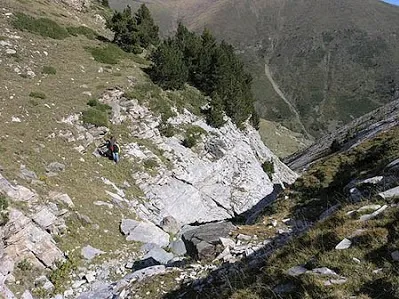
Sistema dels Forats Nº3 I Nº4 de l'Embut
A 542-metre-long system in Núria, with Forat de l'Embut no. 1, no. 3 and no. 4, known since remote times and explored speleologically since 1953.
EspeleoWorld
Sistema dels Forats Nº3 I Nº4 de l'Embut
A 542-metre-long system in Núria, with Forat de l'Embut no. 1, no. 3 and no. 4, known since remote times and explored speleologically since 1953.
Queralbs · Ripollès
Length: 542 m · Depth: 67 m
Updated record
https://espeleoworld.com/en/c/sistema-dels-forats-n-3-i-n-4-de-l-embut
Information can change. Always verify coordinates, access, weather, and cave conditions before setting out.
A 542-metre-long system in Núria, with Forat de l'Embut no. 1, no. 3 and no. 4, known since remote times and explored speleologically since 1953.
Topographic
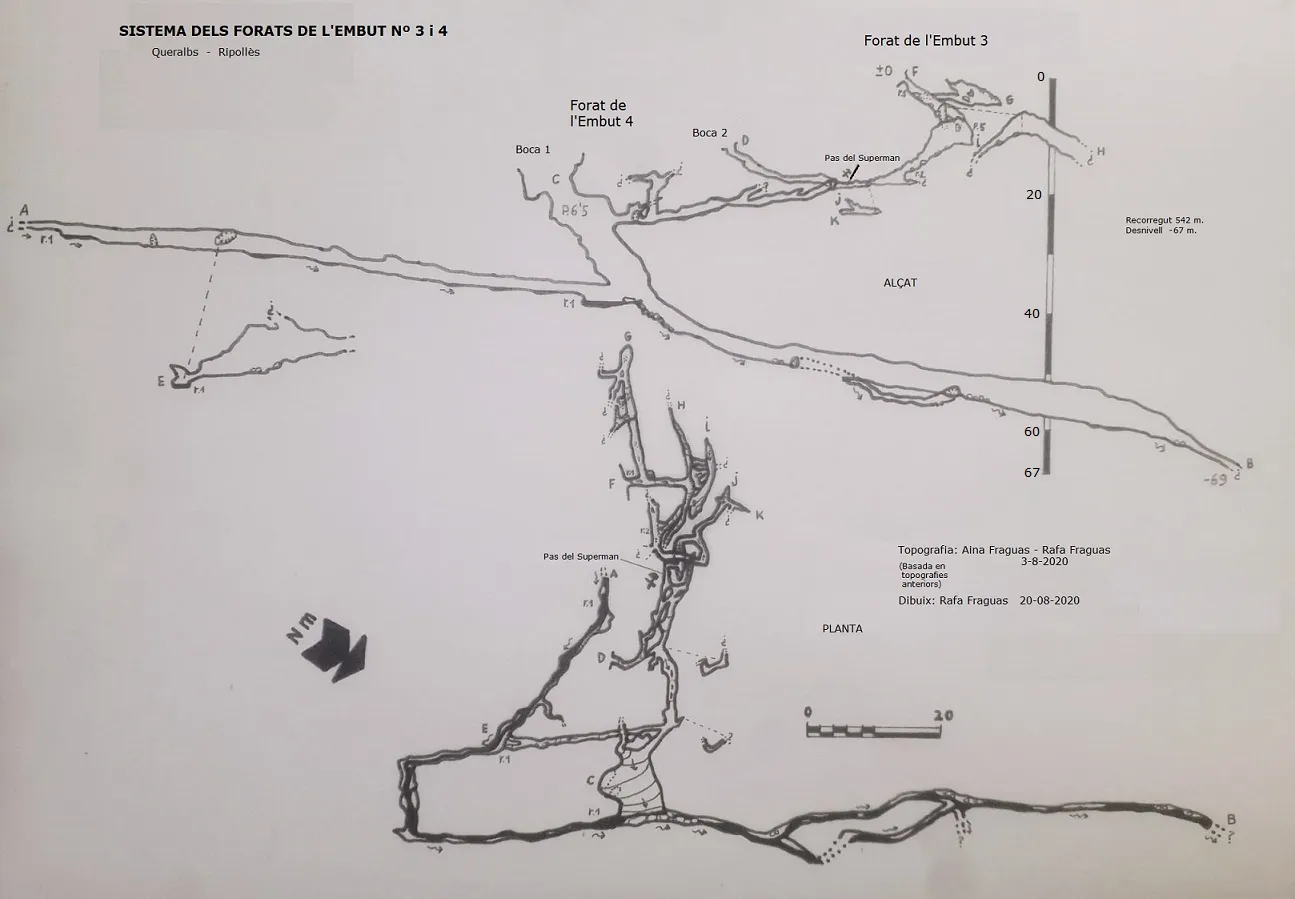
Espeleoindex · CC BY-NC 4.0, https://creativecommons.org/licenses/by-nc/4.0/ · Image © its author.
Photos
Espeleoindex · CC BY-NC 4.0, https://creativecommons.org/licenses/by-nc/4.0/ · Image © its author.
Description
Morphology
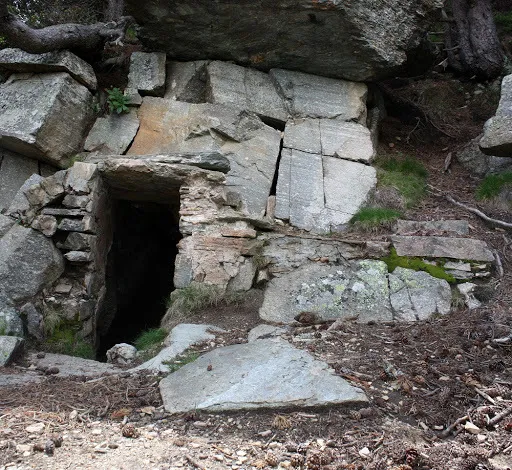
The entrance of Forat de l'Embut no. 3, 0.60 by 0.90 metres, leads to a one-metre drop that leads to a descending gallery one metre wide by about 1.70 metres high. About 3 metres along we find a gallery on the left (1.50 x 1 m.) that ends at 11 metres. One metre before, through a one-metre-diameter hole in the ceiling, we reach an upper gallery. In a SE direction this upper gallery ascends 3 metres, then ends to the right in a crawl of a couple of metres. If from the hole we advance 9 metres in a SW direction we will reach a small final chamber. On the left we find a couple of unimportant branches.
Returning to the entrance gallery, we will continue 5 metres more until we intersect a joint. A P.3.50 blocks our way. Very carefully we will pass to the ledge we see in front and from here we will be able to descend without problems. A descending gallery of about 10 metres continues on the left. The gallery begins one metre wide and gradually narrows until it ends in an impenetrable fissure. If we continue to the right, a steep descending ramp with loose stones lets us advance about 8 metres more. Although the continuation is evident, the narrowness of the passage and the unstable blocks make us give up continuing.
Returning to where the entrance gallery ends, jumping the joint we observe three passages that connect to another joint parallel to the previous one. We will take the left one; at 3.60 metres there is a 2.20-metre drop that takes us to the floor of the joint; this is inclined and is about 7 metres high by 0.50 metres wide. On the left it ends at 3 metres. We will go to the right, descending a ramp of loose stones about 7 metres. Here one can see a 'graffiti' on the wall: “GELS 1970”. We will descend 7 metres more to the right, on a steep slope of – 34º. We find a perpendicular gallery; the right branch ends at 5 metres in a low-ceiling crawl. Following the left branch, at 7 metres the gallery forks. On the left, and passing a crawl (0.50 x 0.50 m.) 2 metres long, we continue 3 metres until the gallery ends. On our left, before the end of the passage, we find a passage that, followed for 3 metres, takes us to a narrow passage where the air current blows. This point is the connection with Forat no. 4 de l'Embut.
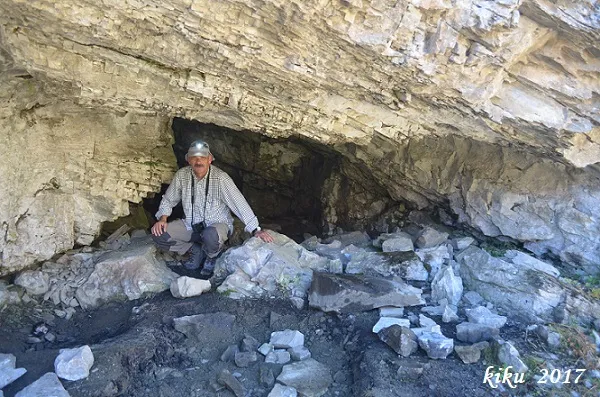
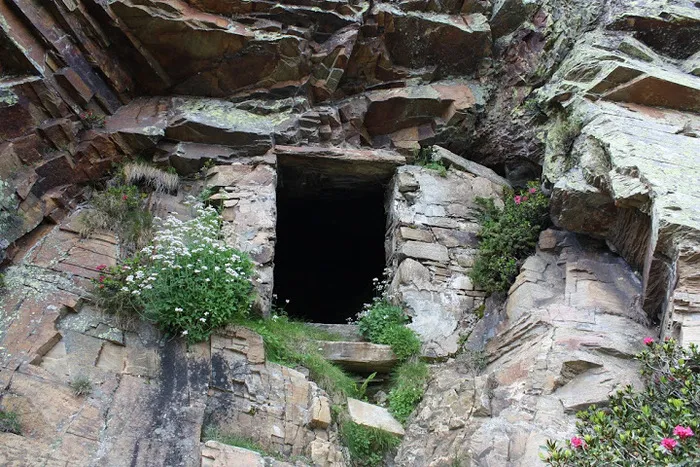
Access via Forat de l'Embut no. 4. We will enter through the entrance located to the S (4 x 1 m.). The other main entrance is 2 metres away and has a large block embedded in the middle. Descending a 6.50-metre pitch we reach a chamber where we can continue along the active galleries or go along the fossil ones. To go along the river we will descend about 8 metres of ramp and enter the icy river that flows very rapidly due to the steep slope. We will go downstream from the aforementioned chamber and at 18 metres we will find a fork; the right one is blocked at 7 metres by the narrowness of the passage, although the river flows through easily.
The left gallery continues with the same morphology: drops of loose blocks, width of 1 to 2 metres and height of 2 metres. About thirty metres further on we reach a small widening where a parallel gallery joins that comes from the aforementioned right gallery. On the right, and observing a low-ceiling place through which the water flows, a clearance allowed advancing about 10 metres more through the cold waters. Continuing downstream we will advance 40 metres more to the – 49 level, where at the contact with the phyllites the passage becomes almost impracticable and goes into a possible sump.
Returning to the entrance chamber, at the base of the pitch and on the left we will see two slightly higher galleries. At 4 metres we will find the first; we will climb 5 metres and then a crawl turns right and becomes impracticable at 2 metres. In the second gallery, of comfortable passage, we will climb two small drops and reach a small chamber where we will find a gallery that heads SE, going to meet the river. This gallery is straight and is about 25 metres long. By means of two passages that converge forming a window, it links with the underground river. If we advance to the right upstream and in a W direction, at 7 metres we will see a small dry meander on the right, which makes a couple of turns before becoming impenetrable.
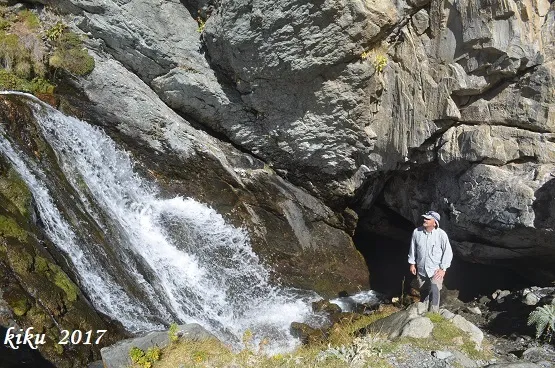
Going up the river, at 15 metres we find a small waterfall, a few formations and a widening on the right. Then comes a second waterfall; two metres further on the river sumps, preventing passage.
Returning to the window of access to the river, we will take the river downstream and after about 15 metres of passage the cavity turns 90º to the left; 11 metres further on it turns again 90º also to the left and 28 metres later we reach a waterfall (R.1) through which we connect with the entrance chamber already described.
Returning to the small chamber where we found the 25-metre gallery of access to the river, we observe a chimney on our right; through it we will climb 6.50 metres to find a couple of very narrow crawls that end at 2 metres of passage. From the small chamber we will follow a comfortable gallery for about 10 metres, at which point we find on our left two continuations that end within a few metres. Continuing 10 metres more along a gallery that has several connections, on our left with another parallel gallery located on a higher level. This 10-metre gallery ends on the right side in a 5-metre crawl. At the end on the left we connect with the parallel gallery. At this point, on our right, there is the narrow passage where a strong air current blows, being the point of connection with Forat no. 3 de l'Embut. Following the gallery, it gradually becomes narrow and rises with small drops until it exits through a very narrow crawl to the outside.
Speleothems
Going up the river, at 15 metres we find a small waterfall, a few formations and a widening on the right.
Hydrology
The river flows very rapidly due to the steep slope. At the – 49 level, at the contact with the phyllites, the passage becomes almost impracticable and goes into a possible sump. Going up the river, at 15 metres we find a small waterfall, a few formations and a widening on the right. Then comes a second waterfall; two metres further on the river sumps, preventing passage.
Progression
Traverse from Forat de l'Embut no. 3 to Forat de l'Embut no. 4. In order to do the traverse, a rope must first be installed at Forat de l'Embut no. 4 to be able to climb the exit.
Entering through the Forat de l'Embut no. 3 and after overcoming an R-2 we follow the small gallery that quickly takes us to a fork; we will follow the left passage, and after a turn also to the left, the passage descends slightly while becoming wider. On the right we find a low-ceiling passage with a strong air current and it turns sharply to the right; now the crawl is narrow and at 2 metres it turns again to the left; here we will find the selective “Pas Superman”, which was cleared. The best way to pass it is lying down looking at the ceiling, with your back stuck to the floor, your right arm stretched forward and your left perpendicular to the body, passing it through an opening between the marble walls. Once past the narrowness we are already at Forat de l'Embut no. 4.
Other details
The cave system (specifically those now catalogued as Forat no. 1 and no. 4 de l'Embut) have been known since remote times, although they are not mentioned in the old catalogues and their history is somewhat complicated. The Forat de l'Embut, let us say the classic one, is no. 4, but in an old postcard (1921) of the Núria valley, the one now known as no. 1 appears photographed.
The first known speleological explorations are those carried out by members of the GES – CMB in July 1953, who mention the Forat de l'Embut (- 20 m.) and return in September of the same year, also visiting 'a cave near l'Embut' (could it be the one later named Coves del Catau de lÓs ?). Of all this information we only have the reference from the GES activity book, with no further data.
They did not return until October 1956, when they made a survey (Embut no. 4) which remained unpublished until it appeared in the Catàleg Espeleològic de Catalunya (no. 4, 1980), forming part of a very confusing composition with the one made in 1971 (Speleon 22, 1976) by Vendrell and Filbà.
It is not until 1964, however, that Alexandre Carreras (GEB) publishes the first data on the l'Embut system, in an article basically dedicated to the hydrogeology of the phenomenon and published in Cavernas no. 3.
Returning to l'Embut no. 1, the one located higher up, there is no speleological news of it and it seems that towards the beginning of the 1950's it became blocked, with which the whole river was swallowed by Forat no. 4, but towards June 1971 a large hole opened in the middle of the bed that descended about 20 metres deep (Embut no. 2) and swallowed the water, but towards the 1980's it became totally blocked and the water again entered through l'Embut no. 4.
Meanwhile, during some visits to l'Embut no. 4 during the summer of 1968, members of the SIE – CEA found a small fissure on the left slope of the torrent, which they cleared and explored, apparently partially. They named it Forat d'en Bes, but according to our friend Antoni Ferro (SIE) it is what is now catalogued as Embut no. 3.
Between 2006 and 2008 members of the GE Badalona and other colleagues went about reviewing and surveying again all the cavities of the area, updating all the data, and they were published in volume 3 of the Catàleg Espeleològic de Catalunya (Jordi de Valles, 2009).
On 1 August 2020 Rafa Fraguas enters through Forat de l'Embut no. 3 with a hammer up to the narrow passage that the previous year had not let him continue. After chipping a marble edge that made access very difficult, he manages to enter it seeking the best possible position, and once on the other side he observes that he was in the fossil zone of Forat de l'Embut no. 4.
On 3 August 2020, after first installing Forat de l'Embut no. 4, he enters again through Forat de l'Embut no. 3, this time accompanied by his daughter Aina, passing through the active course of the river; they take the opportunity to survey the connection zone and exit through the lower entrance, making the first traverse of the new underground system.
History
The whole cave system (specifically those now catalogued as Forat no. 1 and no. 4 de l'Embut) have been known since remote times, although they are not mentioned in the old catalogues and their history is somewhat complicated. The Forat de l'Embut, let us say the classic one, is no. 4, but in an old postcard (1921) of the Núria valley, the one now known as no. 1 appears photographed.
The first known speleological explorations are those carried out by members of the GES – CMB in July 1953, who mention the Forat de l'Embut (- 20 m.) and return in September of the same year, also visiting 'a cave near l'Embut' (could it be the one later named Coves del Catau de lÓs ?). Of all this information we only have the reference from the GES activity book, with no further data.
They did not return until October 1956, when they made a survey (Embut no. 4) which remained unpublished until it appeared in the Catàleg Espeleològic de Catalunya (no. 4, 1980), forming part of a very confusing composition with the one made in 1971 (Speleon 22, 1976) by Vendrell and Filbà.
It is not until 1964, however, that Alexandre Carreras (GEB) publishes the first data on the l'Embut system, in an article basically dedicated to the hydrogeology of the phenomenon and published in Cavernas no. 3.
Returning to l'Embut no. 1, the one located higher up, there is no speleological news of it and it seems that towards the beginning of the 1950's it became blocked, with which the whole river was swallowed by Forat no. 4, but towards June 1971 a large hole opened in the middle of the bed that descended about 20 metres deep (Embut no. 2) and swallowed the water, but towards the 1980's it became totally blocked and the water again entered through l'Embut no. 4.
Meanwhile, during some visits to l'Embut no. 4 during the summer of 1968, members of the SIE – CEA found a small fissure on the left slope of the torrent, which they cleared and explored, apparently partially. They named it Forat d'en Bes, but according to our friend Antoni Ferro (SIE) it is what is now catalogued as Embut no. 3.
Between 2006 and 2008 members of the GE Badalona and other colleagues went about reviewing and surveying again all the cavities of the area, updating all the data, and they were published in volume 3 of the Catàleg Espeleològic de Catalunya (Jordi de Valles, 2009).
On 1 August 2020 Rafa Fraguas enters through Forat de l'Embut no. 3 with a hammer up to the narrow passage that the previous year had not let him continue. After chipping a marble edge that made access very difficult, he manages to enter it seeking the best possible position, and once on the other side he observes that he was in the fossil zone of Forat de l'Embut no. 4.
On 3 August 2020, after first installing Forat de l'Embut no. 4, he enters again through Forat de l'Embut no. 3, this time accompanied by his daughter Aina, passing through the active course of the river; they take the opportunity to survey the connection zone and exit through the lower entrance, making the first traverse of the new underground system.
User Comments (0)
No comments yet.
Be the first to share your experience!
Registered Explorations (0)
No explorations registered yet.
Register your visit to this cave!
Bibliography
- Borràs, J.; Miñarro, JM.; Talavera, F. (1980).- Catàleg Espeleològic de Catalunya. Vol. 4 (el Ripollès, la Garrotxa i l'Alt Empordà). 296 pp. Ed. Políglota. Barcelona.
- Cardona, F. (1989).- Grans cavitats de Catalunya (Vol. 1: La Serralada pirinenca): 198 pp. Espeleo Club de Gràcia. Barcelona.
- Carreras, A. (1964).- “Los fenómenos kársticos del valle de Núria”. Cavernas (3): 102-112. Grup d'Espeleologia de Badalona.
- Cutrona, R.; Bes, A. (1969).- “Forats de l'Embut i Forat d'en Bes”. EspeleoSie (4): 13-15. SIE – Centre Excursionista Àliga. Barcelona.
- Géraud, Ph. (1978).- “L'Avenc del riu de Núria”. L'Echo des Cavernes (2): 7-9. Société Spéléologique de Plantaurel.
- Valles, J. de (2009).-Catàleg Espeleològic de Catalunya. Vol. 3: 381 pp. Espeleo Club de Gràcia / Federació Catalana d'Espeleologia. Barcelona.
- Vendrell, M.; Filbà, Ll. (1976).- “Sistema kárstico del Embut del Puigmal (Núria)”. Speleon (22): 115-122. Centre Excursionista de Catalunya. Barcelona.
- Fotografies (2009) extretes del blog: espeleobloc.blogspot (apunt del 19-10-2009).
- Informació de la connexió dels Forats de l'Embut nº 3 i 4, topografia i fotografies (2020) facilitades per Rafa Fraguas.
Nearby caves


Source: Espeleoindex (espeleoindex.com), modified. CC BY-NC 4.0, https://creativecommons.org/licenses/by-nc/4.0/