
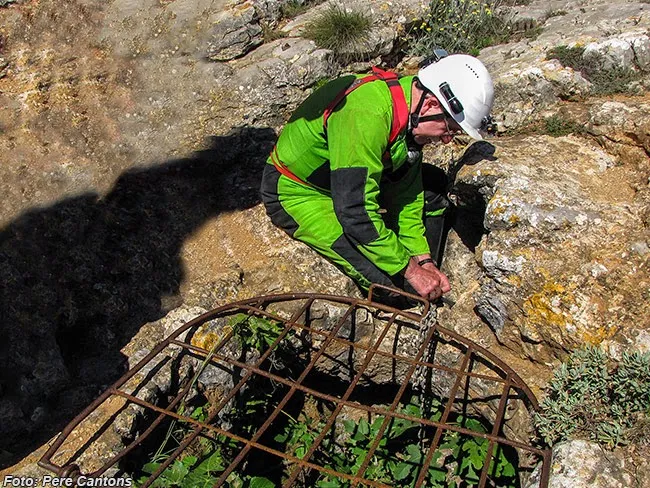
Pou de la Calella
A 55 m deep pit in l'Estartit (Torroella de Montgrí, Baix Empordà), known as Pou de la Calella, with an estimated surveyed length of 230 m and a route discovered in 1977.
EspeleoWorld
Pou de la Calella
A 55 m deep pit in l'Estartit (Torroella de Montgrí, Baix Empordà), known as Pou de la Calella, with an estimated surveyed length of 230 m and a route discovered in 1977.
Torroella de Montgrí · Baix Empordà
Length: 230 m · Depth: 55 m
Updated record
https://espeleoworld.com/en/c/pou-de-la-calella
Information can change. Always verify coordinates, access, weather, and cave conditions before setting out.
A 55 m deep pit in l'Estartit (Torroella de Montgrí, Baix Empordà), known as Pou de la Calella, with an estimated surveyed length of 230 m and a route discovered in 1977.
Topographic
Espeleoindex · CC BY-NC 4.0, https://creativecommons.org/licenses/by-nc/4.0/ · Image © its author.
Photos
Espeleoindex · CC BY-NC 4.0, https://creativecommons.org/licenses/by-nc/4.0/ · Image © its author.
Description
Morphology
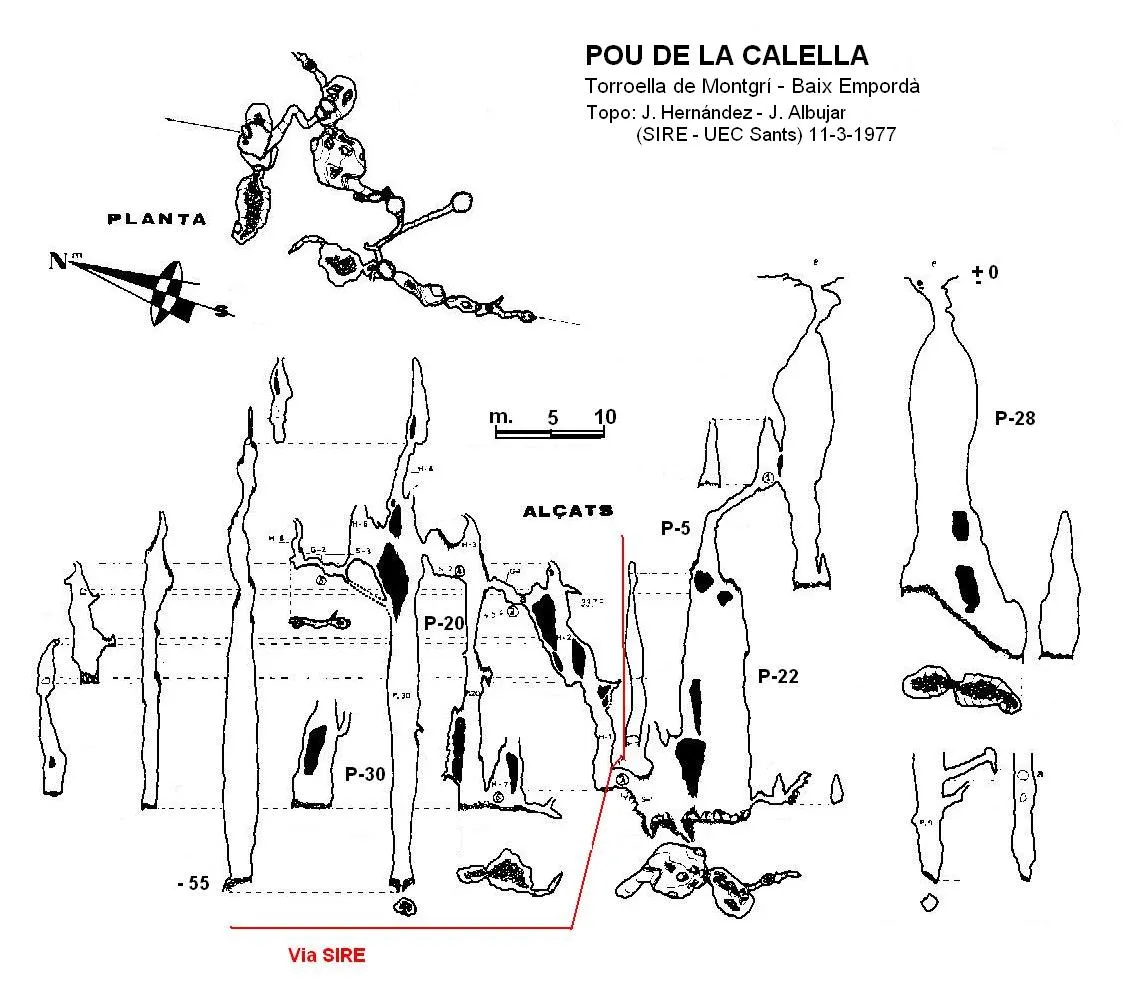
At the end of a flat doline is the mouth of the cavity, which gives way to a 28-metre shaft; at its bottom a 13-metre-long ramp continues, reaching 34 metres of depth with no further continuation. By climbing 9 metres from the base of the shaft along the NW wall, or by a easy pendulum at 19 metres from the start of the vertical, one reaches a ledge from which begins a meandering and descending gallery, of almost circular section, which connects with a small 5-metre shaft and at its base opens the third shaft of the pit. This new vertical presents a drop of just over 22 metres and the presence of welded blocks in its vertical course gives rise at its base to two adjoining chambers; the one in the SW sector presents at its end a short ascending gallery of just over 5 metres in length and where it ends choked by blocks and sediments; the chamber located at the NE end presents on its floor two blind small shafts of just over 2 metres in depth (elevation – 52 m.).
In the ceiling of this latter chamber begin the galleries discovered in 1977 (Via SIRE). First one must climb a 10-metre-high chimney which, by means of a very narrow passage at its dome, leads to a small room of 3 x 1 metres; along its ceiling one continues climbing through a new 12-metre-high chimney, but at 8 metres of ascent one finds a gallery 6 metres in length and shortly after its start, on the left wall, there is a blind 9-metre shaft.
Continuing along the gallery one reaches, after a narrow passage, the mouth of another blind shaft, this one 20 metres deep; once on the other side of the gallery there is a second small room and at its bottom opens a new shaft, of 30 metres drop and at the bottom of which the point of maximum depth of the pit is reached (elevation – 55 m.). At the mouth of the aforementioned shaft a new chimney develops, which if climbed reaches a blockage of blocks and is the point of these galleries closest to the surface, since barely 10 metres separate it from the outside.
Some 15 metres beyond the aforementioned second small room, the cavity finally ends, with two new unexplored chimneys and a small room of 3 x 2 metres.
The total estimated route on the survey we calculate must be around 230 metres. The authors only give the plan length and say it is 75 metres.
History
Certainly the pit was known since remote times by the people of the region, but the first reference we have is the one given by members of the Club Muntanyenc who during a non-speleological excursion on 4 September 1924 found it and baptised it as Avenc del Cap de la Barra, leaving a record in the entity's bulletin.
In the early years of the GES of the Club Muntanyenc Barcelonès they have this reference from their predecessors, but it is not until 30 years later, in October 1954, that members of the GES proceed to what we think is the first exploration of the cavity and of which practically no written record remained. We only know that they kept the name Avenc del Cap de la Barra and attributed to it a depth of... 82 metres! (we know that this is recorded in the GES activity book, although we have not been able to consult this documentation).
In a biospeleological work, Vandel mentions the Buhero de Estartit (could it be the Pou de la Calella?). The isopod he mentions was also found in August 1971 by a member of the SIE, although it is quite common throughout the area.
We know no further news until members of the GIS of the Unió Excursionista de Catalunya – Girona visit it in 1971 and make a first survey. Since then it has been known as Pou de la Calella. That same year, in August, the SIE – CE Àliga (Barcelona) also pay a visit to the pit and survey it (this survey had remained unpublished until now).
Since then the cavity begins to be better known and periodically receives visits from speleologists. But it is not until January 1977 that a friend of members of the SIRE – UEC Sants begins to find some ascending shafts in the lower zone of the pit, which leads different members of the SIRE to dedicate themselves in the following months to the complete exploration and survey of the new Via SIRE.
Bio
Isopods
- Spelaeonethes medius Carl 1908 (collected by Jordi Navarro, 21-8-1971 and identified by A. Lagar)
User Comments (0)
No comments yet.
Be the first to share your experience!
Registered Explorations (0)
No explorations registered yet.
Register your visit to this cave!
Bibliography
- Borràs, J.; Miñarro, JM.; Talavera, F. (1982).- Catàleg Espeleològic de Catalunya (vol. 6): el Baix Empordà, el Gironès, la Selva, l’Osona, el Vallès Oriental i el Maresme: 290 pp. Ed. Políglota. Barcelona.
- Delclós, S. (1972).- “Cuevas y simas del Alt Empordà”. Comunicaciones del II Simposium Metodologia Espeleológica – Topografía. SIE – CEA i Escola Catalana d'Espeleologia. Barcelona.
- GIS – UEC (1971).- “La espeleología en la provincia”. Revista de Gerona (57): 67-71. Diputació Provincial de Girona.
- Hernández, J.; Lacasa, R.; Hidalgo, J. i Pitarch, JM. (1977).- “Nova via en el Pou de la Calella”. Excursionisme (29): 21-23. Unió Excursionista de Catalunya. Barcelona.
- SIRE – UEC Sants (1977).- “Nueva via en el Pou de la Calella”. Boletín Informativo SIRE (1-2, 3ª época): 8pp. s/numerar. SIRE – UEC Sants. Barcelona
- Vandel, A. (1972).- “Les isopodes terrestres et cavernicoles de la Catalogne”. Miscelánea zoológica. 3 (2): 23-41. Museu de Zoologia. Barcelona
- Fotografies extretes del blog: espeleobloc (apunts dels dies 27, 28 i 29 de maig del 2014).
Nearby caves


Source: Espeleoindex (espeleoindex.com), modified. CC BY-NC 4.0, https://creativecommons.org/licenses/by-nc/4.0/