
Pou de Costa Dreta
Important cavitat montserratina de 148 m. de desnivell a Collbató
EspeleoWorld
Pou de Costa Dreta
Important cavitat montserratina de 148 m. de desnivell a Collbató
Collbató · Baix Llobregat
Length: 250 m · Depth: 148 m
Updated record
https://espeleoworld.com/en/c/pou-de-costa-dreta
Information can change. Always verify coordinates, access, weather, and cave conditions before setting out.
A Montserrat cavity with 148 m of vertical drop in Collbató, featuring the Via Directa, the Via Transversal and the Via Gràcia.
Topographic
Espeleoindex · CC BY-NC 4.0, https://creativecommons.org/licenses/by-nc/4.0/ · Image © its author.
Photos
Espeleoindex · CC BY-NC 4.0, https://creativecommons.org/licenses/by-nc/4.0/ · Image © its author.
Description
Morphology
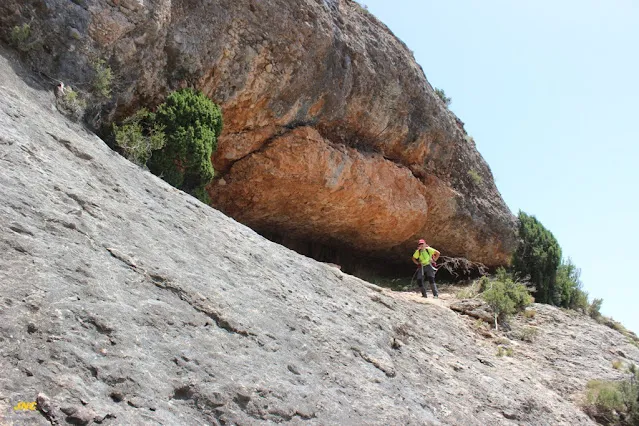
Elongated mouth with an upper lip raised 14 metres above the lower one.
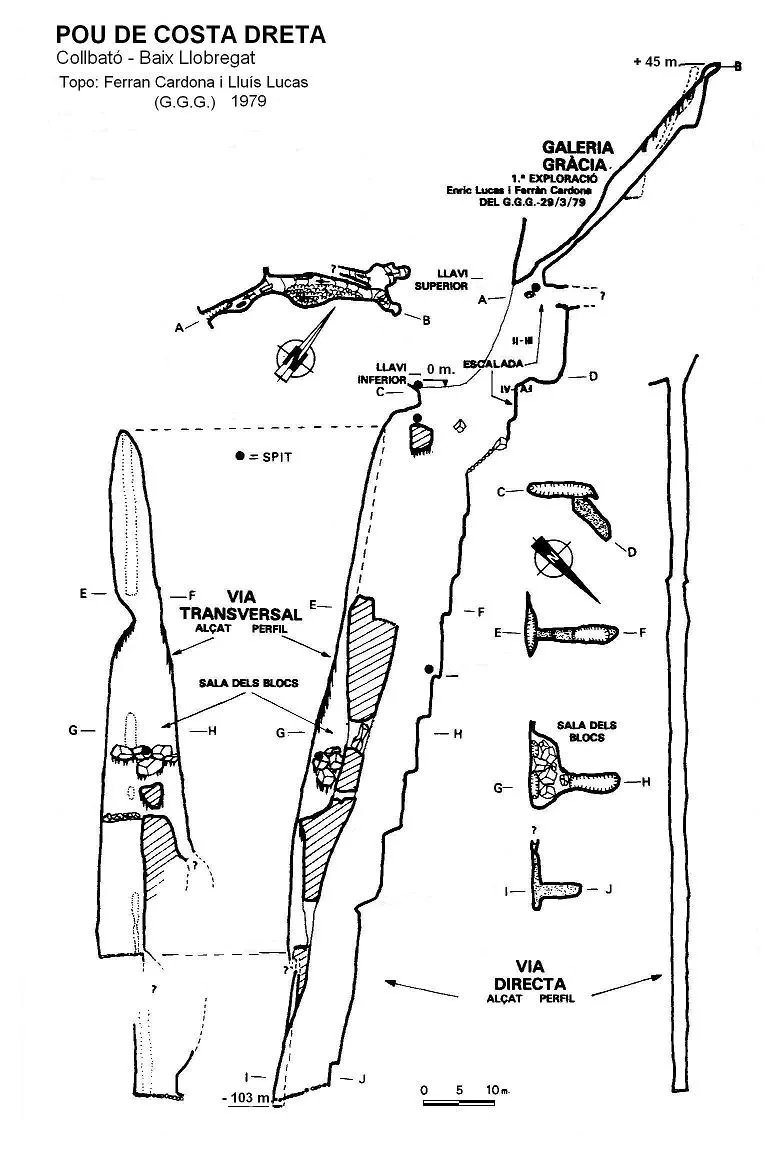
The Via Directa consists of a single pit 103 metres deep with an elongated section. The first section is a direct vertical of 35-40 metres (depending on where it is rigged), followed by a succession of stepped verticals separated by small stable ledges. At the bottom of the pit, a short slope of stones links to a terminal perpendicular joint.
The Via Directa is a pit with evident erosion forms and where clastic and speleothem forms are almost non-existent. By contrast, the Via Transversal presents a much more evolved morphology, where flowstone and clastic processes often mask the primitive erosive forms. It is clearly structured along a joint of the mountain's main fracture family and is arranged transversally to the main pit, the two routes joining in a 'T' shape with different communication points. The Via Gràcia follows a direction parallel to the Via Transversal.
Speleothems
In the Sala dels Blocs a window can be seen that communicates with the main pit. The chamber is decorated with speleothems and has large blocks.
Progression
Back outside and to access the Via Transversal, it is necessary to rig at the SE end of the mouth in order to reach a small ledge at -5 metres, which is no more than a bridge of rock and speleothem that divides the pit. Passing over it, one descends on the other side a vertical of about 30 metres that ends on a ledge; without reaching it, a pendulum must be made that leads to another ledge a few metres above. Here begins a pit of 23 metres that ends in a chamber with speleothems and large blocks (Sala dels Blocs), where a window can be seen that communicates with the main pit.
In the Sala dels Blocs two pits open. One of them ends in front of a narrow passage through which a vertical of notable depth can be seen and which must be assumed to link with the joint that rises from the bottom. Down the other one descends 9 metres and reaches a floor where the narrow mouth of a final pit opens, of 22 metres. A high and narrow window communicates this pit with the main pit of the Via Directa.
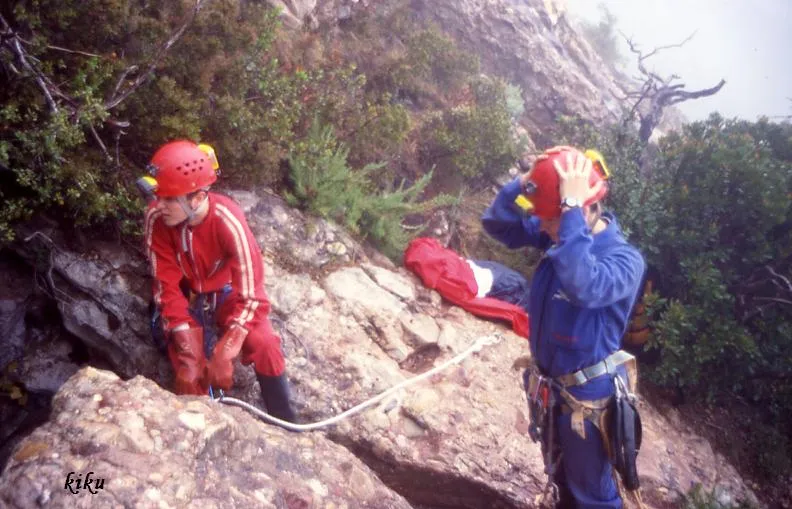
The Via Gràcia begins just at the ceiling that is formed under the upper lip of the mouth; two sections of 8m and 13m must be climbed, separated by a wide ledge. To access the foot of the first section, one must descend about 10m from the mouth of the pit along the north side and stand on a ledge; here begins the first section that was equipped with 7 spits by the first ascensionists, years later (probably around the 90s) someone added a spit just before reaching the wide ledge where a good holm oak grows; on this ledge there is an ERE graffiti, so we think they were the ones who placed the additional spit. From here begins a fairly vertical section of about 13m that leads us under the ceiling of the fissure with an overhanging exit; in this section the first ascensionists left no material, but it can be protected with friends and pitons; at the end one must position oneself on top of a wedged block and here there is a spit and a rusty iron carabiner, and two stainless steel bolts with maillons. From here one must still climb about 2m up the fissure until reaching the start of the ramp of the Gràcia gallery itself; the first metres are narrow and one must crawl. After an even narrower passage the ramp begins to be decorated with speleothems and becomes a little wider and taller; we continue climbing up to the final vertical step where roots can be seen coming from the outside, which must already be quite close; here we are at the +45m level from the start of the pit. About 2m from the start of this last vertical step, on the left-hand side there is a narrow inclined fissure through which one can access some lateral crawls of difficult progression and where there is also a section that climbs up to the same level as the previous step.
History
Known since time immemorial. Very possibly it is the same cavity that Maureta and Thos (1881) mention (among others) at the spot of Pinsverts, following the reference of an old map of the mountain of Montserrat.
The first exploration was carried out on 13 August 1908 by M. Faura, Father Marcet, JM. Có de Triola, J. Llongueres and M. Esteban, accompanying the famous French naturalist Jacques Maheu and his wife, who had also already taken part in the exploration of the Pouetons de les Agulles a few weeks earlier. They made a survey, assigning it a depth of 120 metres.
We have no record of any further exploration until March 1952, when members of the GES-CMB visited it. Over the years, new generations of Catalan speleologists visited it regularly, but without much assiduity. In 1970 members of the SIE-CE Àliga published a new survey of the main pit, assigning it 104 metres of depth.
On 29 March 1979 Enric Lucas and Ferran Cardona, members of the GGG (later EC Gràcia), made a climb up to the ceiling of the upper lip of the mouth, discovering the Via Gràcia and thus increasing the total vertical drop of the cavity. A few days later, they made a new survey of the whole cavity, locating and exploring the Via Transversal.
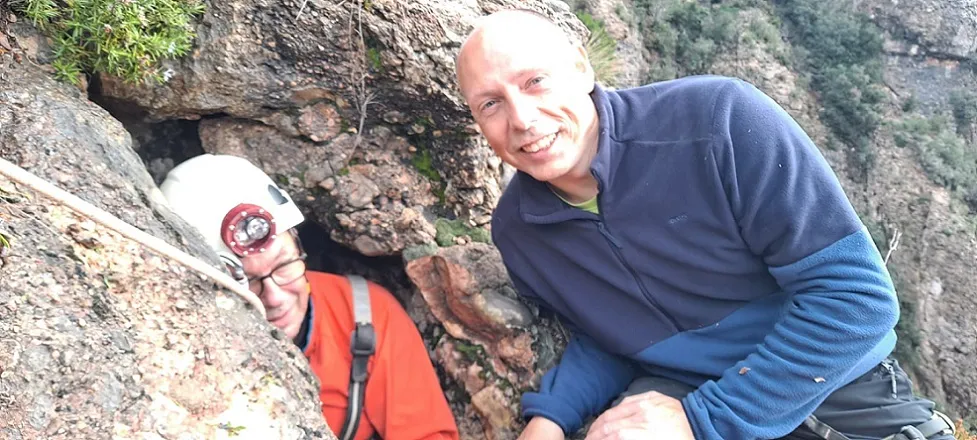
They left the 7 spits on the first climbing section and the spit and carabiner at the end of the second section. It was not until 18 April 2025, 46 years later, that the first repeat of the route was probably made, by Carles Llovet, Cesc Rosell, Joan Carles Juderias and Josep Guarro, who left two bolts with maillons to be able to rappel from the ceiling of the second section and took photographs of the route.
User Comments (0)
No comments yet.
Be the first to share your experience!
Registered Explorations (0)
No explorations registered yet.
Register your visit to this cave!
Bibliography
Cardona, F.; Lucas, E. (1979).-'Nova galeria a l'avenc de Costa Dreta' Exploracions (3): 135-137. EC Gràcia. Barcelona.
Cardona, F. (1990).- Grans cavitats de Catalunya, vol 2. 484 pp. EC Gràcia. Barcelona.
Faura, M. (1911).-'La espeleología de Cataluña' Mem. Real Soc. Esp. Hist. Nat. 6 (6): 167 pp. Museo de Ciencias Naturales. Madrid.
Maheu, J. (1912).-'Exploration et flore souterraine de cavernes de Catalogne et des illes Balears'. Spelunca T. VIII (67-68): 108 pp. Bulletin & Mémoires de la Société de Spéléologie. París.
Rovira; J.; Navarro, J. (1970).-'La sima de la Costa Dreta de Montserrat' EspeleoSie (8): 23-26. SIE-CE Àliga. Barcelona.
Valles, Jordi de (2017).- Catàleg Espeleològic de Catalunya. Vol. 6: 468 pp. Espeleo Club de Gràcia / Federació Catalana d'Espeleologia. Barcelona.
Actualització de les coordenades facilitades per Jordi Perera (2015)
Fotografies de José Hidalgo extretes de Espeleobloc, post del 10-05-2015.
Ampliació de dades i fotografies Via Gràcia facilitades per Josep Guarro (abril 2025)
Nearby caves


Source: Espeleoindex (espeleoindex.com), modified. CC BY-NC 4.0, https://creativecommons.org/licenses/by-nc/4.0/