
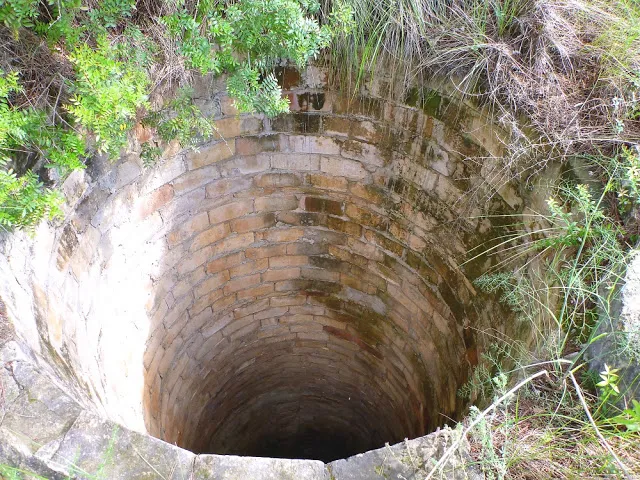
Pou de Cal Santó
Underground chamber at the bottom of an artificial shaft in Cunit (Baix Penedès), discovered while drilling a water well around the mid-1960s.
EspeleoWorld
Pou de Cal Santó
Underground chamber at the bottom of an artificial shaft in Cunit (Baix Penedès), discovered while drilling a water well around the mid-1960s.
Cunit · Baix Penedès
Length: 80 m · Depth: 31 m
Updated record
https://espeleoworld.com/en/c/pou-de-cal-santo
Information can change. Always verify coordinates, access, weather, and cave conditions before setting out.
Underground chamber at the bottom of an artificial shaft in Cunit (Baix Penedès), discovered while drilling a water well around the mid-1960s.
Topographic
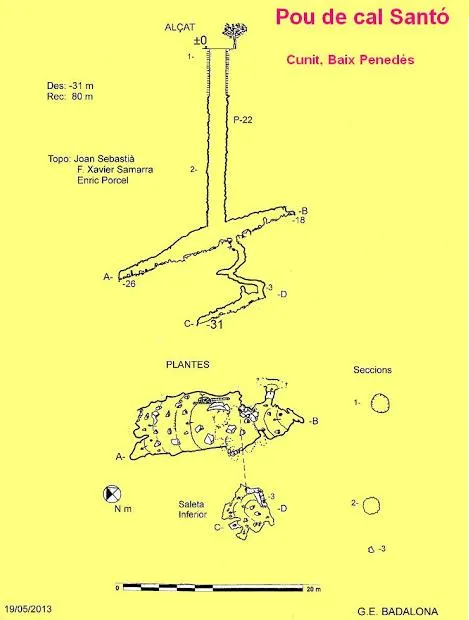
Espeleoindex · CC BY-NC 4.0, https://creativecommons.org/licenses/by-nc/4.0/ · Image © its author.
Photos
Espeleoindex · CC BY-NC 4.0, https://creativecommons.org/licenses/by-nc/4.0/ · Image © its author.
Description
Morphology
A circular entrance 1.90 metres in diameter leads us to a P-22 that intersects the ceiling of a room of natural cavern formation. The shaft, artificial, is lined with bricks for its first five metres to contain the layer of clay. The rest pierces bedrock. Once in the inclined room, about twenty metres long by some three metres wide, and oriented NW-SE, in the lower part we find some formations and the level of -26 metres. Although the ceiling at the base of the shaft has a comfortable height of about 2 m, it descends gently to 0.60 m at the deepest part of the room. Going upwards, the room ends 9 metres further on. At 3 metres from the base of the shaft, upwards and among the rocks, we find a small shaft that does not appear on the previous survey. Although the entrance is a comfortable opening of 1x0.66 metres, 2.60 metres further down it becomes narrow (0.40x0.50 m). We descend 2 metres more and horizontally we find a small blind crawlway that ends at 2 metres. We continue descending about three metres more and after a step we reach the lower small room where this new route ends at the maximum depth level of -31 metres. The small room has a low ceiling (about 0.60 m.), is irregular and with many concretions, with approximate dimensions of 4x5 metres.
Speleothems
In the lower part we find some formations. The lower small room is irregular and with many concretions.
Progression
A circular entrance 1.90 metres in diameter leads us to a P-22 that intersects the ceiling of a room of natural cavern formation. The shaft, artificial, is lined with bricks for its first five metres to contain the layer of clay. The rest pierces bedrock. Once in the inclined room, about twenty metres long by some three metres wide, and oriented NW-SE, in the lower part we find some formations and the level of -26 metres. Although the ceiling at the base of the shaft has a comfortable height of about 2 m, it descends gently to 0.60 m at the deepest part of the room. Going upwards, the room ends 9 metres further on. At 3 metres from the base of the shaft, upwards and among the rocks, we find a small shaft that does not appear on the previous survey. Although the entrance is a comfortable opening of 1x0.66 metres, 2.60 metres further down it becomes narrow (0.40x0.50 m). We descend 2 metres more and horizontally we find a small blind crawlway that ends at 2 metres. We continue descending about three metres more and after a step we reach the lower small room where this new route ends at the maximum depth level of -31 metres. The small room has a low ceiling (about 0.60 m.), is irregular and with many concretions, with approximate dimensions of 4x5 metres.
Other details
Also at the base of the shaft we find some wooden poles (from Telefònica) and a rusty Torrot bicycle. A solitary bat was observed.
History
Discovered during the drilling of a water well around the mid-1960s. The first exploration of which we have news is the one carried out by members of the ERE – CEC on 2 October 1966, who return on the 23rd of the same month to survey it. In 1968 it is visited by members of the SIRE – UEC, who mention it in a list of activities as Avenc de los Rosales.
Practically with no further news of the cavity (it was even thought that the shaft might be covered), but during the visit that members of the GEB, Espeleocorb and SES del Ger made in June 2012 to the nearby Avenc de Sant Antoni, José Antonio Pérez informed them that the shaft still existed and that there was an undocumented lower chamber. It is not until 19 May 2013 that members of the GE Badalona and the EC de Gràcia return to explore and fully survey it.
User Comments (0)
No comments yet.
Be the first to share your experience!
Registered Explorations (0)
No explorations registered yet.
Register your visit to this cave!
Bibliography
- Borràs, J.; Miñarro, J.M.; Talavera, F.(1978).-”l'Alt Camp, la Conca de Barberà, el Baix Penedès i el Tarragonès” Catàleg Espeleològic de Catalunya (Vol.2):1-246. Ed. Políglota. Barcelona.
- Actualització de la fitxa, topografia i fotografies extretes del blog: espeleobloc (post del 30-5-2013) (Fitxa original d'Enric Porcel, GE Badalona)
Nearby caves


Source: Espeleoindex (espeleoindex.com), modified. CC BY-NC 4.0, https://creativecommons.org/licenses/by-nc/4.0/