
Avenc de Sant Antoni
Cave with 82 m of passage in the N of Cunit (Baix Penedès), known and degraded, with an archaeological site from the Neolithic and the Iron Age.
EspeleoWorld
Avenc de Sant Antoni
Cave with 82 m of passage in the N of Cunit (Baix Penedès), known and degraded, with an archaeological site from the Neolithic and the Iron Age.
Cunit · Baix Penedès
Length: 82 m · Depth: 7 m
Updated record
https://espeleoworld.com/en/c/avenc-de-sant-antoni
Information can change. Always verify coordinates, access, weather, and cave conditions before setting out.
Cave with 82 m of passage in the N of Cunit (Baix Penedès), known and degraded, with an archaeological site from the Neolithic and the Iron Age.
Topographic
Espeleoindex · CC BY-NC 4.0, https://creativecommons.org/licenses/by-nc/4.0/ · Image © its author.
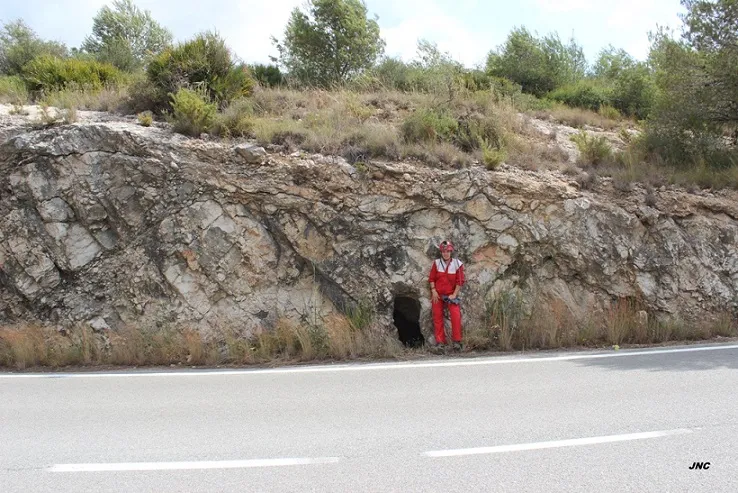
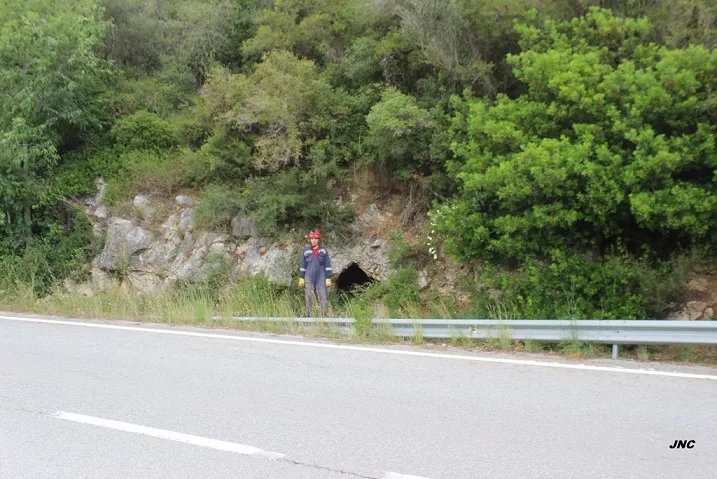
Photos
Espeleoindex · CC BY-NC 4.0, https://creativecommons.org/licenses/by-nc/4.0/ · Image © its author.
Description
Morphology
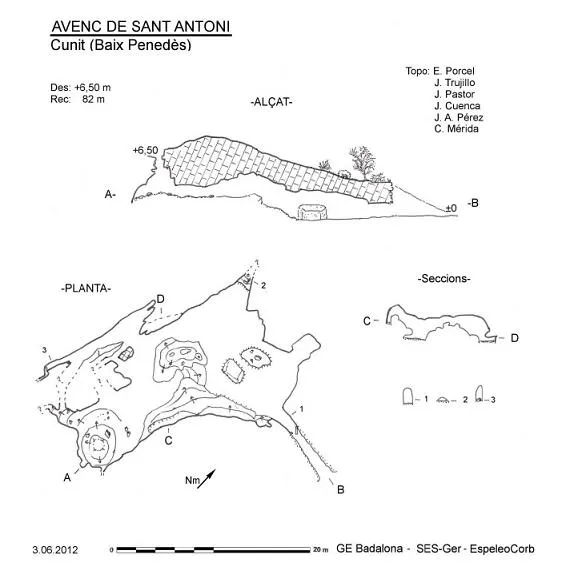
An excavation of 6 metres of passage in the form of a trench, on the slope of the hill, brings us to an old metal door 1.70 metres high and 0.80 metres wide. Once through it we find an artificially excavated tunnel (1.50 x 1 m.) 2.50 metres long that leads us to a chamber, already in the natural cave, which shows clear signs of having been excavated and its sediments removed, in order to level the ground, leaving in the centre some "islets" of the old sediments that are 1.70 metres high.
If we advance to the right we will find a ledge at + 2.40 metres high, where there is an abandoned nest, and behind it continues a narrow crawlway, not accessible.
Continuing to inspect the chamber along the right wall, we will reach a gallery of about 10 metres, at the end a crawlway leads us to another small gallery 3 metres long, 0.50 wide and 1.80 high that ends with a turn to the left and a step that continues with a one-metre micro-crawlway.
Returning to the entrance of the crawlway, on our left there is a flat-out passage that allows us to enter a few metres and which, although we cannot progress due to the narrowness, we do know acoustically that it communicates with another point that we will discuss later.
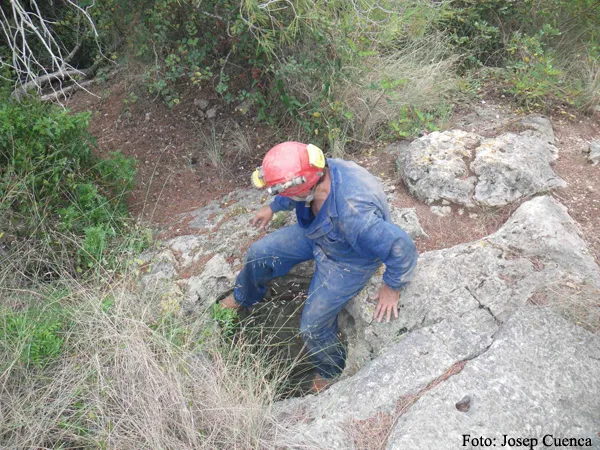
Turning back we will see the light from outside and we will approach another chamber where, on the ceiling, we see the mouth of the pit. In the past this must have been the only entrance to the cave.
It is a mouth 0.84 x 0.75 metres with the remains of an old trapdoor that covered the access. This shaft is 3.40 metres deep. The chamber has a cone of debris from outside, and, in a W direction, a small descending gallery of about 7 metres of passage becomes narrower until it turns into an impenetrable crawlway. On the right, another crawlway is the one that communicates acoustically with the one described above.
If we return to the entrance, and go to the left, after the "islets" we will find a climb and we will soon reach the small chamber of the aforementioned shaft.
History
A cave known since long ago in the area, from the archaeological excavations we know that it was a stopping point of the first settlers of the Cunit area, a site catalogued as historical heritage of Catalonia. It is a natural pit with a Neolithic burial and an approximate chronology of -5500/-2200 years and also remains from the Iron Age (-650/-50). There are biospeleological and malacological citations. Despite everything and, due to its closure for many years by the owner of the Cal Marquès estate (it had been used to grow mushrooms), the cave remained unpublished speleologically. A few years ago the original entrance door was already open, a circumstance that caused an excessive influx of visitors and has rapidly deteriorated the cave ("graffittis", rubbish, breakages).
User Comments (0)
No comments yet.
Be the first to share your experience!
Registered Explorations (0)
No explorations registered yet.
Register your visit to this cave!
Bibliography
- Altimira, C. (1970).- “Moluscos y conchas recogidos en cavidades subterráneas”. Speleon (17): 67-75. Centre Excursionista de Catalunya. Barcelona.
- Balcells, E. (1959).- “Quirópteros de cuevas españolas recolectados desde 1955 a 1958”. Speleon X (1-2): 75-94. Universidad de Oviedo.
- Borràs, J.; Miñarro, J.M.; Talavera, F.(1978).-”l'Alt Camp, la Conca de Barberà, el Baix Penedès i el Tarragonès” Catàleg Espeleològic de Catalunya (Vol.2):1-246. Ed. Políglota. Barcelona.
- Totes les dades, topografia i fotografies ha estat extretes del blog: Espeleobloc (post del 6-9-2012). Fitxa original d'Enric Porcel (GE Badalona)
Nearby caves


Source: Espeleoindex (espeleoindex.com), modified. CC BY-NC 4.0, https://creativecommons.org/licenses/by-nc/4.0/